


Introduction
🔹 The shoulder is one of the most complex, dynamic, and mobile joints in the human body. Its movement is coordinated by a network of superficial and deep muscles that work together to maintain balance, stability, strength, and a wide range of motion. These muscles are essential not only for everyday activities but also for high-performance athletic movements. 💪🔥
🔹 In this journey, we explored the superficial and deep shoulder muscles using one of the most authoritative anatomical sources in the world—Gray’s Anatomy. Broadly, the shoulder muscles can be divided into two primary groups:
1️⃣ Superficial shoulder muscles—such as the deltoid and teres major—which shape the overall form of the shoulder and contribute to powerful, large-scale movements.
2️⃣ Deep shoulder muscles, especially the rotator cuff group (supraspinatus, infraspinatus, teres minor, and subscapularis), which play a crucial role in stabilizing the joint and controlling fine, precise motion. Their most important function is preventing instability and injuries caused by unbalanced or excessive movement. 🛡️🎯
🔹 By examining each muscle’s function, origin, insertion, strengthening methods, innervation, and scientific background, we gained a complete picture of how the shoulder’s muscular system operates. This in-depth study not only clarifies each muscle’s role in movement but also highlights fascinating and practical insights that many people overlook.
🔹 The purpose of this comprehensive exploration is to offer a scientific and practical foundation for understanding shoulder anatomy, preventing injuries, and enhancing both athletic performance and everyday function. With this deeper knowledge, we can design smarter training programs, avoid harmful movement patterns, and develop the shoulder muscles to their fullest potential—both in strength and in stability. 🧠🏋️♂️✨
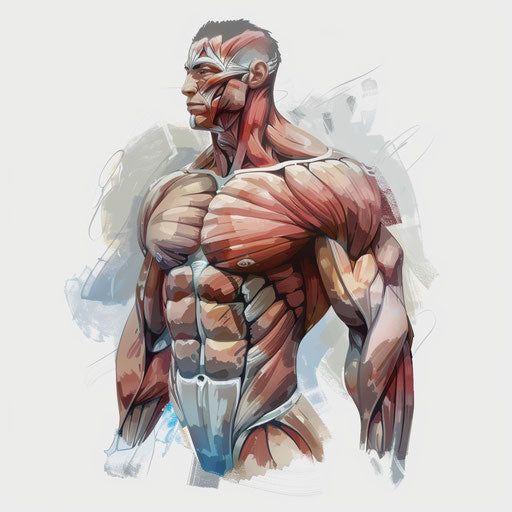
1. Superficial Shoulder Muscles
Superficial Shoulder Muscles
Teres major muscle
Teres Major Muscle
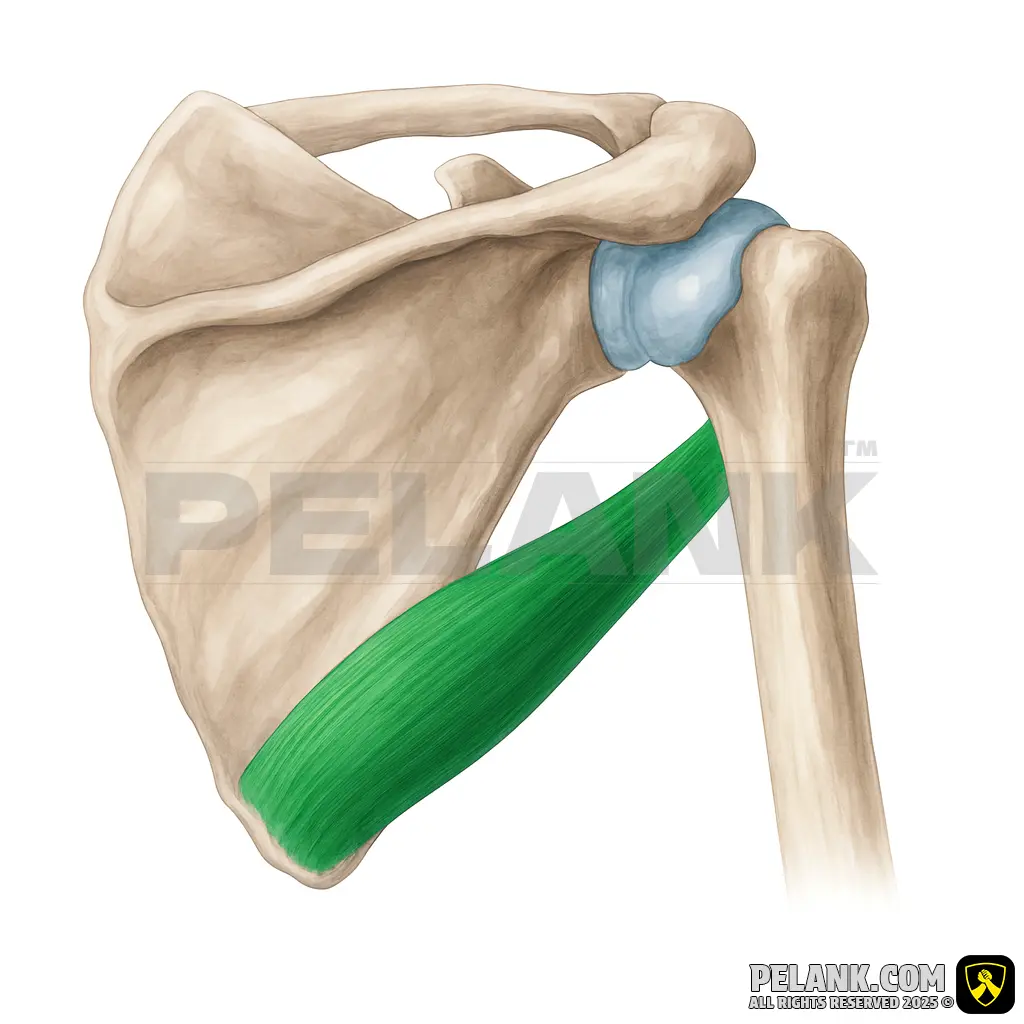
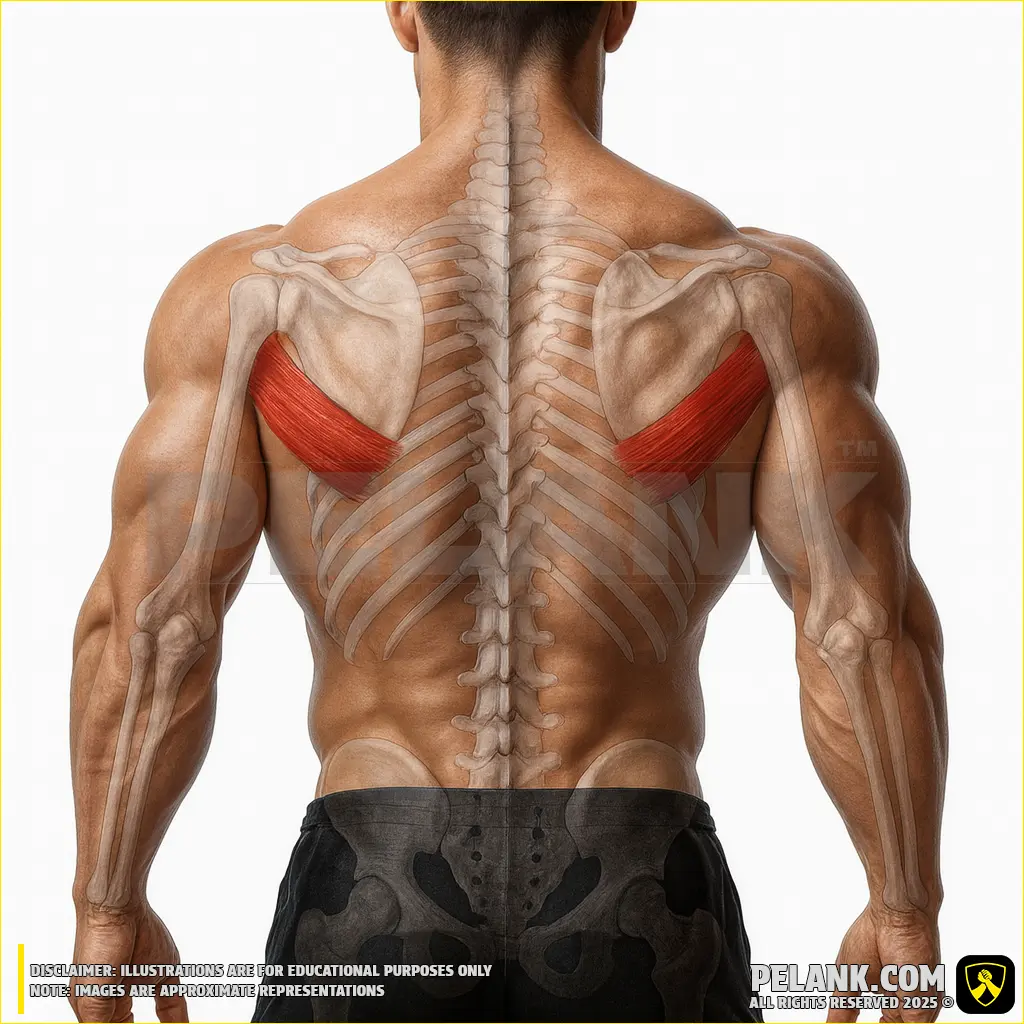
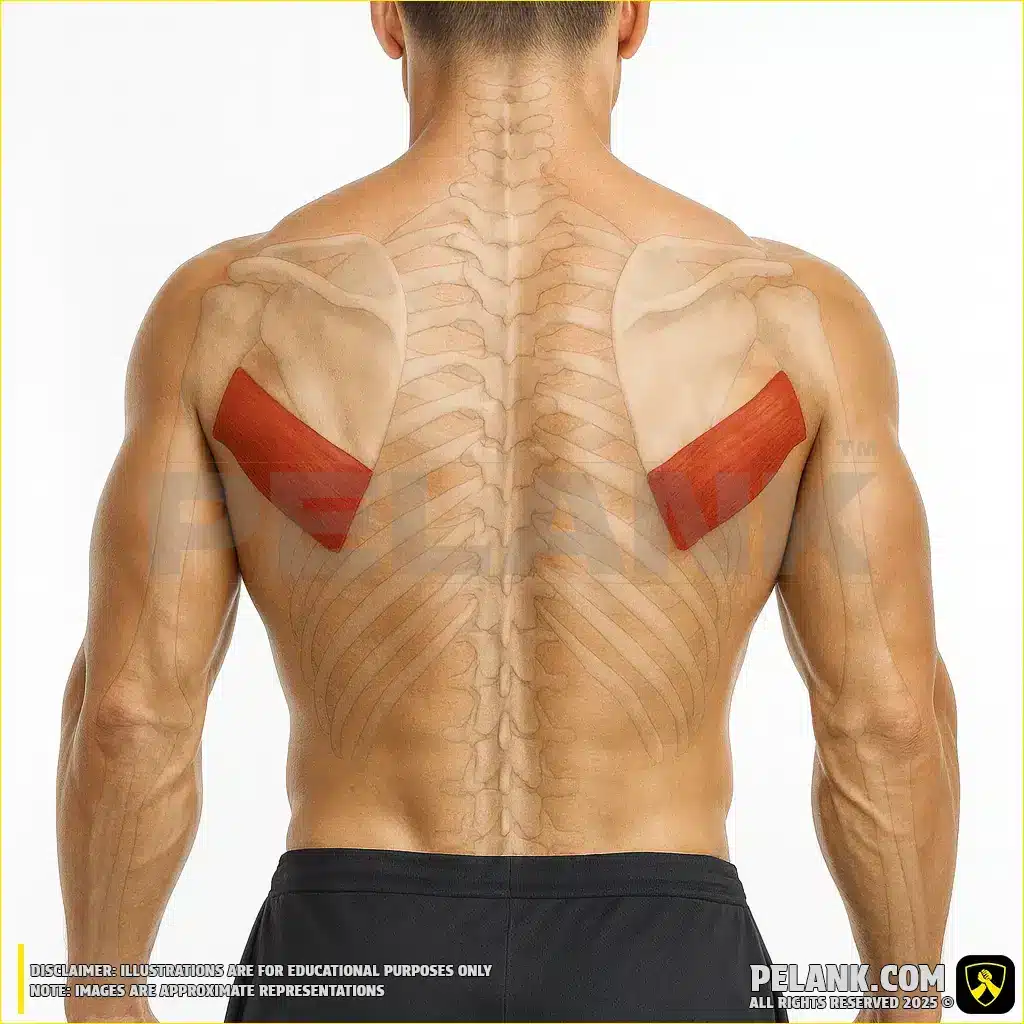
🔹 The teres major is one of the muscles located at the back of the shoulder, positioned next to the latissimus dorsi and often considered its assisting muscle. It plays a key role in pulling and upper body strength movements such as pull-ups, rows, and deadlifts.
🔹 Unlike the teres minor, which is part of the rotator cuff, the teres major does not contribute to rotator cuff stabilization and is more involved in larger arm movements. Weakness in this muscle can lead to reduced pulling and lowering strength and increased strain on the rotator cuff muscles.
🖼️ Image Gallery
Click on the images to enlarge them.
🔷 Full Description
Click on the title to read the sections.
✅ Persian Name: Gerde Bozorg
✅ Latin Name: Teres Major
✅ Common Names: Small Lat Muscle | Shoulder Support Muscle
✅ Location:
🟡 Positioned on the posterior (back) side of the shoulder, beneath the teres minor and adjacent to the latissimus dorsi.
🟡 Originates from the scapula and inserts into the humerus.
🟡 Responsible for internal rotation of the arm, shoulder adduction, and extension. It also contributes to shoulder joint stabilization.
✅ 🔹 Origin
✔ Inferior angle and lateral border of the scapula (Inferior Angle of Scapula)
✅ 🔹 Insertion
✔ Medial lip of the intertubercular sulcus of the humerus (Medial Lip of Intertubercular Sulcus of Humerus)
✅ 🔹 Function
📌 Primary functions of the teres major:
✔ Internal rotation of the arm – rotating the arm inward
✔ Adduction of the arm – bringing the arm closer to the body
✔ Extension of the arm – moving the arm backward
📌 Movements that activate the teres major:
✔ Pulling exercises such as pull-ups and rows
✔ Resistance training like lat pulldowns and deadlifts
✔ Power movements such as shot put and javelin throws
✅ 💪🏻 Muscle Fiber Types
✔ A combination of ✔ A combination of slow-twitch fibers (Type I) and fast-twitch fibers (Type II).
✔ Predominantly composed of slow-twitch fibers, which enhance the muscle’s endurance during pulling and resistance-based movements.
✅ 🏋🏻♂️ Role in Sports and Physical Activities
✔ A key muscle in all upper-body pulling and resistance movements
✔ Plays a vital role in weightlifting, gymnastics, swimming, climbing, and stretch-based sports
✔ Weakness in this muscle can reduce the ability to pull the body upward and perform pulling movements effectively.
✅ 🧗🏻♂️ Strength and Endurance
✔ A strength-endurance muscle that plays an essential role in all upper-back movements.
✔ When weak, it places excessive strain on the rotator cuff muscles and the shoulder joint.
✅ 🧠 Innervation
✔ Lower Subscapular Nerve (C5, C6, C7)
✅ 🩸 Blood Supply
✔ Circumflex Scapular Artery
✅ 🤼♂️ Role in Sports and Physical Activities
✔ A crucial muscle in bodybuilding, weightlifting, swimming, climbing, and pulling movements
✔ Actively engaged in all rowing, pull-up, deadlift, and lat pulldown exercises
✔ If weak, it can reduce pulling strength and increase stress on the shoulder joint.
✅ 🏌🏻♂️ Interaction with Other Muscles and Joints
✔ Strong synergy with the latissimus dorsi, teres minor, rotator cuff muscles, and posterior deltoid
✔ Weakness in this muscle can increase stress on the glenohumeral (shoulder) joint and reduce the arm’s range of motion.
✅ 💉 Vulnerability and Potential Issues
✔ Weakness in the teres major may lead to reduced control during pulling movements and increased stress on the shoulder joint.
✔ Overuse and improper exercise execution can result in inflammation and muscle strain.
✅ 🏋🏻♂️ Strength Training Exercises for the Teres Major
1️⃣ Pull-Ups – One of the best exercises to strengthen this muscle
2️⃣ Lat Pulldown – An effective workout for increasing muscle strength
3️⃣ Single Arm Row – Combines strengthening of the teres major and back muscles
4️⃣ Medicine Ball Throws – Enhances explosive power of the muscle
5️⃣ Deadlift – Boosts endurance and strength of the teres major
✅ 🧘🏻♀️ Stretching and Recovery
✔ Overhead and backward arm stretches to improve flexibility and prevent muscle tightness
✔ Using a foam roller to relieve tension and enhance blood circulation
✅ Fun Fact
✔ The teres major is often referred to as the “lat helper” due to its position and supportive role alongside the latissimus dorsi.
✅ Practical Tip
✔ Strengthening the teres major enhances performance in all pulling and rowing movements, but improper form can place excessive stress on the shoulder joint.
🔴 Name and Location:
A superficial muscle located at the back of the shoulder, next to the latissimus dorsi, involved in upper-body pulling and strength movements.
🟠 Anatomy: Originates from the lower part of the scapula and inserts into the humerus.
🟡 Function:
✔ Internal rotation of the arm
✔ Arm adduction
✔ Arm extension
🟢 Physiology: Primarily composed of slow-twitch fibers to support endurance during pulling movements.
🔵 Innervation: Lower subscapular nerve, which controls the movements of this muscle.
🟣 Importance: Plays a key role in bodybuilding, weightlifting, climbing, and swimming.
🟤 Exercises: Pull-ups, lat pulldowns, rows, deadlifts.
⚫ Fun Facts: Known as the “lat helper” in pulling and resistance movements.
Deltoid Muscle
Deltoideus Muscle
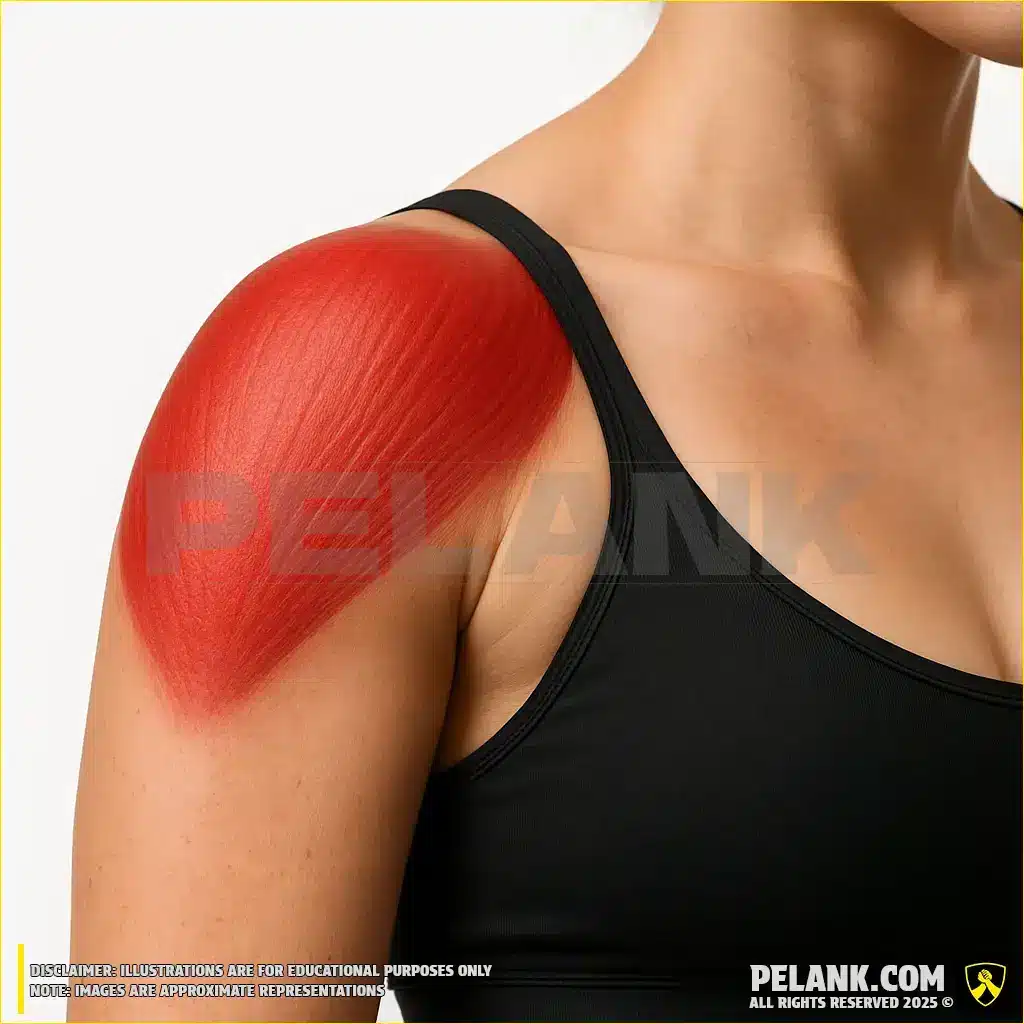
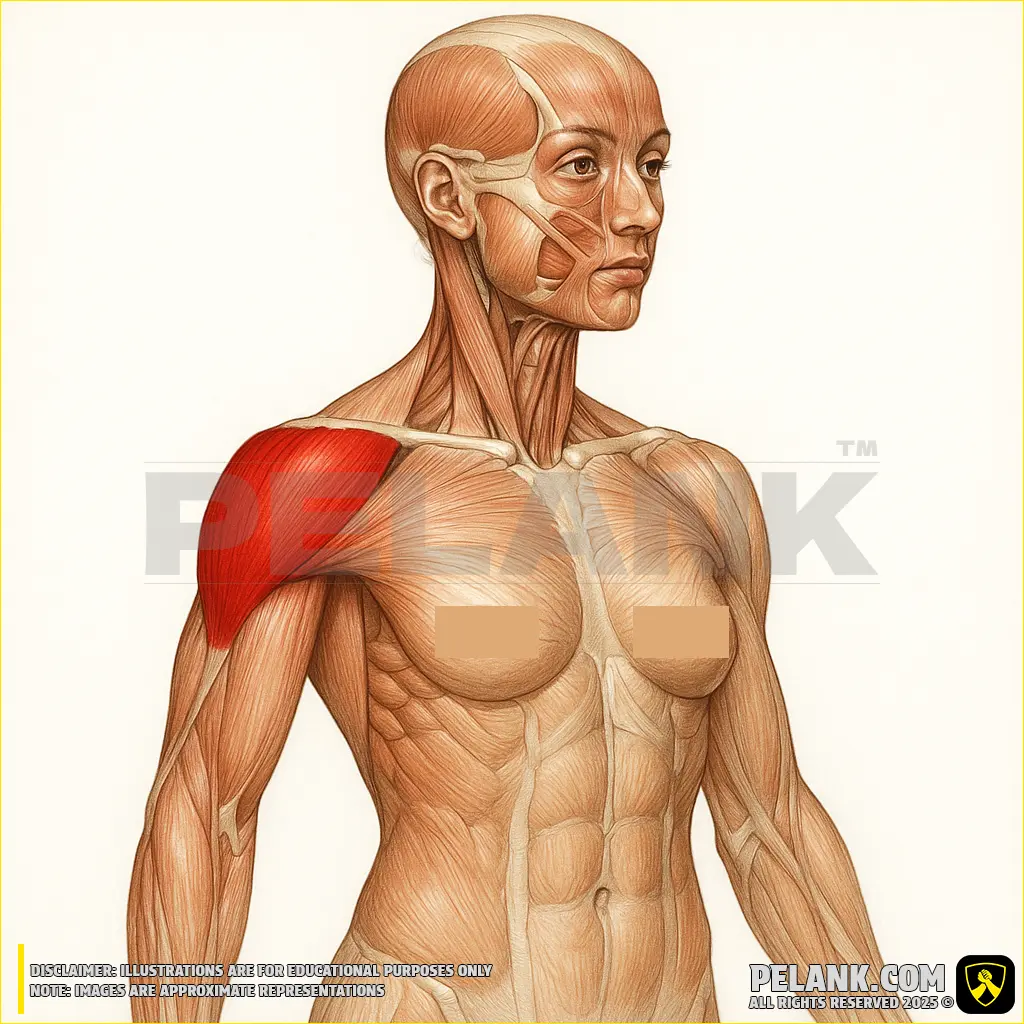
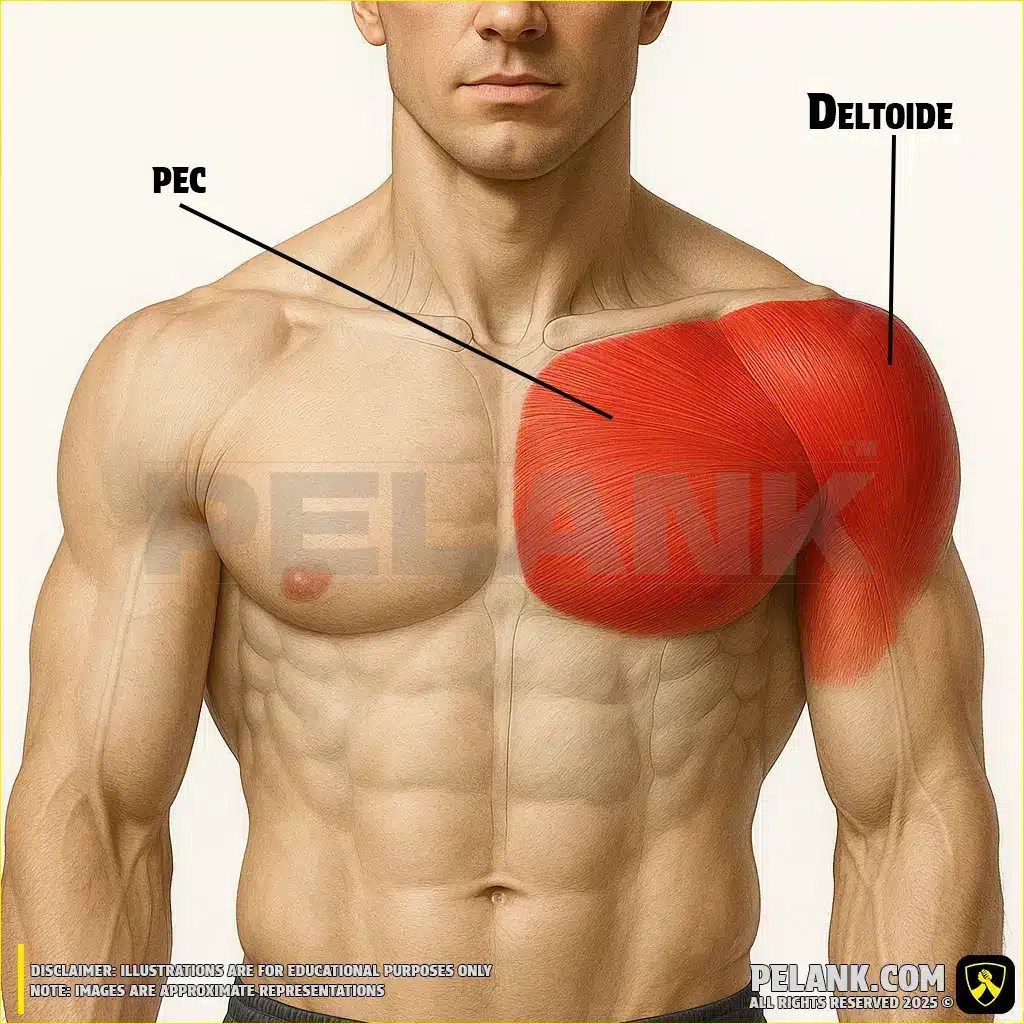
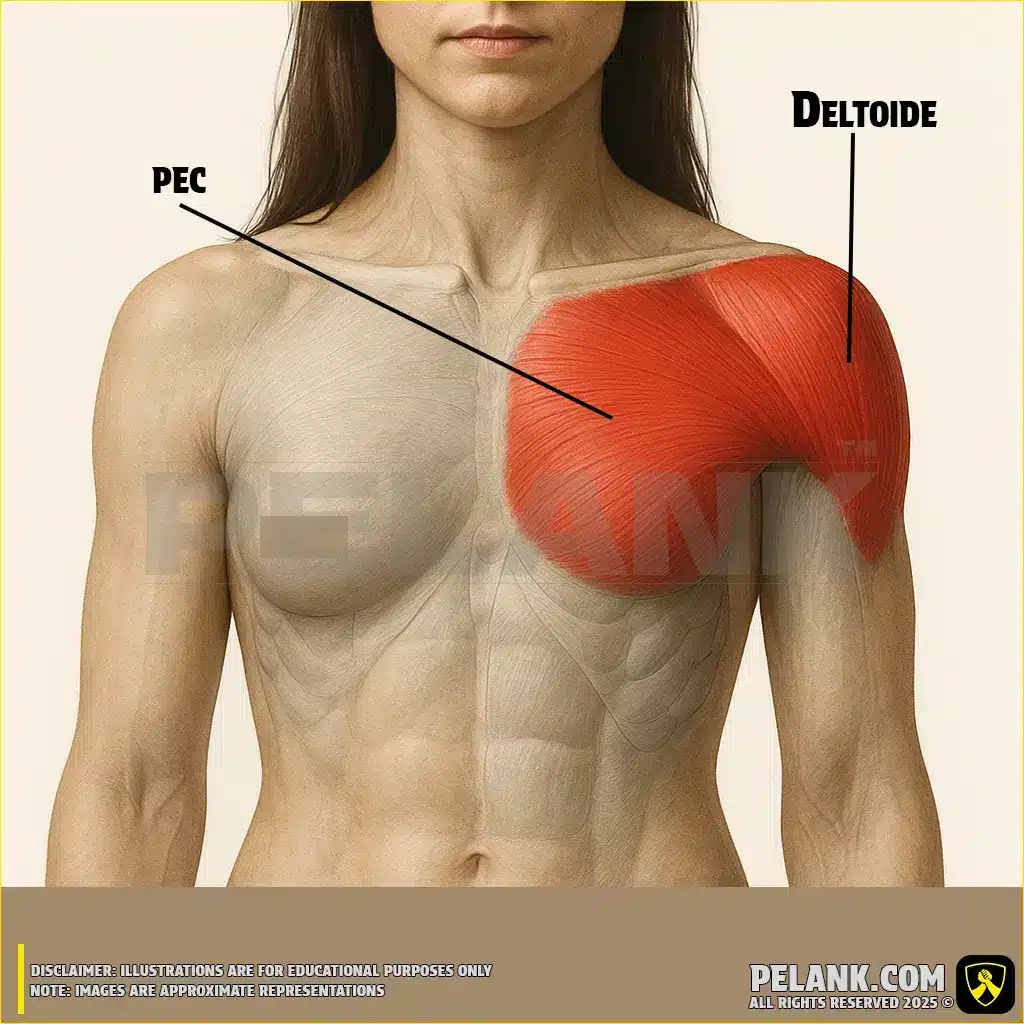
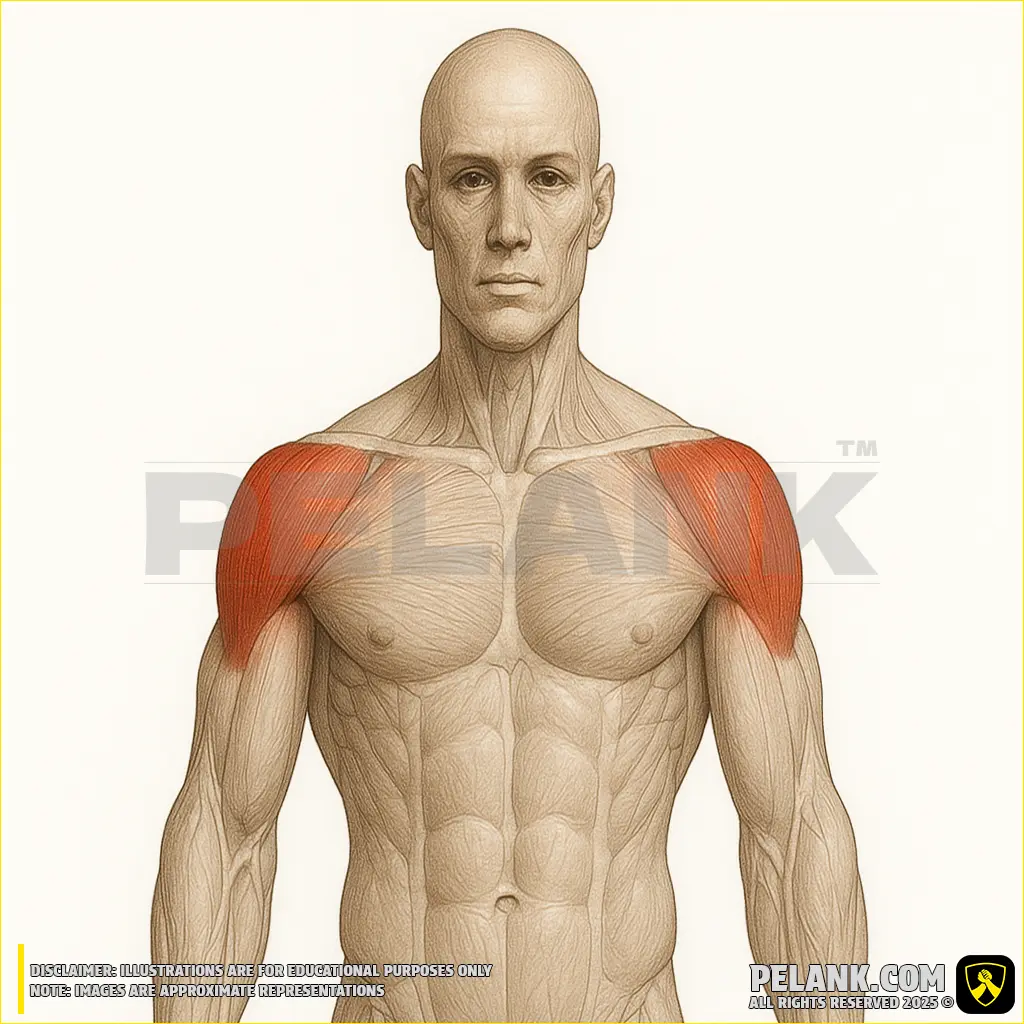
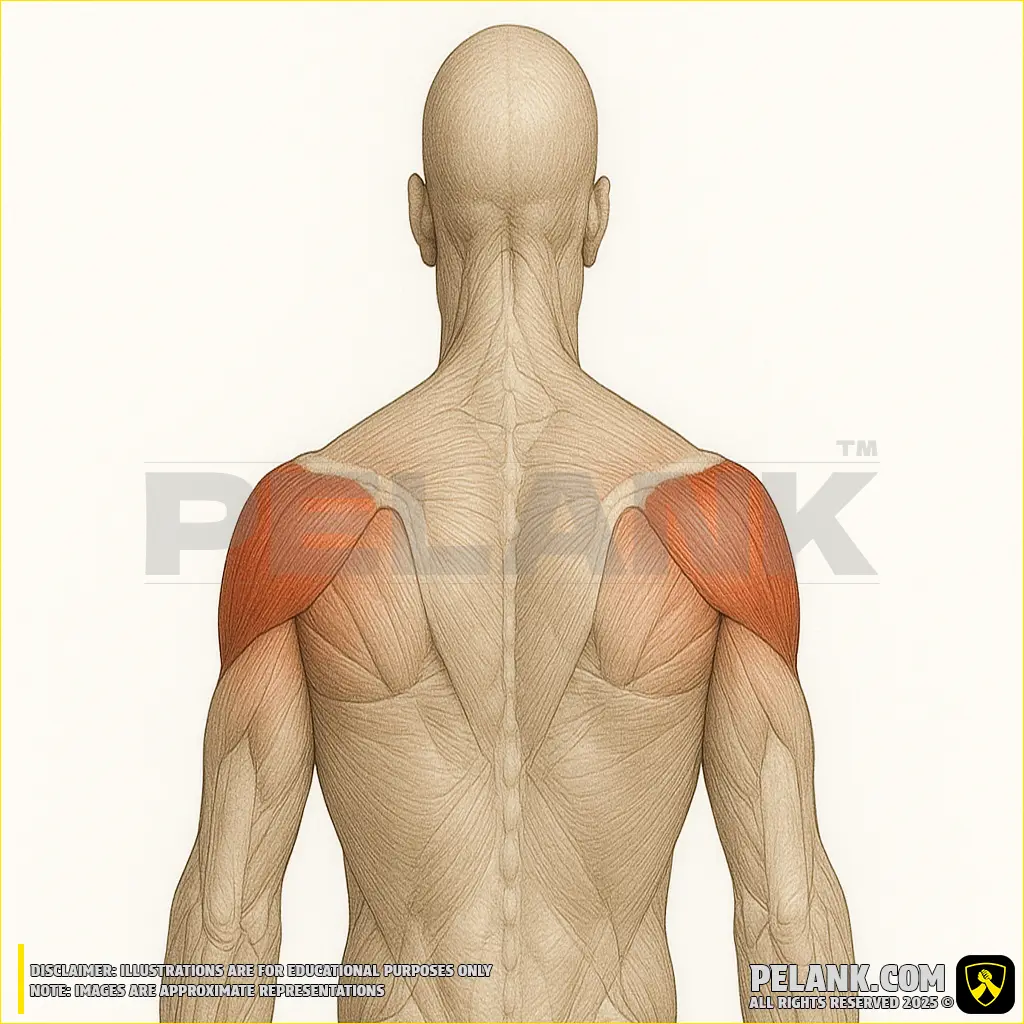
🔹 The deltoid muscle is one of the most important and voluminous muscles of the shoulder region. Its primary function is to move the arm in various directions and stabilize the shoulder joint. Due to its triangular shape, it is named “deltoid,” derived from the Greek word “Δέλτα” (delta), meaning triangle.
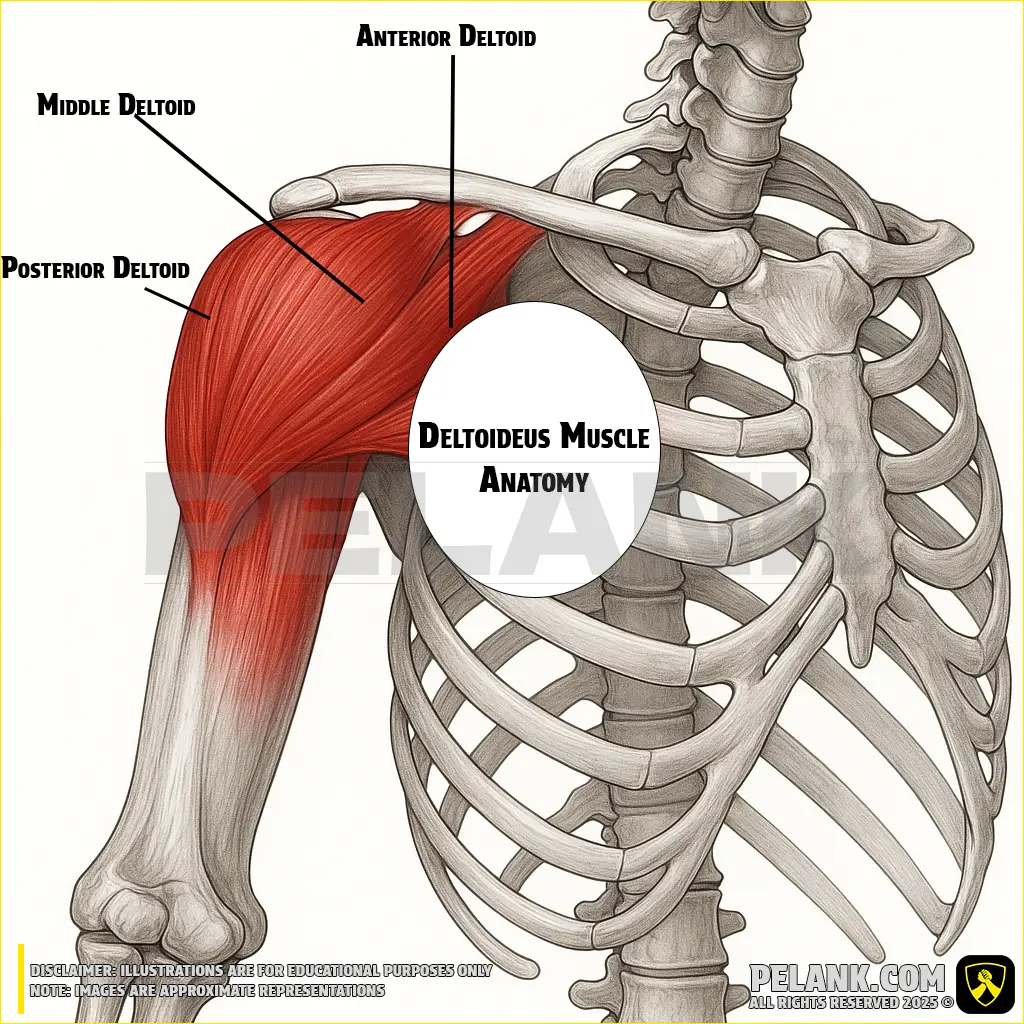
🔹 The deltoid muscle is divided into three distinct heads, each playing a specific role in shoulder movement. The anterior head assists in forward motions and arm flexion, the middle head is responsible for abduction and lifting the arm, and the posterior head supports extension and movements behind the body. This muscle is essential for the stability and strength of the shoulder joint, and its weakness can lead to limited range of motion, reduced shoulder power, and an increased risk of injury.
🖼️ Image Gallery
Click on the images to enlarge them.



🔷 Full Description
Click on the title to read the sections.
✅ Persian Name: Deltoeid
✅ Latin Name: Deltoideus
✅ Common Name: Shoulder Muscle
✅ Location:
🟡 A superficial muscle located at the top of the upper arm, covering the shoulder joint.
🟡 It forms a cap-like structure over the shoulder joint.
🟡 It directly overlays the head of the humerus and originates from the clavicle, scapula, and the upper part of the arm.
✅ 🔹 Origin
✔ Anterior part: from the outer surface of the clavicle
✔ Middle part: from the acromion, a portion of the scapula
✔ Posterior part: from the spine of the scapula
✅ 🔹 Insertion
✔ All parts of the deltoid muscle insert onto the deltoid tuberosity of the humerus.
✅ 🔹 Function
📌 The deltoid muscle is divided into three parts, each with a specific function:
1️⃣ Anterior Head
- ✔ Moving the arm forward (shoulder flexion)
- ✔ Internal rotation of the arm
- ✔ Assists in horizontal adduction of the arm (moving the arm forward across the body)
2️⃣ Middle Head
- ✔ Lifting the arm outward (shoulder abduction)
- ✔ Assists in stabilizing the shoulder during arm elevation
3️⃣ Posterior Head
- ✔ Moving the arm backward (shoulder extension)
- ✔ External rotation of the arm
- ✔ Assists in horizontal abduction of the arm (moving the arm backward across the body)
📌 Function Summary: The deltoid muscle plays a key role in all shoulder movements and is one of the primary muscles responsible for moving the arm in various directions.
✅ 💪🏻 Muscle Fiber Types
✔ The deltoid muscle consists of a combination of fiber types. ✔ A combination of slow-twitch fibers (Type I) and fast-twitch fibers (Type II). ✔ It is composed of both fiber types.
✔ The anterior and posterior heads contain more fast-twitch fibers, which are suited for powerful and rapid movements.
✔ The middle head has a higher proportion of slow-twitch fibers, which help maintain muscular endurance during sustained activity.
✅ 🏋🏻♂️ Role in Sports and Physical Activities
✔ Plays a key role in all overhead movements, such as shoulder press and bench press.
✔ Crucial for sports like weightlifting, swimming, gymnastics, and wrestling.
✔ Considered one of the primary muscles involved in carrying heavy objects, throwing, and raising the arm.
✅ 🧗🏻♂️ Strength and Endurance
✔ The deltoid plays a vital role in maintaining shoulder joint stability, and its weakness can reduce control over shoulder movements.
✔ This muscle is well-suited for both strength and endurance activities and is heavily engaged in many professional sports.
✅ 🧠 Innervation
✔ Axillary Nerve (also known as the underarm nerve) – responsible for controlling deltoid muscle movements and providing sensation to the shoulder area.
✅ 🩸 Blood Supply
✔ Posterior Circumflex Humeral Artery
✔ Thoracoacromial Artery
✅ 🤼♂️ Role in Sports and Physical Activities
✔ Directly involved in all shoulder and arm movements.
✔ A key muscle for athletes in bodybuilding, weightlifting, swimming, boxing, and combat sports.
✔ Strengthening this muscle improves shoulder shape, prevents injuries, and boosts upper body strength.
✅ 🏌🏻♂️ Interaction with Other Muscles and Joints
✔ Works closely with the rotator cuff muscles, back muscles, and pectoralis major.
✔ Weakness in this muscle can lead to excessive strain on the shoulder and scapular joints, increasing the risk of injury.
✅ 💉 Vulnerability and Potential Issues
✔ One of the most injury-prone muscles in bodybuilding and strength sports due to its crucial role in heavy movements.
✔ Common injuries include tears, strains, tendon inflammation, and cramps—often caused by improper use of heavy weights.
✅ 🏋🏻♂️ Strength Training Exercises for the Deltoid Muscle
1️⃣ Dumbbell or Barbell Shoulder Press – Strengthens all parts of the deltoid
2️⃣ Lateral Raise – Targets the middle head of the deltoid
3️⃣ Bent-Over Reverse Fly – Strengthens the posterior head of the deltoid
4️⃣ Front Raise with Dumbbell or Barbell – Focuses on the anterior head
5️⃣ Arnold Press – Activates all heads of the deltoid simultaneously
✅ 🧘🏻♀️ Stretching and Recovery
✔ Forward and backward shoulder stretches
✔ Wall walks with the hand to improve flexibility
✅ Fun Fact
✔ The deltoid muscle is actually one of the key muscles that shapes and enhances the appearance of the upper body.
✅ Practical Tip
✔ Overtraining the deltoid without strengthening the back and rotator cuff muscles can disrupt shoulder muscle balance.
🔴 Name and Location: A superficial muscle that covers the shoulder joint and originates from the clavicle, scapula, and humerus.
🟠 Anatomy: Composed of three parts—anterior, middle, and posterior—each responsible for different shoulder movements.
🟡 Function:
✔ Anterior: Arm flexion and internal rotation
✔ Middle: Arm abduction and elevation
✔ Posterior: Arm extension and external rotation
🟢 Physiology: A combination of slow- and fast-twitch fibers, allowing for both endurance and explosive power movements.
🔵 Innervation: Axillary nerve, which controls the muscle’s movement and sensation in the shoulder area.
🟣 Importance: Active in all upper-body movements, bodybuilding, weightlifting, swimming, boxing, and combat sports.
🟤 Exercises: Shoulder press, lateral raise, front raise, bent-over raise, Arnold press.
⚫ Fun Fact: A key muscle for shoulder strength and aesthetics, yet one of the most injury-prone muscles during heavy training.
Deltoid Muscle Sections
Separate parts of the Deltoid
Anterior Deltoid muscle
Anterior Deltoid Muscle
🔹 The anterior deltoid is one of the three parts of the deltoid muscle. Its primary functions are moving the arm forward (flexion), internal rotation, and assisting in horizontal shoulder movements. This muscle plays a key role in many upper-body exercises, especially strength training movements like bench press, front raises, and throwing actions.
🔹 The anterior deltoid is one of the most important muscles involved in pressing and pushing movements. Due to its engagement in many strength exercises, it is often well-developed among athletes and bodybuilders. However, overusing this muscle without strengthening the posterior shoulder muscles (posterior deltoid and rotator cuff) can lead to muscular imbalances and increase the risk of shoulder injuries.

🔷 Full Description
Click on the title to read the sections.
✅ Persian Name: Deltoid Ghodami
✅ Latin Name: Anterior Deltoid
✅ Common Names: Front part of the deltoid muscle | Anterior head of the shoulder
✅ Location:
🟡 Located at the front of the shoulder, forming the anterior part of the deltoid muscle.
🟡 Originates from the clavicle and lies over the upper part of the humerus.
🟡 Alongside the middle and posterior parts of the deltoid, it acts as part of the shoulder cap and assists in arm movements.
✅ 🔹 Origin
✔ Anterior surface of the lateral third of the clavicle (Clavicle – Anterior Surface of Lateral Third)
✅ 🔹 Insertion
✔ Deltoid tuberosity on the humerus bone (Deltoid Tuberosity, Humerus)
✅ 🔹 Function
📌 Primary functions of the anterior deltoid:
✔ Arm flexion – moving the arm forward (like raising the hand in front of the body)
✔ Internal rotation of the arm – rotating the arm inward toward the body
✔ Assisting in horizontal adduction – moving the arm inward on a horizontal plane (such as during a chest fly)
✔ Helping stabilize the shoulder joint during upper-body movements
📌 Movements that activate the anterior deltoid:
✔ Raising the arm forward (such as front raises)
✔ Throwing movements (ball throws, javelin throws)
✔ Moving weights in pressing and fly exercises
✅ 💪🏻 Muscle Fiber Types
✔ A combination of fast-twitch fibers (Type II) and slow-twitch fibers (Type I)
✔ Predominantly composed of fast-twitch fibers for rapid and powerful movements
✔ This characteristic makes the anterior deltoid highly active in explosive and strength exercises like weightlifting and throwing
✅ 🏋🏻♂️ Role in Sports and Physical Activities
✔ Active in all pressing, throwing, and forward arm-raising exercises
✔ Plays a key role in strength sports, bodybuilding, weightlifting, boxing, and discus throwing
✔ An important muscle in daily activities such as lifting objects and carrying items
✅ 🧗🏻♂️ Strength and Endurance
✔ Requires high strength for pressing exercises and overhead movements
✔ Overdevelopment can lead to muscular imbalances and increase the risk of shoulder injuries
✅ 🧠 Innervation
✔ Axillary nerve (C5, C6), which controls the movements of this muscle.
✅ 🩸 Blood Supply
✔ Posterior Circumflex Humeral Artery
✔ Thoracoacromial Artery
✅ 🤼♂️ Role in Sports and Physical Activities
✔ One of the key muscles for pushing and pressing movements in bodybuilding and weightlifting
✔ Active in throwing sports, swimming, boxing, gymnastics, and pulling movements
✔ Weakness can reduce pressing strength and increase the risk of shoulder injury
✅ 🏌🏻♂️ Interaction with Other Muscles and Joints
✔ Closely connected with the middle deltoid, pectoralis major, rotator cuff muscles, and triceps brachii
✔ Weakness in this muscle can lead to excessive strain on the shoulder joint and reduced upper body strength
✅ 💉 Vulnerability and Potential Issues
✔ One of the muscles prone to inflammation and strain due to high activity in upper-body training
✔ Weakness can cause excessive strain on the pectoral and shoulder muscles, leading to shoulder injuries
✅ 🏋🏻♂️ Strength Training Exercises for the Anterior Deltoid
1️⃣ Front Raise with Dumbbells – the most important exercise for strengthening the anterior deltoid
2️⃣ Overhead Shoulder Press with Dumbbells or Barbell – high engagement of the anterior deltoid
3️⃣ Arnold Press – simultaneous strengthening of all deltoid parts with emphasis on the anterior head
4️⃣ Incline Bench Press – combined strengthening of the anterior deltoid and pectoralis major
5️⃣ Close-Grip Push-ups – bodyweight exercise targeting this muscle
✅ 🧘🏻♀️ Stretching and Recovery
✔ Stretching the arm forward and across the body to improve flexibility and prevent muscle tightness
✔ Using a foam roller to reduce muscle tension and enhance blood flow
✅ Fun Fact
✔ The anterior deltoid is most engaged in throwing movements, which is why athletes in discus, javelin, and boxing typically have a very strong anterior deltoid.
✅ Practical Tip
✔ Overdeveloping the anterior deltoid without balancing it with the posterior deltoid can lead to muscular imbalances and increased stress on the shoulder joint.
🔴 Name and Location: A superficial muscle located at the front of the shoulder joint, originating from the clavicle.
🟠 Anatomy: Part of the deltoid muscle that, along with the middle and posterior deltoids, surrounds the shoulder and attaches to the humerus.
🟡 Function:
✔ Arm flexion – moving the hand forward
✔ Internal rotation of the arm – rotating the hand inward
✔ Horizontal adduction – assisting in bringing the arm inward on a horizontal plane
🟢 Physiology: Composed mainly of fast-twitch fibers, which provide power and speed in pressing movements.
🔵 Innervation: Axillary nerve, which controls the movements of this muscle.
🟣 Importance: Plays a vital role in pressing exercises, throwing, bodybuilding, boxing, and strength sports.
🟤 Exercises:
✔ Front raise
✔ Shoulder press
✔ Arnold press
✔ Incline bench press
✔ Close-grip push-ups
⚫ Fun Fact: One of the most utilized muscles in throwing and pressing movements, which, if overdeveloped, can lead to muscular imbalances and shoulder injuries.
Middle Deltoid muscle
Middle Deltoid Muscle
🔹 The middle deltoid is one of the three parts of the deltoid muscle. Its primary function is to lift the arm outward (abduction) and assist in stabilizing the shoulder during overhead movements. Due to its position on the side of the shoulder, it has the greatest impact on creating the rounded, muscular shape of the shoulders.
🔹 This part of the deltoid is less involved than the anterior section in daily activities and requires specific training for strengthening. Weakness in this muscle can lead to narrower shoulders and limited overhead movement. Strengthening it improves muscular balance in the shoulder and helps prevent shoulder injuries.

🔷 Full Description
Click on the title to read the sections.
✅ Persian Name: Deltoid Miani | Deltoid Janebi
✅ Latin Name: Lateral Deltoid | Middle Deltoid
✅ Common Names: Middle part of the deltoid muscle | Middle head of the shoulder
✅ Location:
🟡 Located on the lateral side of the shoulder, between the anterior and posterior deltoids.
🟡 A superficial muscle covering the shoulder joint that, along with the other two parts, shapes the size and form of the shoulder.
🟡 The primary muscle responsible for moving the arm away from the body (abduction) and plays a role in shoulder joint stabilization.
✅ 🔹 Origin
✔ Acromion process of the scapula (Acromion of Scapula)
✅ 🔹 Insertion
✔ Deltoid tuberosity on the humerus bone (Deltoid Tuberosity, Humerus)
✅ 🔹 Function
📌 Primary functions of the middle deltoid:
✔ Arm abduction – moving the arm outward from the body
✔ Stabilizing the shoulder joint during overhead movements
✔ Assisting lateral arm movements in resistance training exercises
📌 Movements that activate the middle deltoid:
✔ Raising the arm sideways (such as lateral raises)
✔ Overhead movements (such as shoulder press)
✔ Lateral arm movements in sports like volleyball and swimming
✅ 💪🏻 Muscle Fiber Types
✔ A combination of ✔ A combination of slow-twitch fibers (Type I) and fast-twitch fibers (Type II).
✔ Predominantly composed of slow-twitch fibers for controlled and endurance movements
✔ Plays a significant role in stability and sustained strength during shoulder activities
✅ 🏋🏻♂️ Role in Sports and Physical Activities
✔ A key muscle in all lateral and overhead movements
✔ Essential in swimming, volleyball, basketball, handball, and gymnastics
✔ Weakness in this muscle reduces arm control and increases the risk of shoulder injury
✅ 🧗🏻♂️ Strength and Endurance
✔ Plays a key role in sustained overhead activities such as volleyball and weightlifting
✔ Requires focused training for strengthening, as it is less engaged in daily exercises
✅ 🧠 Innervation
✔ Axillary nerve (C5, C6), which controls the movements of this muscle.
✅ 🩸 Blood Supply
✔ Posterior Circumflex Humeral Artery
✔ Thoracoacromial Artery
✅ 🤼♂️ Role in Sports and Physical Activities
✔ One of the most important muscles for shoulder width and muscular shape
✔ Involved in all lateral and overhead exercises such as swimming, volleyball, and throwing
✔ Weakness can cause muscular imbalances and increase stress on the shoulder joint
✅ 🏌🏻♂️ Interaction with Other Muscles and Joints
✔ Strong connection with the anterior deltoid, posterior deltoid, and rotator cuff muscles
✔ Weakness in this muscle can cause excessive strain on the anterior deltoid and upper back muscles
✅ 💉 Vulnerability and Potential Issues
✔ Weakness in this muscle can lead to limited lateral movements and increased stress on the shoulder joint.
✔ Improper use of heavy weights during lateral exercises may cause shoulder tendon inflammation.
✅ 🏋🏻♂️ Strength Training Exercises for the Middle Deltoid
1️⃣ Dumbbell Lateral Raise – the most effective exercise for strengthening this muscle
2️⃣ Overhead Shoulder Press – directly engages the middle deltoid
3️⃣ Cable Lateral Raise – provides continuous tension on the muscle
4️⃣ Arm Raises with Resistance Bands – enhances muscular endurance
5️⃣ Reverse Fly with Bands or Dumbbells – fully activates the muscle through its range of motion
✅ 🧘🏻♀️ Stretching and Recovery
✔ Stretching the arm out to the sides with gentle pressure toward the body
✔ Using a foam roller to reduce tension and accelerate recovery
✅ Fun Fact
✔ The middle deltoid greatly influences the V-shaped appearance of the upper body. Athletes with broad, well-defined shoulders typically have a well-developed middle deltoid.
✅ Practical Tip
✔ Improper form and incomplete execution of lateral raises reduce middle deltoid activation and place extra strain on other muscles. For better results, perform the movement through the full range of motion with proper control.
🔴 Name and Location: A superficial muscle located at the sides of the shoulder joint, responsible for moving the arm away from the body (abduction).
🟠 Anatomy: Originates from the acromion of the scapula and inserts into the deltoid tuberosity of the humerus.
🟡 Function:
✔ Lifting the arm out to the side
✔ Stabilizing the shoulder during overhead movements
🟢 Physiology: Contains slow-twitch fibers suited for controlled and endurance movements.
🔵 Innervation: Axillary nerve, which controls the movements of this muscle.
🟣 Importance: Plays a vital role in swimming, volleyball, gymnastics, and weightlifting.
🟤 Exercises: Lateral raise, shoulder press, cable lateral raise.
⚫ Fun Fact: The key muscle responsible for shoulder width and the V-shaped upper body appearance.
Posterior deltoid muscle
Posterior Deltoid Muscle
🔹 The posterior deltoid is one of the three parts of the deltoid muscle. Its primary functions are moving the arm backward, external rotation, and assisting in horizontal shoulder movements. Unlike the anterior and middle deltoids, it is less engaged in daily activities but is essential for shoulder muscle balance, strengthening the back, and preventing shoulder injuries.
🔹 The posterior deltoid is directly involved in pulling exercises and weightlifting movements. Weakness in this muscle can lead to shoulder drooping, reduced endurance of the upper back, and an increased risk of injury to the glenohumeral (shoulder) joint.

🔷 Full Description
Click on the title to read the sections.
✅ Persian Name: Deltoid Khalfi | Deltoid Poshti
✅ Latin Name: Posterior Deltoid
✅ Common Names: Posterior part of the deltoid muscle | Posterior head of the shoulder
✅ Location:
🟡 Located on the posterior (back) side of the shoulder, behind the shoulder joint.
🟡 A superficial muscle that, along with the anterior and middle parts, completes the deltoid muscle.
🟡 Primarily responsible for moving the arm backward (extension), external rotation, and assisting in horizontal shoulder movements.
✅ 🔹 Origin
✔ Spine of the scapula (Spine of Scapula)
✅ 🔹 Insertion
✔ Deltoid tuberosity on the humerus bone (Deltoid Tuberosity, Humerus)
✅ 🔹 Function
📌 Primary functions of the posterior deltoid:
✔ Arm extension – moving the arm backward (such as pulling a rope or cable)
✔ External rotation of the arm – rotating the hand outward away from the body
✔ Horizontal adduction – assisting arm movement backward on a horizontal plane (such as reverse fly)
✔ Stabilizing the shoulder joint during pulling and resistance exercises
📌 Movements that activate the posterior deltoid:
✔ Pulling exercises such as rowing, pull-ups, and face pulls
✔ Resistance training like reverse fly, bent-over lateral raise, and rear cable pulls
✔ Sports movements such as javelin throwing and butterfly swimming
✅ 💪🏻 Muscle Fiber Types
✔ A combination of fast-twitch fibers (Type II) and slow-twitch fibers (Type I)
✔ Composed mostly of fast-twitch fibers for powerful and quick pulling movements
✔ Plays a crucial role in stabilizing pulling actions and enhancing upper back endurance
✅ 🏋🏻♂️ Role in Sports and Physical Activities
✔ A key muscle in pulling and resistance exercises such as pull-ups, rowing, and reverse fly
✔ Plays an important role in wrestling, gymnastics, weightlifting, and swimming
✔ Weakness in this muscle can cause shoulder drooping and limit pulling movements
✅ 🧗🏻♂️ Strength and Endurance
✔ One of the most important muscles for maintaining shoulder balance and preventing injuries from asymmetrical training
✔ Strengthening it improves upper back stability and enhances motor control during strength exercises
✅ 🧠 Innervation
✔ Axillary nerve (C5, C6), responsible for controlling the movements of this muscle.
✅ 🩸 Blood Supply
✔ Posterior Circumflex Humeral Artery
✔ Thoracoacromial Artery
✅ 🤼♂️ Role in Sports and Physical Activities
✔ A vital muscle for maintaining shoulder muscle balance and preventing rounded shoulders
✔ Plays an important role in pulling, resistance, and sports activities like wrestling and swimming
✔ Weakness can lead to muscular imbalance and increased strain on the front shoulder muscles
✅ 🏌🏻♂️ Interaction with Other Muscles and Joints
✔ Strong synergy with the middle deltoid, back muscles, rotator cuff muscles, and lower trapezius
✔ Weakness in this muscle can reduce shoulder joint performance and limit range of motion
✅ 💉 Vulnerability and Potential Issues
✔ Weakness in the posterior deltoid increases the risk of injury during pressing and pulling exercises.
✔ Excessive strain during heavy weight training may cause tendon strains and inflammation in the rear shoulder region.
✅ 🏋🏻♂️ Strength Training Exercises for the Posterior Deltoid
1️⃣ Reverse Fly with Dumbbells – one of the best exercises to strengthen the posterior deltoid
2️⃣ Bent-over Lateral Raise with Dumbbells – effective for increasing muscle size
3️⃣ Face Pull – a specialized exercise to enhance upper back stability
4️⃣ Single Arm Row with Dumbbells – combines strengthening of the posterior deltoid and back muscles
5️⃣ Reverse Cable Fly – provides continuous tension on this muscle
✅ 🧘🏻♀️ Stretching and Recovery
✔ Stretching the arm forward and overhead to improve flexibility and prevent muscle tightness
✔ Using a foam roller to reduce tension and enhance blood circulation
✅ Fun Fact
✔ The posterior deltoid is often undertrained in workout programs but is essential for shoulder stability and endurance.
✅ Practical Tip
✔ Overdeveloping the anterior deltoid without balancing the posterior deltoid can disrupt shoulder muscle balance and increase the risk of shoulder injuries.
🔴 Name and Location: A superficial muscle located at the back of the shoulder joint, responsible for pulling and rotational movements of the arm.
🟠 Anatomy: Originates from the spine of the scapula and inserts into the deltoid tuberosity of the humerus.
🟡 Function:
✔ Moving the arm backward (extension)
✔ External rotation of the arm
✔ Assisting pulling movements in resistance training
🟢 Physiology: Predominantly composed of fast-twitch fibers for powerful and rapid pulling movements.
🔵 Innervation: Axillary nerve, which controls the movements of this muscle.
🟣 Importance: Plays a key role in resistance sports, weightlifting, and gymnastics.
🟤 Exercises: Reverse fly, bent-over lateral raise, face pull, rowing.
⚫ Fun Fact: One of the most important muscles for maintaining shoulder balance and preventing rounded shoulders.
2. Deep Shoulder Muscles
Deep Shoulder Muscles
Rotator Cuff Muscles
Rotator Cuff Muscles
Supraspinatus Muscle
Supraspinatus Muscle
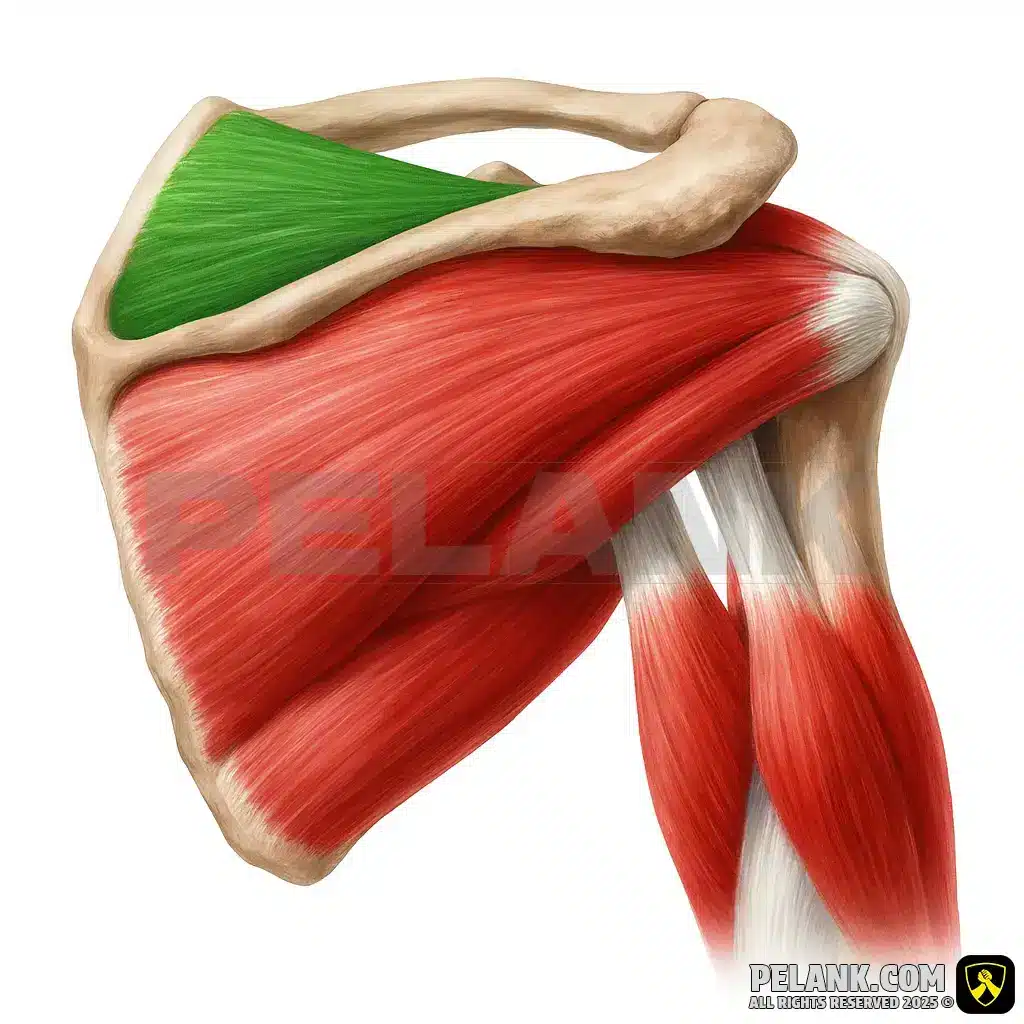
🔹 The supraspinatus muscle is one of the four main rotator cuff muscles and plays a vital role in stabilizing the glenohumeral (shoulder) joint. It is especially important in initiating arm abduction before the middle deltoid activates. Additionally, it helps prevent shoulder dislocation and enhances joint stability.
🔹 The supraspinatus muscle is often undertrained in daily workouts, but its weakness is one of the most common causes of shoulder pain and injuries such as shoulder impingement syndrome. Therefore, athletes and bodybuilders should pay special attention to strengthening this muscle.
🔷 Full Description
Click on the title to read the sections.
✅ Persian Name: Fogh-e Khari
✅ Latin Name: Supraspinatus
✅ Common Names: Upper Scapular Muscle | Superior Rotator Cuff Muscle
✅ Location:
🟡 Located at the upper part of the scapula, within the supraspinous fossa.
🟡 This muscle is part of the rotator cuff group, which stabilizes the shoulder joint.
🟡 Responsible for initiating arm abduction (moving the arm away from the body) and assisting in shoulder stabilization during arm movements.
✅ 🔹 Origin
✔ Supraspinous fossa of the scapula (Supraspinous Fossa of Scapula)
✅ 🔹 Insertion
✔ Superior facet of the greater tubercle of the humerus (Greater Tubercle of Humerus)
✅ 🔹 Function
📌 Primary functions of the supraspinatus muscle:
✔ Initiates arm abduction – moving the arm outward away from the body during the first 15 degrees
✔ Assists in stabilizing the shoulder joint throughout arm movements
✔ Prevents shoulder dislocation during heavy or sudden movements
📌 Movements that activate the supraspinatus:
✔ Raising the arm in lateral raises and resistance shoulder exercises
✔ Assisting shoulder joint stabilization in sports like tennis, volleyball, basketball, and swimming
✔ Throwing and pulling movements that require high control
✅ 💪🏻 Muscle Fiber Types
✔ A combination of ✔ A combination of slow-twitch fibers (Type I) and fast-twitch fibers (Type II).
✔ Predominantly composed of slow-twitch fibers, which enhance the muscle’s endurance during prolonged and controlled movements.
✅ 🏋🏻♂️ Role in Sports and Physical Activities
✔ An important muscle for controlling overhead movements and stabilizing the shoulder in sports like swimming, volleyball, and basketball
✔ Active in light resistance and stretching exercises to prevent shoulder injuries
✔ Weakness in this muscle increases the risk of shoulder joint injuries and reduces range of motion
✅ 🧗🏻♂️ Strength and Endurance
✔ A small but crucial muscle for shoulder stability and movement control
✔ Requires controlled training to strengthen without excessive strain
✅ 🧠 Innervation
✔ Suprascapular nerve (C5, C6), which controls the movements of this muscle.
✅ 🩸 Blood Supply
✔ Suprascapular artery
✅ 🤼♂️ Role in Sports and Physical Activities
✔ A key muscle for stabilizing the shoulder joint and preventing dislocation
✔ Active in throwing sports, tennis, basketball, gymnastics, and weightlifting
✔ Weakness can increase the likelihood of shoulder pain and injuries
✅ 🏌🏻♂️ Interaction with Other Muscles and Joints
✔ Strong synergy with the middle deltoid, other rotator cuff muscles (infraspinatus, teres minor, subscapularis), and pectoral muscles
✔ Weakness in this muscle increases stress on the deltoid and shoulder joint
✅ 💉 Vulnerability and Potential Issues
✔ One of the most commonly injured muscles prone to tears and inflammation.
✔ Weakness or inflammation of this muscle can lead to Shoulder Impingement Syndrome.
✅ 🏋🏻♂️ Strength Training Exercises for the Supraspinatus
1️⃣ Lateral Raise with Light Dumbbells – gradual strengthening without excessive strain
2️⃣ External Rotation with Resistance Band – improves muscle control and strength
3️⃣ Isometric Shoulder Exercises – helps stabilize the shoulder joint without injury
4️⃣ Controlled movements within the natural range of motion – prevents excessive stress on the muscle
5️⃣ Physiotherapy exercises to improve rotator cuff function
✅ 🧘🏻♀️ Stretching and Recovery
✔ Stretching the arm across the body to improve flexibility and reduce muscle tension
✔ Using a foam roller to enhance blood flow and decrease inflammation
✅ Fun Fact
✔ The supraspinatus muscle initiates arm abduction, but after the first 15 degrees, the middle deltoid takes over this function.
✅ Practical Tip
✔ Strengthening the supraspinatus with light weights and resistance bands is the best way to prevent injury and improve shoulder function.
🔴 Name and Location: A deep muscle located on the top of the scapula, and part of the rotator cuff.
🟠 Anatomy: Originates from the supraspinous fossa of the scapula and inserts into the greater tubercle of the humerus.
🟡 Function:
✔ Initiates arm abduction (moving the arm away from the body)
✔ Stabilizes the shoulder during arm movements
🟢 Physiology: Predominantly composed of slow-twitch fibers for precise and stable movement control.
🔵 Innervation: Suprascapular nerve, which controls this muscle.
🟣 Importance: Plays a vital role in controlling overhead movements and preventing shoulder injuries.
🟤 Exercises: Light lateral raises, external rotations with resistance bands, physiotherapy exercises.
⚫ Fun Fact: It initiates the abduction movement, but after 15 degrees, the middle deltoid takes over.
Infraspinatus Muscle
Infraspinatus Muscle
🔹 The infraspinatus muscle is one of the four key rotator cuff muscles, playing a crucial role in stabilizing and controlling the shoulder joint. It is essential for external rotation of the arm and maintaining shoulder joint stability.
🔹 This muscle is actively engaged in many athletic movements such as throwing, pulling weights, and rotational shoulder actions. Weakness in the infraspinatus can lead to shoulder joint instability, reduced range of motion, and an increased risk of injuries like rotator cuff tendon tears.

🔷 Full Description
Click on the title to read the sections.
✅ Persian Name: Tahte Khari
✅ Latin Name: Infraspinatus
✅ Common Name: External Rotator of the Shoulder | Posterior Rotator Cuff Muscle
✅ Location:
🟡 Located on the posterior (back) side of the scapula, within the infraspinous fossa.
🟡 It is part of the rotator cuff muscle group responsible for external rotation and stabilization of the shoulder.
🟡 Its primary function is to externally rotate the arm and prevent excessive displacement of the humeral head in the glenohumeral joint.
✅ 🔹 Muscle Origin
✔ Infraspinous fossa of the scapula
✅ 🔹 Muscle Insertion
✔ Greater tubercle of the humerus
✅ 🔹 Muscle Function
📌 Primary functions of the infraspinatus muscle:
✔ External rotation of the arm – rotating the arm outward
✔ Stabilizing the shoulder joint against sudden forces
✔ Controlling throwing and rotational shoulder movements
📌 Movements involving activation of the infraspinatus:
✔ External rotation of the arm in resistance exercises (e.g., band external rotations)
✔ Throwing movements such as ball throws, javelin throws, and discus throws
✔ Resistance-based exercises like lateral pulls and controlled shoulder movements
✅ 💪🏻 Muscle Fiber Types
✔ A combination of ✔ A combination of slow-twitch fibers (Type I) and fast-twitch fibers (Type II).
✔ Contains a higher proportion of slow-twitch fibers, which contribute to endurance and shoulder joint control.
✅ 🏋🏻♂️ Role in Sports and Physical Activities
✔ A key muscle for controlling rotational movements and stabilizing the shoulder in sports like swimming, baseball, basketball, and weightlifting
✔ Engaged in light resistance and stretching exercises to prevent shoulder injuries
✔ Weakness in this muscle can lead to shoulder instability and reduced range of motion.
✅ 🧗🏻♂️ Muscle Strength and Endurance
✔ A small but essential muscle for controlling and stabilizing shoulder movements
✔ Requires controlled exercises to enhance stability and prevent tendon inflammation
✅ 🧠 Innervation
✔ Suprascapular nerve (C5, C6), which controls the function of this muscle.
✅ 🩸 Blood Supply
✔ Suprascapular artery
✅ 🤼♂️ Role in Sports and Physical Activities
✔ A key muscle in stabilizing the shoulder joint and controlling rotational movements
✔ Active in sports involving throwing, gymnastics, swimming, wrestling, and weightlifting
✔ Weakness in this muscle increases the risk of rotator cuff tears and reduces the power of throwing motions.
✅ 🏌🏻♂️ Interaction with Other Muscles and Joints
✔ Works closely with the posterior deltoid, other rotator cuff muscles (supraspinatus, teres minor, subscapularis), and the posterior shoulder muscles
✔ Weakness in this muscle increases the load on the shoulder joint and its stabilizing muscles.
✅ 💉 Vulnerability and Potential Issues
✔ One of the most commonly injured muscles due to throwing motions and sudden stress.
✔ Weakness or inflammation in this muscle can lead to shoulder pain, and partial or complete rotator cuff tears.
✅ 🏋🏻♂️ Strengthening Exercises for the Infraspinatus
1️⃣ External Rotation with Resistance Band – one of the most effective exercises to strengthen this muscle
2️⃣ Isometric Shoulder Exercises – enhances shoulder stability
3️⃣ Reverse Fly with Dumbbells – improves muscle strength and endurance
4️⃣ Controlled Range of Motion Exercises – helps prevent tendon inflammation
5️⃣ Physiotherapy Exercises – improves overall rotator cuff function
✅ 🧘🏻♀️ Stretching and Recovery Movements
✔ Outward arm stretches to improve flexibility and reduce muscle tension
✔ Using a foam roller to enhance blood flow and reduce inflammation
✅ Fun Fact
✔ The infraspinatus is one of the most important muscles in throwing movements, and athletes in throwing sports often have a highly developed infraspinatus.
✅ Practical Tip
✔ Strengthening the infraspinatus with light weights and resistance bands is the most effective way to prevent injuries and improve shoulder movement control.
🔴 Name and Location: A deep muscle located on the back of the scapula, beneath the supraspinatus, and part of the rotator cuff group.
🟠 Anatomy: Originates from the infraspinous fossa of the scapula and inserts into the greater tubercle of the humerus.
🟡 Function:
✔ External rotation of the arm
✔ Shoulder stabilization during throwing movements
🟢 Physiology: Predominantly composed of slow-twitch fibers for shoulder joint control and endurance.
🔵 Innervation: Suprascapular nerve, which controls this muscle.
🟣 Importance: Plays a vital role in throwing, rotational movements, and stabilizing the shoulder joint.
🟤 Exercises: Band external rotations, physiotherapy exercises, reverse fly.
⚫ Fun Fact: One of the key muscles for enhancing shoulder control and stability in throwing sports.
Teres Minor Muscle
Teres Minor Muscle
🔹 The teres minor is one of the four main rotator cuff muscles and works alongside the infraspinatus in external rotation of the arm. In addition to stabilizing the glenohumeral (shoulder) joint, it aids in controlled arm movements during both athletic and everyday activities.
🔹 Unlike the infraspinatus, which has greater power in external rotation, the teres minor plays a more prominent role in stabilizing the shoulder joint and maintaining balance during rotational and resistance movements. Weakness in this muscle can increase stress on the shoulder joint and reduce control in throwing and rotational actions.

🔷 Full Description
Click on the title to read the sections.
✅ Persian Name: Gerde Kochak
✅ Latin Name: Teres Minor
✅ Common Name: Small Shoulder Rotator | Posterior Rotator Cuff Muscle
✅ Location:
🟡 Positioned on the posterior side of the scapula, just below the infraspinatus and above the teres major.
🟡 It is part of the rotator cuff muscle group, responsible for external rotation and stabilization of the shoulder.
🟡 As a small yet essential muscle, it plays a critical role in controlling rotational arm movements and maintaining shoulder joint stability.
✅ 🔹 Muscle Origin
✔ Lateral border of the scapula
✅ 🔹 Muscle Insertion
✔ Greater tubercle of the humerus
✅ 🔹 Muscle Function
📌 Primary functions of the teres minor muscle:
✔ External rotation of the arm – rotating the arm outward
✔ Assists in stabilizing the shoulder joint against lateral forces
✔ Controls resistance movements and helps prevent shoulder dislocation
📌 Movements involving activation of the teres minor:
✔ External rotation of the arm during resistance exercises (e.g., band external rotations)
✔ Shoulder strengthening exercises such as face pulls and bent-over lateral raises
✔ Throwing movements that require high shoulder control (e.g., javelin, ball, and discus throws)
✅ 💪🏻 Muscle Fiber Types
✔ A combination of ✔ A combination of slow-twitch fibers (Type I) and fast-twitch fibers (Type II).
✔ Contains a higher proportion of slow-twitch fibers, which contribute to endurance and shoulder joint control.
✅ 🏋🏻♂️ Role in Sports and Physical Activities
✔ A key muscle for controlling rotational movements and stabilizing the shoulder in sports like swimming, baseball, basketball, and weightlifting
✔ Engaged in light resistance and stretching exercises to prevent shoulder injuries
✔ Weakness in this muscle can lead to shoulder instability and reduced range of motion.
✅ 🧗🏻♂️ Muscle Strength and Endurance
✔ A small but essential muscle for controlling and stabilizing shoulder movements
✔ Requires controlled exercises to enhance stability and prevent tendon inflammation
✅ 🧠 Innervation
✔ Axillary nerve (C5, C6), which controls the movements of this muscle.
✅ 🩸 Blood Supply
✔ Posterior circumflex humeral artery
✅ 🤼♂️ Role in Sports and Physical Activities
✔ A key muscle in stabilizing the shoulder joint and controlling rotational movements
✔ Active in sports involving throwing, gymnastics, swimming, wrestling, and weightlifting
✔ Weakness in this muscle increases the risk of rotator cuff tears and reduces the power of throwing motions.
✅ 🏌🏻♂️ Interaction with Other Muscles and Joints
✔ Works closely with the posterior deltoid, other rotator cuff muscles (supraspinatus, infraspinatus, subscapularis), and the posterior shoulder muscles
✔ Weakness in this muscle increases stress on the shoulder joint and its stabilizing muscles
✅ 💉 Vulnerability and Potential Issues
✔ One of the most commonly injured muscles due to throwing motions and sudden stress.
✔ Weakness or inflammation in this muscle can lead to shoulder pain, and partial or complete rotator cuff tears.
✅ 🏋🏻♂️ Strengthening Exercises for the Teres Minor
1️⃣ External Rotation with Resistance Band – one of the best exercises to strengthen this muscle
2️⃣ Isometric Shoulder Exercises – improves shoulder stability
3️⃣ Reverse Fly with Dumbbells – enhances muscle strength and endurance
4️⃣ Controlled Range of Motion Exercises – helps prevent tendon inflammation
5️⃣ Physiotherapy Exercises – improves the function of the rotator cuff muscles
✅ 🧘🏻♀️ Stretching and Recovery Movements
✔ Outward arm stretches to improve flexibility and reduce muscle tension
✔ Using a foam roller to enhance blood flow and reduce inflammation
✅ Fun Fact
✔ The teres minor works alongside the infraspinatus in external arm rotation, but it plays a more prominent role in stabilizing the shoulder joint.
✅ Practical Tip
✔ Strengthening the teres minor through controlled exercises is one of the best ways to prevent injuries and improve shoulder movement control.
🔴 Name and Location: A deep muscle located on the back of the scapula, between the infraspinatus and teres major muscles, and part of the rotator cuff group.
🟠 Anatomy: Originates from the lateral border of the scapula and inserts into the greater tubercle of the humerus.
🟡 Function:
✔ External rotation of the arm
✔ Stabilization of the shoulder during rotational and resistance movements
🟢 Physiology: Predominantly composed of slow-twitch fibers for shoulder joint control and endurance.
🔵 Innervation: Axillary nerve, which controls this muscle.
🟣 Importance: Plays a vital role in throwing, rotational movements, and stabilizing the shoulder joint.
🟤 Exercises: Band external rotations, physiotherapy exercises, reverse fly.
⚫ Fun Fact: One of the key muscles for maintaining shoulder strength and balance in power and throwing sports.
Subscapularis Muscle
Subscapularis Muscle
🔹 The subscapularis is the largest of the rotator cuff muscles and the only one in the group responsible for internal rotation of the arm. It plays a key role in stabilizing the shoulder joint and enhancing the power of throwing and resistance movements.
🔹 Unlike the other rotator cuff muscles, which primarily contribute to external rotation and overhead stabilization of the shoulder, the subscapularis is responsible for internal rotation of the arm and compressing the humeral head into the glenoid cavity. Weakness in this muscle can increase the risk of shoulder dislocation and reduce the range of motion.

🔷 Full Description
Click on the title to read the sections.
✅ Persian Name: Tahte Ketfi
✅ Latin Name: Subscapularis
✅ Common Name: Internal Shoulder Rotator | Shoulder Joint Stabilizer
✅ Location:
🟡 Located on the anterior (front) surface of the scapula, within the subscapular fossa.
🟡 It is one of the four rotator cuff muscles and plays a vital role in stabilizing the glenohumeral (shoulder) joint.
🟡 Its primary function is internal rotation of the arm and preventing excessive displacement of the humeral head within the shoulder joint.
✅ 🔹 Muscle Origin
✔ Subscapular fossa of the scapula
✅ 🔹 Muscle Insertion
✔ Lesser tubercle of the humerus
✅ 🔹 Muscle Function
📌 Primary functions of the subscapularis muscle:
✔ Internal rotation of the arm – rotating the arm inward toward the body
✔ Stabilizing the shoulder joint during heavy and resistance movements
✔ Controlling pressing motions and enhancing joint stability
📌 Movements involving activation of the subscapularis:
✔ Internal rotation of the arm during resistance exercises (e.g., band internal rotations)
✔ Pressing movements such as bench press and shoulder press
✔ Throwing exercises like shot put and discus throw
✅ 💪🏻 Muscle Fiber Types
✔ A combination of ✔ A combination of slow-twitch fibers (Type I) and fast-twitch fibers (Type II).
✔ Contains a higher proportion of slow-twitch fibers, which contribute to endurance and shoulder joint control.
✅ 🏋🏻♂️ Role in Sports and Physical Activities
✔ A key muscle for controlling rotational movements and stabilizing the shoulder in sports like gymnastics, swimming, wrestling, and weightlifting
✔ Active in light resistance and stretching exercises to prevent shoulder injuries
✔ Weakness in this muscle can lead to shoulder instability and reduced ability in pressing movements
✅ 🧗🏻♂️ Muscle Strength and Endurance
✔ A strong muscle involved in stabilizing and controlling pressing and rotational shoulder movements
✔ Requires controlled exercises to build strength and prevent tendon inflammation
✅ 🧠 Innervation
✔ Subscapular nerve (C5, C6, C7), which controls this muscle
✅ 🩸 Blood Supply
✔ Subscapular artery
✅ 🤼♂️ Role in Sports and Physical Activities
✔ A key muscle for stabilizing the shoulder joint and controlling rotational and pressing movements
✔ Active in sports such as wrestling, weightlifting, swimming, and throwing events
✔ Weakness in this muscle increases the risk of shoulder injuries and reduces shoulder mobility and strength
✅ 🏌🏻♂️ Interaction with Other Muscles and Joints
✔ Works closely with other rotator cuff muscles (supraspinatus, infraspinatus, teres minor) and the pectoral muscles
✔ Weakness in this muscle increases stress on the shoulder joint and its stabilizing muscles
✅ 💉 Vulnerability and Potential Issues
✔ One of the muscles most prone to inflammation due to heavy and high-pressure movements
✔ Weakness or inflammation in this muscle can lead to shoulder pain, and partial or complete rotator cuff tears
✅ 🏋🏻♂️ Strengthening Exercises for the Subscapularis
1️⃣ Internal Rotation with Resistance Band – one of the best exercises to strengthen this muscle
2️⃣ Isometric Shoulder Exercises – improves shoulder stability
3️⃣ Pressing movements such as bench press and shoulder press – increases muscle strength
4️⃣ Controlled Range of Motion Exercises – helps prevent tendon inflammation
5️⃣ Physiotherapy Exercises – enhances the function of the rotator cuff muscles
✅ 🧘🏻♀️ Stretching and Recovery Movements
✔ Arm across-the-body stretches to improve flexibility and reduce muscle tension
✔ Using a foam roller to enhance blood circulation and reduce inflammation
✅ Fun Fact
✔ The subscapularis is the largest rotator cuff muscle and is the most engaged during rotational and pressing movements.
✅ Practical Tip
✔ Strengthening the subscapularis with light resistance exercises is one of the best ways to prevent injuries and improve shoulder movement control.
🔴 Name and Location: A deep muscle located on the anterior surface of the scapula, and part of the rotator cuff group.
🟠 Anatomy: Originates from the subscapular fossa of the scapula and inserts into the lesser tubercle of the humerus.
🟡 Function:
✔ Internal rotation of the arm
✔ Stabilization of the shoulder during pressing movements
🟢 Physiology: Predominantly composed of slow-twitch fibers for shoulder joint control and endurance.
🔵 Innervation: Subscapular nerve, which controls this muscle.
🟣 Importance: Plays a vital role in pressing and throwing sports, as well as in stabilizing the shoulder joint.
🟤 Exercises: Band internal rotations, physiotherapy exercises, bench press, and shoulder press.
⚫ Fun Fact: The largest rotator cuff muscle, playing a crucial role in shoulder stability and strength.
Interesting and Practical Facts
1. The deltoid muscle isn’t always active!
Most people assume the deltoid is involved in all shoulder movements, but the first 15 degrees of arm abduction are entirely carried out by the supraspinatus muscle. Only after that does the deltoid take over. 🔄💪
2. The rotator cuff muscles are more important than the deltoid!
If the rotator cuff muscles are weak, the deltoid can’t function properly either — this weakness can lead to muscle imbalances, shoulder pain, and reduced range of motion. 🌊🏋️♂️
3. The teres minor and infraspinatus muscles don’t always work together!
Although both muscles perform external rotation of the shoulder, the teres minor primarily focuses on stabilizing the shoulder, while the infraspinatus is the main muscle responsible for external rotation. 🎭💪
4. Internal rotation of the shoulder generates the most power!
Contrary to popular belief, internal shoulder rotation — performed by the subscapularis, teres major, and pectoralis major — is stronger than external rotation! This is why pressing movements like the bench press can handle much heavier weights. 💥💪
5. Teres major: Friend or foe?
The teres major is known as the "supporter of the latissimus dorsi," but if it becomes too strong, it can reduce shoulder range of motion and interfere with rotator cuff movements. 💀🚨
6. Push-ups are one of the best exercises for the deltoid!
Although most people think of push-ups as a chest exercise, the anterior deltoid is fully engaged in all pressing movements! 🏆💪
7. Throwing athletes often have muscle imbalances in their shoulders!
Athletes in sports like discus, javelin, baseball, and tennis often have a strong anterior deltoid but a weak posterior deltoid, leading to muscle imbalances and shoulder pain! ⚾💥
8. The best exercise for the middle deltoid isn’t the lateral raise!
Dumbbell lateral raises are great, but the best way to activate the middle deltoid is using resistance bands, as they provide continuous tension throughout the movement. 🏋️♀️💪
9. The shoulder moves across three axes!
Unlike many joints, the shoulder is one of the most flexible joints in the body, capable of moving along three axes (flexion, extension, abduction, and rotation). 🤯🌀
10. A bigger deltoid isn't always stronger!
A larger deltoid doesn't necessarily mean greater strength. Many individuals with bulky shoulders actually have weak rotator cuff muscles, making them more prone to injury. 🎭⚠️
11. 11. Foam rolling can help relieve painful shoulders!
Using foam rolling on the rotator cuff and deltoid muscles can reduce muscle tightness and improve range of motion. 🌀💆♂️
12. Poor sleep posture can ruin your shoulders!
Sleeping on one shoulder for prolonged periods can lead to tendon inflammation and decreased blood circulation in the deltoid and rotator cuff muscles. 😴🚑
13. Incorrect movements can cause impingement syndrome!
Improper execution of shoulder exercises, especially lateral raises with incorrect range of motion, can lead to shoulder impingement and severe pain. ⚡💥
14. The anterior deltoid grows even without targeted training!
Since the anterior deltoid is involved in most pressing movements (bench press, push-ups, and overhead press), it doesn’t require much separate training. 💡💪
15. Neglecting the posterior deltoid can lead to neck pain!
Weakness of the posterior deltoid causes the shoulders to lean forward, leading to neck strain and pain. 🏋️♂️🔄
16. Lifting heavy objects without strengthening the shoulder muscles is dangerous!
A strong deltoid, especially the middle deltoid and rotator cuff muscles, helps prevent injuries when lifting heavy objects. 🏋️♀️🦾
17. Most people have incorrect range of motion!
Many people raise their arms too high during shoulder exercises, increasing pressure on the shoulder joint and risking potential injuries. 🚫💪
18. Corrective exercises can save your shoulders!
Movements like external rotation and isometric exercises can make your shoulders stronger and more stable. 🛠️💪
19. Muscle warm-up is essential for the shoulder!
Exercising without warming up, especially around the shoulder joint, can lead to rotator cuff muscle tears. 🏃♂️🔥
20. Using resistance bands works wonders for the shoulder!
Stretching and resistance exercises with bands are the best way to increase rotator cuff muscle endurance and prevent shoulder injuries. 🏋️♂️🎯
Conclusion
🔹 The shoulder muscles are among the most complex and important muscles in the body, playing a role in a wide range of daily and athletic movements.
🔹 Muscle balance between the deltoid and rotator cuff muscles is the key to shoulder health, endurance, and strength.
🔹 Many shoulder injuries result from weakness or improper training of supporting muscles such as the posterior deltoid and rotator cuff muscles.
🔹 Corrective exercises, proper warm-up, resistance bands, and correct range of motion help prevent common injuries.
🔹 If you care about the strength, flexibility, and stability of your shoulders, take strengthening all shoulder muscles seriously!
Sharing

Mohsen Taheri
Further Reading
Pelank Life | Body Health Assessment
The Best Body Health Calculators Using Scientific Methods
Developed by Pelank Life ©
References
Resources
✅ Anatomy and Medical Books
✅ Research Resources and Standardized Terminology Databases
✅ Visual Resources and Professional Anatomy Atlases
✅ Educational Resources – Official Textual and Visual References
