



What Is Bodybuilding? A Comprehensive Scientific Guide in 13 Sections

What Is Bodybuilding? A Comprehensive, Science-Based Guide from Beginner to Advanced
✅ Introduction
Why Should You Read This Guide All the Way Through?
🟢 If you think bodybuilding is just lifting weights to get bigger, you’ve already made the first common mistake right here.
💡 Modern bodybuilding is a smart combination of training science, muscle physiology, targeted nutrition, precise recovery, and data-driven programming.
🏗️ In this guide, we’re not going to waste your time with cliché advice like “eat more” or “lift heavier.”
📊 This article is written specifically for people who want to engineer their bodies—not guess their way through it.
🎯 Who Is This Article For?
👶 If you’re a beginner and don’t know where to start
🏋️ If you’ve trained for months or even years but your results have stalled
📈 If you’re looking for science-based muscle growth, proper fat loss, or body recomposition
🧪 If you want to know which supplements actually work and which are just marketing
🧩 If you like using smart tools to calculate training and nutrition
👉 This guide is written exactly for you.
🧬 Bodybuilding: Beyond Appearance, Deep into Science
🔬 Bodybuilding means controlled stimulation of the neuromuscular system to create long-term adaptation.
⚙️ It means precise manipulation of volume, intensity, frequency, tempo, and range of motion.
📐 It means making decisions based on numbers—not feelings.
💥 In this article, you’ll learn:
🧠 How muscle actually grows
📏 What your ideal training volume is
🍽️ What to eat, how much to eat, and when
💊 Which supplements are actually worth your money
🛠️ How to use tools to make your progress measurable
🚀 Why is this guide different from the rest?
❌ This is not a translated or copy-pasted article
❌ It’s not full of vague, empty motivational advice
✅ This is a complete roadmap for science-based bodybuilding
✅ Built on credible sources, real-world experience, and modern training standards
✅ Designed so you can come back to it and use it again and again
🧭 If you stick with us until the end…
🔑 By the end of this guide:
You’ll know exactly what level you’re at
You’ll understand what your next training step is
You’ll be able to personalize your program, nutrition, and supplements
And most importantly, you won’t repeat costly mistakes
🔥 So if you’re ready to learn bodybuilding the right way—scientifically and sustainably—
👇 let’s start right here.
What Does Bodybuilding Actually Mean?
Scientific Definition + Practical Definition
🟢 Bodybuilding means the purposeful use of resistance training + nutrition + recovery to build a stronger, more muscular, more balanced, and more controllable body. The key point is that bodybuilding is not just lifting weights; bodybuilding is about planning, measuring, and adjusting the path so your body changes exactly according to your goal.
✅ Bodybuilding in one sentence
✅ Bodybuilding is “engineering the body” through resistance training, smart nutrition, and precise recovery.
🔬 From a scientific perspective, resistance training sends a “signal” to the body.
🧬 If nutrition and sleep are properly managed, the body turns that signal into “adaptation”: more muscle, greater strength, better performance.
⚠️ If recovery is poor, that same signal turns into fatigue, joint pain, and stalled progress.
✅ What are the main goals of bodybuilding?
1️⃣ Hypertrophy
🧠 Goal: increasing muscle size through precise management of training volume, proximity to failure, and logical progression.
🍽️ Usually requires slightly above-maintenance calories + sufficient protein.
2️⃣ Strength
🎯 Goal: increasing force production (not just appearance).
📌 Greater focus on compound movements, higher intensity, and longer rest periods.
3️⃣ Fat Loss (Cut)
🎯 Goal: preserving muscle while reducing body fat.
🍽️ It is usually done with a calorie deficit, but resistance training plays the role of “muscle preservation” here.
4️⃣ Body Recomposition
🎯 Goal: gaining muscle while losing fat at the same time (possible, but more challenging).
✅ This is the best scenario for beginners, people returning after a break, or those who plan and track their training very precisely.
🆚 Bodybuilding vs Fitness, Powerlifting, CrossFit, and Functional Training
1️⃣ Bodybuilding vs Fitness
💡 Fitness is a broader concept: overall health and general preparedness, including cardio, mobility, endurance, and lifestyle.
🏋️ Bodybuilding is more specialized: building muscle and shaping the body through resistance training and controlled variables.
📌 Many people train for fitness, but bodybuilding means “a clear goal + a precise method.”
2️⃣ Bodybuilding vs Powerlifting
🎯 Powerlifting focuses on maximizing strength in the squat, bench press, and deadlift.
🧱 Bodybuilding focuses on developing muscle across the entire body and improving symmetry and proportions.
✅ A powerlifter may be very strong but not have complete muscular balance from an aesthetic perspective.
✅ A bodybuilder may look outstanding but not hold top numbers in the three powerlifting lifts.
3️⃣ Bodybuilding vs CrossFit
⚙️ CrossFit is a blend of weightlifting, gymnastics, and metabolic conditioning (aerobic/anaerobic), performed at high intensity and often under time pressure.
🏗️ Bodybuilding focuses more on technical control, targeted volume, muscle emphasis, and measurable progression.
📌 CrossFit is typically “performance-driven”; bodybuilding is “muscle-driven” (though it can also improve performance).
4️⃣ Bodybuilding vs Functional Training
🧰 Functional training aims to improve real-life and sport-specific movements: balance, stability, coordination, and movement patterns.
🏋️ Bodybuilding focuses more on developing the muscular system (which can also serve as a foundation for performance).
📌 Practical truth: properly programmed bodybuilding also improves performance—because stronger muscles mean better control.
🧠 Bodybuilding means changing your body through scientific, measurable methods—not guesswork or luck.
🎯 Whatever your goal is (hypertrophy, strength, cutting, or recomposition), bodybuilding has the tools—if you program it correctly.
The Science of Muscle Growth
How Does Muscle Actually Grow?
🟢 Muscle growth means that after receiving a “training stimulus,” the body uses nutrition and recovery to rebuild itself so it can better tolerate the same stress next time (adaptation).
🔁 This adaptation typically shows up as a gradual increase in force production, improved motor control, and eventually an increase in muscle cross-sectional area.
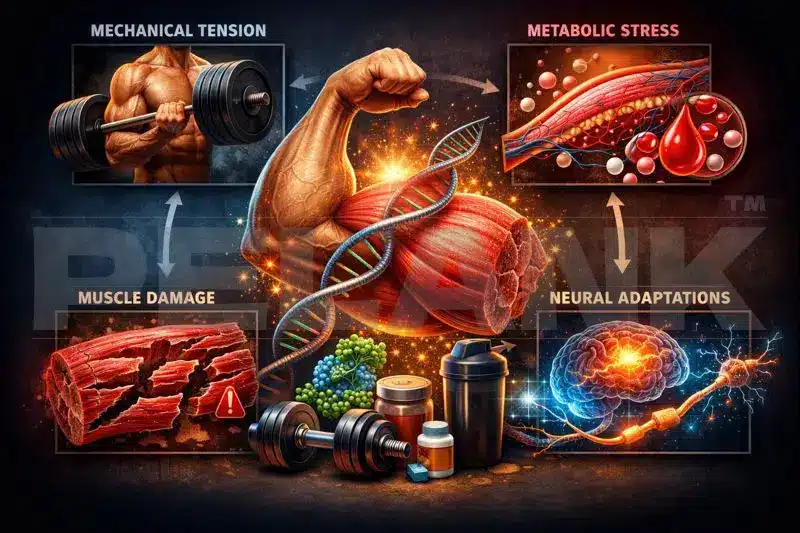
📌 In scientific literature, three common pathways are used to explain muscle growth: mechanical tension, metabolic stress, and muscle damage. In practice, however, the most important factor you can precisely control and progressively increase over time is effective mechanical tension.
✅ What Is Mechanical Tension—and Why Is It the “King”?
Mechanical Tension
🏗️ Mechanical tension means forcing a muscle to produce force under load, through an appropriate range of motion, with repeatable technique. This is the signal most strongly associated with long-term, sustainable growth.
📏 Tension is not just “heavy weight”; it’s a combination of load, range of motion, control, and a logical proximity to failure in your working sets.
🎛️ A practical measure of mechanical tension is your ability to improve one of the following week to week—while keeping form consistent: weight, reps, or the quality of hard reps.
✅ Metabolic Stress and Muscle Pump
Helpful—or Just a Good Feeling?
🩸 Metabolic stress refers to local fatigue and the buildup of metabolic byproducts inside the muscle, usually accompanied by a pump and burning sensation during moderate to high reps.
💥 Evidence suggests this factor can be supportive, especially when used to increase tolerable training volume, but it usually does not replace mechanical tension.
🧾 The practical takeaway is to view the pump as a sign of engagement, not proof of growth—because you can have an amazing pump while numerical progress and set quality go nowhere.
🩹 Muscle Damage
How Much Is Necessary—and How Much Is Risky?
🚑 Muscle damage refers to micro-tears that occur especially with new exercises, high volume, or an emphasis on the eccentric phase, and it can be accompanied by delayed-onset muscle soreness (DOMS).
⚠️ The more modern view is that high levels of damage are not required for growth and can even slow progress by reducing the quality of subsequent sessions; growth can occur with minimal damage if the stimulus and consistency are right.
🧊 The practical takeaway is that your training should be repeatable—meaning you train in a way that allows you to continue with high quality next week, not wipe yourself out for several days with one session.
🧠 The Role of the Nervous System in Strength and Load Control
Neural Adaptations
⚡ Early in the training journey, a significant portion of strength gains comes from neural adaptations: better motor unit coordination, improved timing, and more efficient movement patterns.
🧭 Even for muscle growth, the nervous system matters—because better control and stability allow mechanical tension to land more precisely on the target muscle and make measurable progression easier.
🧬 Genetics and Muscle Fiber Type
Why Doesn’t Everyone Grow the Same?
🧩 Differences in how people respond to training are real; genetics, training history, sleep quality, stress levels, and even how sets are executed can cause two people on the same program to get different results.
🧵 Muscle fiber type (slow-twitch vs fast-twitch) can influence preferences for certain intensities and rep ranges, but for most people, smart programming can deliver excellent results even without knowing their exact fiber makeup.
🎯 The practical takeaway is to be data-driven instead of comparative: track real progress through repeatable performance records, form quality, and weekly volume trends, then adjust the program accordingly.
✅ In summary:
🏁 Muscle growth is most likely when you consistently apply sufficient mechanical tension over time, with tolerable volume and genuine recovery.
🔍 Metabolic stress can be a useful supplement, but excessive damage usually increases recovery cost without offering a clear advantage.
🧠 If you had to track only one metric, it should be measurable progression with consistent form.
📚 References for this section: [s1] [s2] [s3] [s4] [s5] [s6] [s7] [s8]
Golden Principles of Bodybuilding Training
Non-Negotiable Rules
✅ Training Volume (Volume)
What Is an Effective Set? How Many Sets per Week Are Enough?
🧾 An “effective set” is one that truly challenges the target muscle; warm-up sets, very light sets, or loose, low-effort sets usually don’t count.
🎯 For hypertrophy, most working sets are most effective when they reach close to failure (not necessarily all the way to absolute failure).
🧱 A safe starting range for most people: about 6–10 effective sets per muscle per week (then gradually increase).
📈 A common range for solid growth (depending on experience and recovery): about 10–20 effective sets per muscle per week.
🪜 If your progress is good, there’s no need to increase volume; only raise volume when growth or strength stalls despite maintaining quality.
🧩 Count compound movement sets intelligently; for example, the bench press is “primary” for chest but also contributes to triceps (don’t count every set as 100% for every muscle).
🧯 If increasing sets leads to joint pain, poor sleep, or declining performance, you’ve exceeded your recovery capacity and should reduce volume or improve its distribution.
✅ Intensity
%1RM, Set Difficulty, Proximity to Failure (RIR/RPE)
🎛️ “Intensity” has two forms: load relative to your max (%1RM) and the actual difficulty of the set (how close you are to failure).
🧠 For muscle growth, you don’t need to lift heavy all the time; a wide range of rep schemes can build muscle—as long as the sets are truly challenging.
🧱 Simple practical rule: perform most main sets with about 0–3 reps in reserve (RIR) so they drive growth while remaining repeatable.
⚠️ Treat training to absolute failure as a tool, not a rule; use it mainly for final sets, isolation exercises, or short phases to avoid excessive systemic fatigue.
🔍 If you use RPE: most hypertrophy sets typically fall around RPE 7–9 (not constantly at RPE 10).

✅ Frequency
How Many Times per Week Should You Train Each Muscle?
🔁 Frequency means how many times each muscle is trained per week, not just how many sessions you train.
🧭 For most people, training each muscle twice per week is a very solid and sustainable starting point because it spreads volume better and keeps set quality higher.
📌 If your weekly volume is high (for example, more than 14–16 sets for a muscle), splitting it across 2–3 sessions is usually more logical than cramming it into one day.
🧊 If you’re very new or extremely time-constrained, even once per week can produce results—but you’ll usually hit your progress ceiling sooner.
✅ Tempo
Slow Eccentrics, Pauses, Control—When and Why?
🎬 Tempo refers to the rhythm of each rep: lowering (eccentric), pause, lifting (concentric), pause.
🧊 Controlled eccentrics (for example, about 2–4 seconds) are often a safe and effective choice; they increase tension while helping maintain proper form.
⚡ Perform the concentric phase powerfully but under control; the goal is not to throw the weight, but to produce force along the correct path.
🧷 Short pauses at key positions (such as the bottom of a squat or the chest in a bench press) can reduce cheating and improve rep quality.
🚫 Extremely slow, showy tempos (very long reps) usually increase fatigue without providing clear additional benefits for growth.
✅ Range of Motion (ROM)
Is Full Range of Motion Always Best?
📐 In most exercises, a controlled full range of motion is an excellent default choice because it distributes work across more muscle lengths.
🧩 Full ROM should not be “pain-driven”; if you experience joint pain at a certain point, adjust the range intelligently so stress stays on the muscle—not the joint.
🧲 Partial ranges can be useful tools (for example, when you want to overload a specific portion of the movement), but they shouldn’t permanently replace full ROM.
🦴 Golden rule: choose a range of motion that is safe, repeatable, and allows for measurable progression.
✅ Progressive Overload
The Most Precise Ways to Progress
🪙 Progressive overload means forcing the body to adapt to slightly more than before; without progression, the body has no strong reason to grow.
🧮 The simplest progression model: increase reps first, then once you reach the top of the range, add a small amount of weight (double progression).
🧰 Progression methods aren’t limited to weight; increasing effective sets, improving range of motion, improving control, or reducing rest time can also create overload.
📒 Progression must be tracked; if you don’t write numbers down, you’ll usually end up spinning your wheels and slowing progress.
🛠️ When you stall, check these before changing your entire program: form quality, true RIR, sleep, calories/protein, and weekly volume distribution.
🧊 Deloads (planned reductions in volume or intensity) are a pro-level tool to dissipate accumulated fatigue and restart progress.
📚 References for this section: [s4] [s5] [s9] [s10] [s11] [s12] [s13]
Exercise Selection in Bodybuilding
Which Exercises Actually Deliver Results?
🧭 Exercise selection means deciding which movement patterns and which tools and angles will produce the highest return for your goal—not just stacking popular exercises together.
🔎 The best choices are exercises that allow measurable progression, fit your body (no joint pain), and remain repeatable over time.
✅ Compound vs Isolation
The Role of Each in Muscle Growth
🏗️ Compound exercises (such as squats, presses, and rows) are usually the backbone of a program because they train large amounts of muscle in less time and make progression easier to track.
🧪 Research evidence shows that when overall training conditions (like effort and volume) are well managed, both compound and isolation exercises can contribute to muscle growth, and the differences are often context-dependent, not absolute.
🎯 Isolation exercises (such as biceps curls, lateral raises, and cable triceps work) are the best tools for targeted hypertrophy, filling weak points, and training muscles that receive less stimulus in compound movements.
🧷 The golden combination for most people is: a few compound movements as the core, plus 2–4 isolation exercises for finishing and precise targeting—especially if you’re aiming for symmetry and detail.
⏳ If time is limited, compounds always take priority; if you have the time and recovery capacity, isolation work can elevate result quality (without endlessly loading compounds heavier).

✅ Machines vs Dumbbells vs Barbells
Which One Is Better—and When?
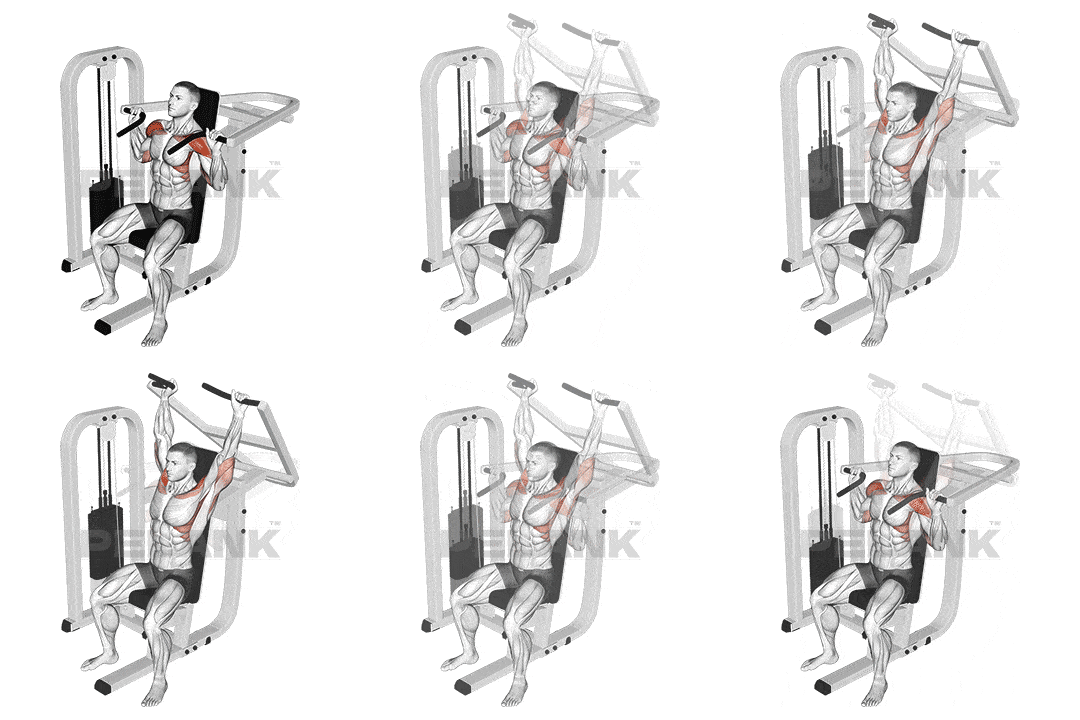
🧱 Machines are often excellent for hypertrophy because they provide a more stable movement path, make training close to failure safer, and reduce unwanted joint stress—especially in later sets.
🎛️ Dumbbells offer greater freedom of movement and are very useful for correcting left–right imbalances and finding joint-friendly paths, but they’re often limited by stability and fine-grained load progression.
🧲 Barbells are powerful overload tools for certain lifts (like squats, deadlifts, and bench press), but if your body doesn’t tolerate a fixed bar path well, you may hit joint or technical limits sooner.
📚 Overall evidence summary: at the level of muscle growth, there is rarely a consistent, absolute superiority of one tool over another; differences tend to show up more in strength testing specificity and ease of pushing hard.
🧩 Practical choice: if hypertrophy is your goal, choose the tool that allows you to maintain consistent form, high effort, and measurable week-to-week progression.
✅ Essential Movement Patterns
Squat, Hip Hinge, Push, Pull, Lunge, Core
🧱 To build a well-developed body without structural weaknesses, your program should cover these movement patterns—not just exercise names.
🪑 Squat pattern (knee-dominant): squats, leg press, front squats, forward lunges.
🧲 Hip hinge pattern (hip-dominant): Romanian deadlift, hip thrust, good morning, back extension.
🏹 Horizontal push: barbell/dumbbell bench press, machine press, push-ups.
🧗 Horizontal pull: dumbbell/barbell rows, seated cable row, T-bar row.
🛰️ Vertical push: overhead press, shoulder press machine, landmine press.
🧗♂️ Vertical pull: pull-ups, lat pulldown, cable pullover.
🛡️ Core: anti-extension (planks/ab wheel), anti-rotation (Pallof press), carries (farmer carries) for true stability.
✅ Muscle Balance and Imbalance Prevention
Imbalance
⚖️ Imbalances usually come from omitting a movement pattern or overemphasizing one family of exercises—for example, lots of pressing with insufficient pulling, or quad-dominant training without adequate hamstring and glute work.
🧯 Simple upper-body rule: keep pulling volume at least equal to pressing volume (and if your shoulders are sensitive, slightly more is often beneficial).
🧠 For healthy shoulders, pressing alone isn’t enough; the scapular muscles and rotator cuff need dedicated work as well (controlled rows, face pulls, precise light external rotations).
🧩 For balanced lower-body development, always include a serious hip hinge alongside squats, and don’t remove single-leg work for proper hip and knee control.
📌 60-second checklist: if you press → pull as well; if you squat → hinge as well; if you train bilateral → include unilateral; if you build the front → build the back too.
📚 References for this section: [s14] [s15] [s16] [s17]
Bodybuilding Programming
From Beginner to Advanced
🧩 Programming means intelligently arranging volume, intensity, frequency, and exercise selection so you grow, stay repeatable, and avoid burnout.
📌 The core rule is this: as your level increases, fatigue management becomes more important than simply adding more training.
🎯 The goal of a good program isn’t to destroy you today; it’s to make you stronger, more muscular, and more consistent 12 weeks from now.
✅ Beginner Program
Minimum Effective Dose + Fastest Safe Progress
🟢 A beginner is someone whose technique isn’t yet consistent and whose body responds very quickly to training; therefore, the best program is simple, repeatable, and progressive.
🧱 A beginner’s main focus should be: learning movement patterns, building habits, and achieving numerical progression with consistent form (not excessive variety).
🧮 Recommended starting volume for most beginners: about 6–10 effective sets per muscle per week (low, but high quality).
🎚️ Set intensity/difficulty: perform most sets at around RIR 2–3 to protect technique and make recovery easier.
⏳ Practical rep ranges: mostly 6–12 for main lifts and 10–20 for isolation exercises (with control).
📅 Best frequency for beginners: full-body 3 days per week, or full-body 2 days + one light/corrective day.
📝 Simplest progression model: within a rep range (for example, 8–12), increase reps first; once the top is reached, add a small amount of weight (double progression).

🧪 Sample Beginner Program Skeleton (3-Day Full Body):
Day A | Day B | Day C |
|---|---|---|
Squat / Leg Press | Hip Hinge (RDL) | Repeat Day A or B with lower volume / more control |
Bench Press | Overhead Press | Light isolation work for shoulders/arms |
Rowing Movements | Lat Pulldown / Pull-Ups | |
Core | Lunges |
🛡️ Beginner red flag: if you change too many exercises every session, the body never gets the chance to solidify skills and achieve real progression.
✅ Intermediate Program
Managing Volume, Weak Points, and Smart Variation
🟡 An intermediate lifter is someone who no longer hits big PRs every week but can still make significant progress with proper programming; at this stage, volume and fatigue management win the game.
📊 Typical growth-friendly volume for intermediates often falls in the range of 10–20 effective sets per muscle per week (depending on the muscle, goals, sleep, and nutrition).
🧠 One of the best moves at the intermediate level is to view training in mesocycles: 4–6 weeks of focused work followed by a lighter week or deload.
🧷 Smart variation means small, calculated changes—adjusting press angles, rowing variations, or swapping one exercise to reduce joint stress—not overhauling the entire program every week.
🎯 This stage is ideal for addressing weak points: if your lateral delts lag or your back is underdeveloped, add targeted volume there and reduce volume elsewhere.
🗂️ Very effective splits for intermediates: upper/lower 4 days per week or PPL 5–6 days per week, with better volume distribution and set quality.
📒 Golden rule for intermediates: if you’re going to increase volume, first make sure set quality (true RIR, control, range of motion) stays consistent—otherwise, you’re just buying fatigue.
🧱 Sample Intermediate Program Skeleton (4-Day Upper/Lower):
Upper Body 1 | Lower Body 1 | Upper Body 2 | Lower Body 2 |
|---|---|---|---|
Horizontal Press | Squat-Dominant | Vertical Press | Hip-Hinge Dominant |
Horizontal Pull | Calves | Vertical Pull | Hamstrings |
Shoulders / Isolation | Core | Triceps / Biceps | Glutes |
✅ Advanced Program
Periodization, Blocks, Specialization
🔵 Advanced trainees usually need more precise stimuli to grow, because their bodies have adapted to basic volume and intensity, and progress slows down.
🗺️ Periodization means dividing training into targeted phases—for example, a hypertrophy-focused phase, followed by an intensity-focused phase, and finally a stabilization/recovery phase.
🧱 Blocks typically follow this logic:
- 📦 Accumulation: higher volume, moderate intensity, focus on muscle growth and work capacity
- ⚙️ Intensification: lower volume, higher intensity, focus on strength and muscle retention
- 🧊 Deload / Resensitization: reducing fatigue and preparing for the next training wave
🎛️ At the advanced level, autoregulation becomes very important: adjusting effort and volume based on sleep, stress, joint status, and weekly performance—not just what’s written on paper.
📈 Specialization means that over a 6–10 week period, you deliberately push one or two muscles forward with targeted volume increases while keeping other muscles at maintenance.
🧾 Sample 12-Week Advanced Roadmap (highly practical and executable):
- 🧱 Weeks 1–4: Volume-focused (more sets, higher RIR)
- 🏋️ Weeks 5–8: Intensity-focused (heavier weights, fewer sets, closer RIR)
- 🧊 Week 9: Deload
- 🎯 Weeks 10–12: Specialization (high volume for target muscle, maintenance for the rest)
✅ Standard Split Types
Full Body | Upper/Lower | PPL | Bro Split
🧍 Full Body (2–3 days): the best option for beginners and those with limited time; good frequency, fast learning, and lower fatigue risk.
🏗️ Upper/Lower (4 days): an excellent balance between volume and frequency; suitable for intermediates and even busy advanced lifters.
🔧 PPL (5–6 days): ideal for those with good recovery and enough time; spreads high volume more easily, but becomes quickly fatiguing if sleep or nutrition is poor.
🎭 Bro Split (one muscle per day): can work for some advanced lifters seeking very high volume for a single muscle, but for most people it usually leads to lower frequency and slower progress compared to twice-per-week models.
🧠 The criterion for choosing a split isn’t whether it looks “cool”; it’s whether you can maintain measurable week-to-week progression with it.
🔁 Deload and Planned Recovery
When Is It Needed?
🧊 A deload is a short phase (usually 4–7 days) where you reduce accumulated fatigue so you can return to training with high quality.
📉 A deload becomes necessary when the following signs appear across multiple sessions: declining performance, poor sleep, unusual joint pain, reduced motivation, or a constant feeling of heaviness.
🛠️ The simplest deload model: reduce volume by 30–50% and keep intensity moderate (either the same weights with fewer sets, or the same sets with more reps in reserve).
🧯 A deload should not turn into “time off”; its goal is to maintain movement patterns while dissipating fatigue—not to reset everything to zero.
📅 For many people, a deload every 4–8 weeks makes sense; however, if you’re new or not training with very high volume, it may be needed less often.
📚 References for this section: [s4] [s9] [s10] [s13]
Bodybuilding Nutrition
Muscle Is Built with Food
🧭 Successful bodybuilding stands on three pillars: proper training, sufficient recovery, and nutrition that is measurable.
🧱 If your training is excellent but calories and protein are not properly set, your body either lacks the raw materials to build muscle—or loses muscle during a cut.
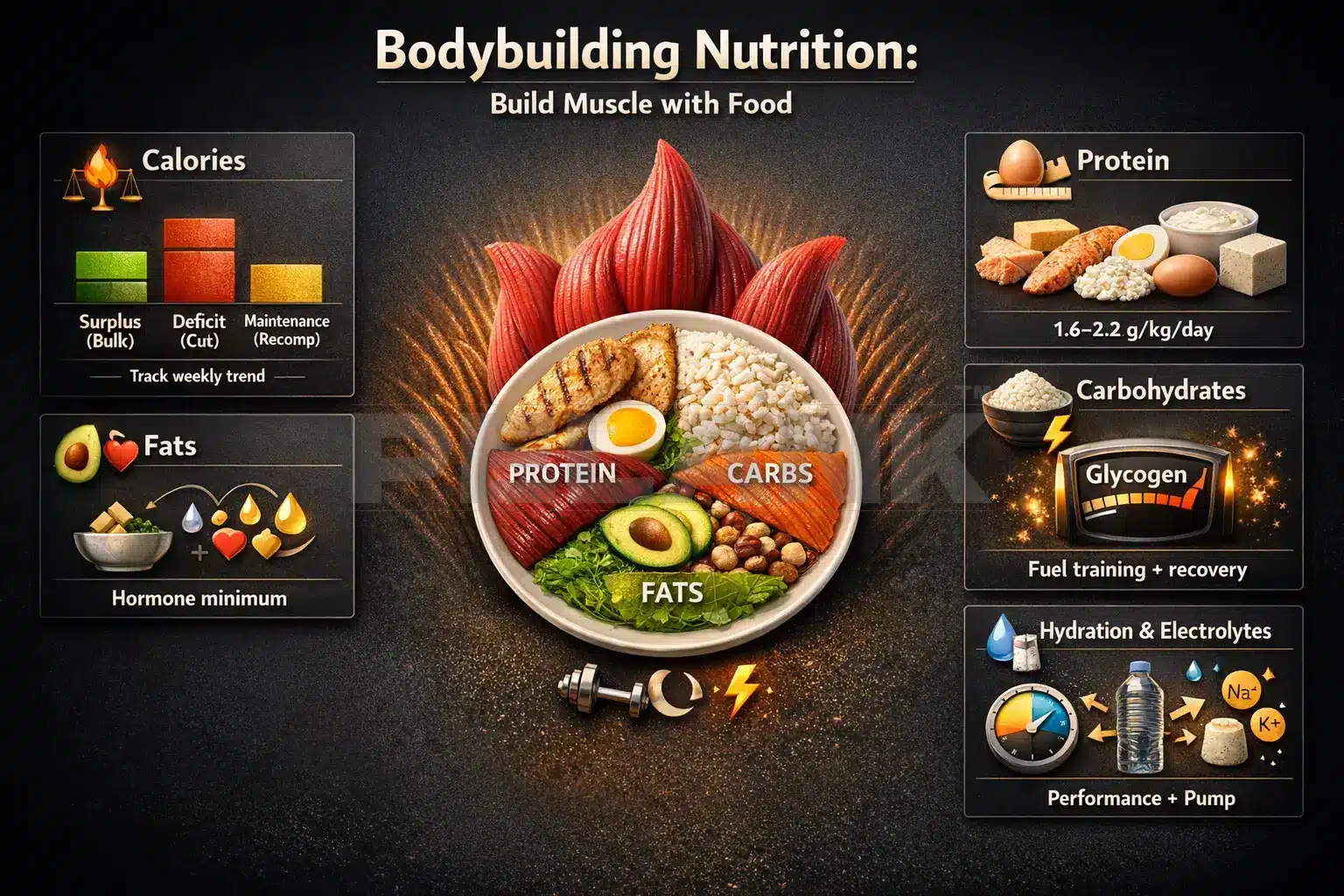
🔥 Calories
Surplus for Bulking, Deficit for Cutting, Balance for Recomposition
🧮 Calories are the primary driver of changes in body weight and body composition; after that, macro quality and distribution fine-tune the outcome.
📈 For a clean bulk, a small surplus is usually better than a large one because it limits unnecessary fat gain.
📉 For a successful cut, a reasonable deficit is better than an aggressive one because it preserves training performance and muscle mass.
🎯 Suggested starting points (adjust as needed):
🟢 Bulking: about 5–10% above maintenance
🟠 Cutting: about 10–20% below maintenance
⚖️ Recomposition: near maintenance, with a focus on high protein and progressive training
📊 Best tracking metrics: weekly average body weight + waist circumference + training performance (not single-day scale weight).

🥚 Protein
Exact Intake, Meal Distribution, Source Quality
🧪 Protein is the most important macro for building and preserving muscle, especially when training volume is high or during a cut.
📏 Practical range for most trained individuals:
🧷 Bulking/Recomp: about 1.6–2.2 g per kg of body weight per day
🧷 Hard cut: usually closer to the upper end (and sometimes higher) to reduce muscle loss risk
🍽️ Spreading protein intake across meals is generally better than consuming it all at once, because it stimulates muscle protein synthesis multiple times per day.
🕒 Simple, practical approach: 3–5 protein-rich meals per day, each with a meaningful dose.
🥩 Source quality means choosing proteins that are both highly digestible and more complete in amino acid profile; combining plant sources can also work if total intake and variety are properly managed.
🍚 Carbohydrates
Training Fuel and Glycogen Recovery
⚡ Carbohydrates are the primary fuel for high-intensity, hypertrophy-focused training and help you produce more high-quality sets.
🔁 When carbohydrate intake is sufficient, recovery between sessions improves and performance drops are less likely.
📌 If your training is heavy and high-volume, carbohydrate deficiency often shows up as reduced pump, fewer reps at the end of sets, and lower overall session quality.
📈 Adjust carbohydrates practically based on training volume: more on harder days, less on lighter days.
🥑 Fats
Hormones, Health, and Essential Minimums
🧠 Fats are important for overall health, absorption of certain vitamins, and normal body function, but in bodybuilding they usually rank third in priority after protein and total calories.
📉 Excessively lowering fats (especially during long cutting phases) can worsen recovery and overall well-being and reduce adherence.
📌 A safe starting point for most people: keep fat intake at a moderate, stable level, and create deficits or surpluses primarily through carbohydrates (to preserve training performance).
⏰ Nutrient Timing
How Important Is Pre/Post-Workout Timing—Really?
🧩 The most important factor is total daily calories and protein; timing mainly serves as optimization, not a magic solution.
🏋️ Pre-workout, a combination of protein and carbohydrates helps provide energy and maintain set quality.
🧱 Post-workout, the main goal is to get sufficient protein and appropriate carbohydrates within the next few hours to support recovery and improve the next session.
🛌 If you want one simple optimization, the most consistent option is spreading protein intake across the day and placing at least one protein-rich meal close to your training window.
💧 Water and Electrolytes
Pump, Performance, and Preventing Training Drop-Off
🚰 Even mild dehydration can reduce performance and exercise tolerance while increasing perceived fatigue.
🧂 Electrolytes (especially sodium) are important for maintaining blood volume, muscle contraction, and preventing performance drops during sweaty training sessions.
⚖️ The best practical way to personalize hydration: check body weight before and after training and adjust fluids so significant weight loss doesn’t occur.
🌡️ In hot conditions or during long sessions, plain water alone may not be enough, and adding electrolytes can make a noticeable difference in training quality.
📚 References for this section: [s18] [s19] [s20] [s21] [s22] [s23] [s24]
Bodybuilding Supplements
Reality vs Marketing
🎯 First, lock in this rule: supplements are enhancers, not replacements—if calories, protein, sleep, and programming aren’t dialed in, even the best supplements are just wasted money.
🧭 A professional approach to supplements means: a supplement only earns a place if it solves a real problem (protein gaps, performance drops, vitamin deficiencies, poor recovery…).
🧾 The golden filter before buying: measurable effect? effective dose? safety? cost-to-benefit value?
🧱 Creatine: Why It’s the Best Supplement in the World
Dosage, Timing, Safety
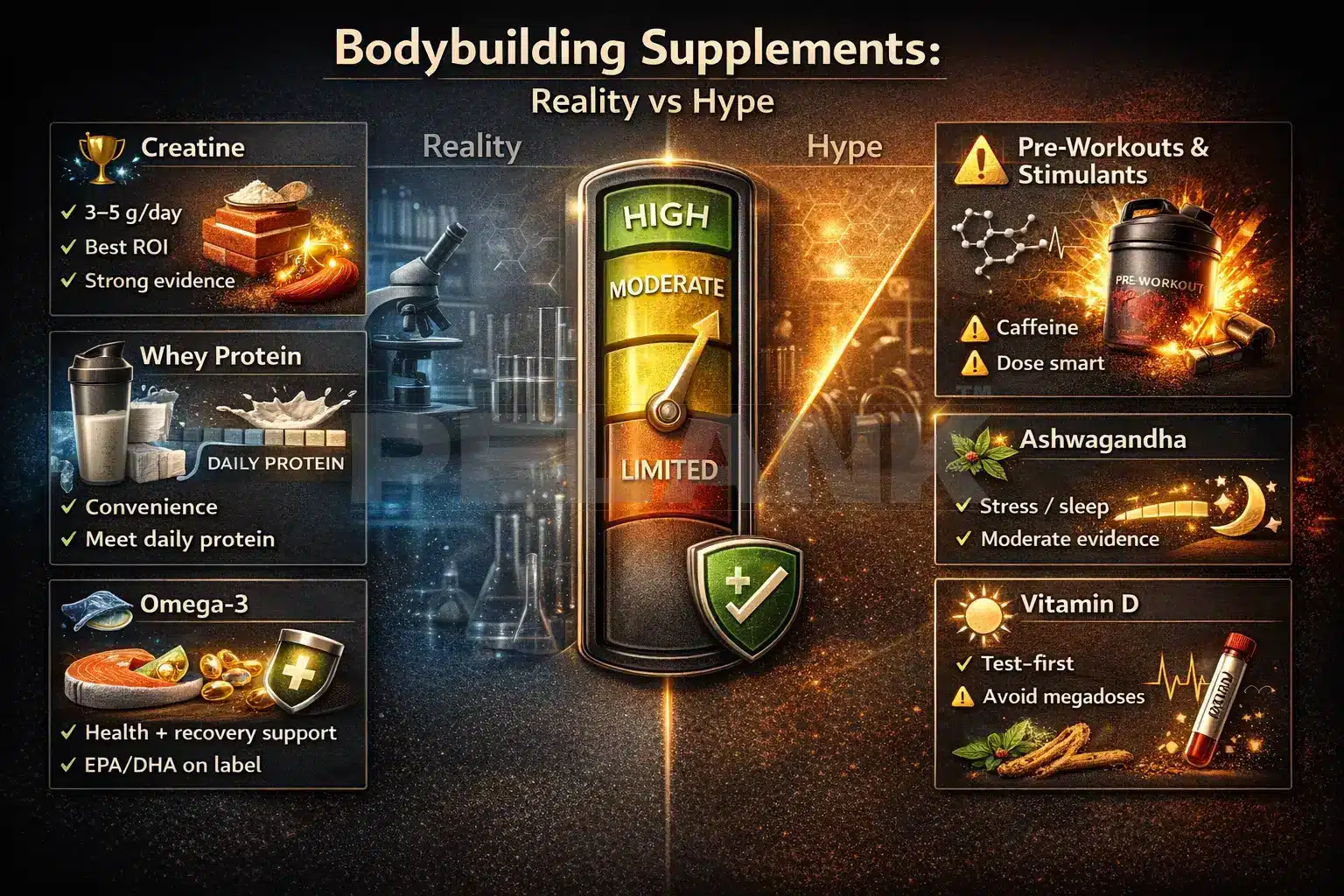
🧱 Creatine monohydrate is one of the very few supplements that delivers clear practical benefits (strength, power, training volume), has excellent cost-effectiveness, and is backed by extensive research.
⚡ Its practical mechanism is increasing phosphocreatine stores, helping you produce a few higher-quality reps during short, hard sets; over time, that extra “quality” turns into growth.
🧮 Simple, standard dose: 3–5 grams per day (every day, including rest days).
🚀 If you’re in a hurry: a “loading phase” is typically 20 grams per day for 5–7 days (split into 4 doses), then drop to 3–5 grams; however, loading isn’t required—you’ll reach the same saturation point with consistent daily intake.
⏱️ Timing: for long-term effects, timing isn’t very critical; what matters is daily consistency (you can take it with meals or around training for routine convenience).
⚠️ Safety notes: generally reported as safe in healthy individuals, but if you have kidney disease, underlying medical conditions, or take specific medications, it’s best to consult a physician first.

🥛 Whey Protein: When It’s Necessary vs When It’s Just Convenience
🥛 Whey is a convenience tool: if you can meet your daily protein needs through whole foods, whey isn’t mandatory; but if you can’t, it’s one of the easiest ways to close the gap.
📏 Practical starting point: for most bodybuilders, reaching about 1.6–2.2 g of protein per kg of body weight per day makes sense; whey simply helps make that number practical.
🧩 Common, effective dose: 20–40 grams of whey per serving, depending on daily needs and the size of other meals.
🧠 Timing: if total daily protein is adequate, timing is mainly an optimization factor; whey post-workout is just a convenient option, not a magic solution.
🧬 Product selection: if you’re lactose intolerant, whey isolate is usually better tolerated; if you have a milk protein allergy, whey is not a good choice.
✅ Clean-buy rule: choose a product with a transparent label and preferably third-party testing (such as NSF, Informed Choice, or USP).
🐟 Omega-3: Recovery and Joint/Inflammation Health
🐟 Omega-3s (EPA/DHA) are more of a health-focused supplement with potential effects on inflammation and recovery than a “rapid muscle-building” supplement.
🧊 Regarding muscle soreness and post-workout recovery, research findings are mixed; some show minimal or uncertain effects while others suggest benefits in specific contexts—so don’t expect miracles for DOMS.
🧾 Common practical dosage: many protocols revolve around 1–2 grams of combined EPA + DHA per day (not “1000 mg fish oil”; what matters is the EPA/DHA amount on the label).
🦴 If your concern is joints, tendons, mild chronic inflammation, or general health, omega-3 makes more sense than taking it purely for pump or muscle gains.
⚠️ Caution: if you’re taking blood thinners or have upcoming surgery, be sure to check with a physician.
☀️ Vitamin D: Who Actually Needs It
Testing, Dosage, Red Lines
☀️ Vitamin D is a targeted supplement, not a universal one; the best decision is based on a 25(OH)D blood test, not guesswork.
🧪 People at higher risk of deficiency include those with limited sun exposure, darker skin, living at higher latitudes with low sunlight, overweight individuals, or a history of deficiency.
📌 Common daily doses for maintenance or mild correction typically fall in the 1,000–2,000 IU range, but treating a true deficiency may require higher short-term doses, ideally under supervision.
🧯 Safety red line: high and long-term intake without testing can lead to hypercalcemia and serious complications; here, “more = better” is dangerous.
🥑 Absorption tip: it’s usually better absorbed when taken with a meal that contains fat.
🌿 Ashwagandha: Stress, Sleep, Performance
How Strong Is the Evidence?
🌿 Human studies suggest ashwagandha may improve certain markers of performance/strength, stress, and sleep, but its effects are generally moderate and depend on product quality, dosage, and duration.
🌙 If your main issue is sleep or stress, ashwagandha may indirectly support training because better sleep = better recovery.
🧪 Typical study dosage: often around 300 mg twice daily (about 600 mg total) of a standardized extract for several weeks.
⚠️ Serious cautions: not recommended during pregnancy or breastfeeding; may interact with certain medications (especially thyroid-related or sedatives); and rare cases of liver issues have been reported—so brand quality and medical history matter.
✅ If you choose to use it, look for a standardized extract with clearly defined specifications (such as active compound percentages) from a reputable brand.
⚠️ Pre-Workouts and Stimulants
Benefits, Risks, and Red Lines
⚡ The reality is that in most pre-workout products, the primary active ingredient is caffeine; the rest of the ingredients are sometimes helpful, sometimes just label decoration.
⏱️ An effective caffeine dose for many people is about 3–6 mg/kg, taken roughly 60 minutes before training; very high doses usually increase side effects without providing extra benefit.
🧨 The real benefit of stimulants is increased alertness, reduced perception of fatigue, and improved set quality—especially on heavy days or when energy is low.
🌙 The main risk is sleep disruption; if sleep suffers, the entire growth cycle takes a hit, even if the workout itself felt better.
🚫 Common red lines: severe anxiety, heart palpitations, uncontrolled blood pressure, combining multiple caffeine sources (coffee + energy drinks + pre-workout), or taking high doses late in the afternoon/evening.
🧾 Label-reading tip: avoid products with vague “proprietary blends” and unclear caffeine amounts; you should know exactly how many milligrams of caffeine you’re consuming.
✅ In summary:
🥇 If you only want two supplements with the highest return: creatine + (if needed) whey to help meet protein intake.
🥈 If your goal is session performance and your sleep allows it: targeted caffeine (not every day, not uncontrolled).
🧩 If you have a real deficiency or need: vitamin D based on testing, omega-3 for health/inflammation, and ashwagandha for sleep/stress (with caution and reputable brands).
📚 References for this section: [s18] [s19] [s25] [s26] [s27] [s28] [s29] [s30] [s31]
Recovery in Bodybuilding
The Hidden Driver of Real Growth
🧩 Muscle growth starts in the gym, but it’s completed outside the gym; if recovery is poor, even a great program turns into fatigue instead of growth.
📌 The professional standard for recovery isn’t simply “not feeling tired”; it’s the ability to maintain set quality, measurable progression, and joint health week after week.
🛌 Sleep: The Most Important “Supplement” in Bodybuilding
Quantity + Quality
🌙 Sleep is where a large portion of tissue repair, regulation of appetite- and recovery-related hormones, and consolidation of neural adaptations take place.
⏳ For most bodybuilders, a practical and sustainable target is usually around 7–9 hours of sleep per night—but quality matters just as much as quantity.
🧠 When sleep is short or fragmented, these are usually the first things to decline: focus, tolerance for hard final sets, motivation, and joint recovery.
🔧 Simple but effective optimizations: consistent bedtime, reduced light exposure late at night, cutting caffeine several hours before sleep, and a cool, dark room.
📉 Signs of sleep deprivation in training: clear performance drops, higher RPE at familiar loads, and longer recovery times between sessions.

🧘 Mobility and Warm-Ups
Injury Prevention and Performance Enhancement
🔥 The goal of a warm-up isn’t “breaking a sweat”; it’s preparing the nervous system and joints to produce force through the correct movement paths.
🧭 A good warm-up usually has three layers: raising body temperature, specific activation (such as scapular or hip work), and ramp-up sets for the main movement.
🧘 Mobility has real value only when it improves your movement, not when it just fills training time—meaning you work on the joint or pattern that is actually limiting you.
🛠️ Practical rule: if a limitation is compromising your form or range of motion, targeted mobility can improve set quality and, as a result, create more effective tension.
⚠️ Long static stretching immediately before heavy sets is usually not the first choice; for many people, dynamic and more specific warm-ups work better.
🧠 Stress and Cortisol
Why Some People Regress with “More Training”
🌪️ The body doesn’t perceive stress as only “psychological”; heavy training, lack of sleep, aggressive dieting, high job stress, and even calorie deficits all add up and increase recovery cost.
📉 When total stress is high, tolerance for training volume drops, and instead of growth, signs like performance decline, insomnia, joint pain, and loss of motivation appear.
🧯 A common mistake is increasing training volume during high-stress periods; the smarter move is usually to temporarily reduce volume, maintain quality, and prioritize sleep and nutrition.
🧭 Practical rule: when life stress rises, your program must become flexible—this is exactly where deloads and autoregulation matter.
🦴 Joints, Tendons, and Connective Tissues
Building Muscle Without Breaking the Body
🦴 Muscle typically adapts faster than tendons and connective structures; if load and volume increase much faster than joint tolerance, chronic pain tends to follow.
🔩 Tendons tend to adapt better to regular, gradual, and repeatable loading than to sudden spikes and unplanned PRs.
🧰 Golden rules for long-term durability: choose exercises that fit your body, use controllable ranges of motion, maintain consistent technique, and manage fatigue (not fight through pain).
🧯 If a joint starts hurting, you usually need to adjust these four levers: volume, range of motion, exercise/angle selection, and proximity to failure.
📌 Pro-level message: real bodybuilding means years of high-quality training; a program that abuses the joints will eventually kill progress too.
📚 References for this section: [s32] [s33] [s34]
Injuries and Pain in Bodybuilding
What’s Normal—and What’s a Warning?
🧠 The difference between pros and everyone else isn’t that they don’t feel pain—it’s that they know which sensations are normal and which mean the path needs correction so progress can continue.
😬 Muscle Soreness (DOMS)
Not Helpful—Just a “Signal”
🕒 DOMS usually begins 12–24 hours after training, peaks around 24–72 hours, and then gradually fades.
🎯 Having DOMS does not mean you trained well or grew more; it simply indicates a novel stimulus or an increase in eccentric stress or volume that the body hasn’t fully adapted to yet.
🧊 Proper DOMS management means temporarily reducing intensity or volume for 1–2 sessions, keeping the movement with lighter loads, and prioritizing sleep and nutrition so the quality of upcoming sessions isn’t compromised.
🧷 If you chase severe soreness every session, your program usually becomes unsustainable; the goal of bodybuilding is repeatable, progressive training, not muscle destruction every workout.
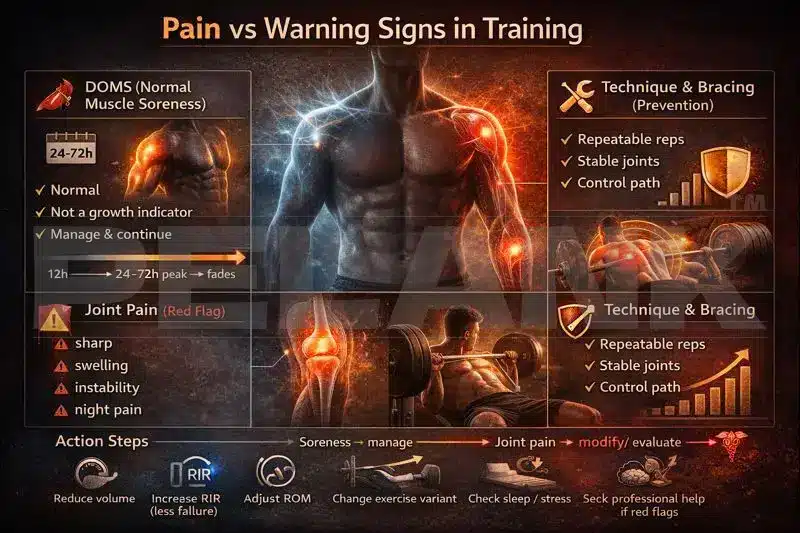
🚨 Joint Pain: Why It Matters and What to Fix
🛑 Joint pain is usually a warning sign—especially if it’s sharp, burning inside the joint, associated with locking, instability, or progressively worsening; don’t confuse this type of pain with muscle soreness.
🪛 The first standard fixes usually come from adjusting four levers: reducing volume, reducing proximity to failure, modifying range of motion, or changing exercise angle and equipment.
📉 If a specific exercise triggers pain, train the same muscle with a joint-friendly substitute so progress doesn’t stall—for example, swapping barbell presses for dumbbells or machines, or changing grip and angle.
🧪 Tendon-related pain often responds better to gradual loading and program consistency than to extreme changes or sudden weight jumps; instead of fighting pain, adjust load intelligently and slow progression.
🧭 If pain is present at rest, worsens at night, shows clear swelling or warmth, causes numbness or tingling, or leads to sudden strength loss, a professional medical or physiotherapy evaluation is recommended.
🧰 Technique and Form Principles: Movement Path, Bracing, Scapular and Pelvic Stability
🧱 Good form means reps are repeatable; loose, unstable sets usually increase joint stress while reducing effective tension on the target muscle.
🧿 In upper-body movements, scapular control is critical; when the shoulder blades are loose or excessively protracted, the shoulder hits limitations sooner and pain risk increases.
🦵 In lower-body movements, controlling the pelvis and knees—and mastering proper squat and hip hinge patterns—determines whether stress loads the muscles or gets poorly distributed to the back and knees.
🎥 The best tool for spotting form breakdown is simple video from side and front angles; if form collapses in later sets, it usually means load, volume, or proximity to failure has outpaced your ability to control it.
✅ In summary:
🗒️ Muscle soreness can be normal, but the standard of proper training is sustainable progression without increasing joint pain; anything that threatens that path should be managed by adjusting the program—not by forcing more effort.
📚 References for this section: [s4] [s34] [s35] [s36] [s37]
Pelank Body Health Calculators
Pelank Life ©
🧭 Smart tools aren’t meant to replace knowledge; they’re meant to move decision-making from guesswork and feelings to numbers and logic.
🎯 The best way to use Pelank Tools is to update your data every 2–4 weeks and adjust your training and nutrition based on trends—not single snapshot numbers.
🧾 Daily Calorie (TDEE) Calculator and Smart Goal Setting
🔥 TDEE means the total calories your body burns in a day, accounting for activity, training, and basal metabolism.
📌 A good TDEE tool doesn’t just spit out a number; it should tell you what range makes sense for your goal (bulking, cutting, or recomposition).
📈 For a clean bulk, the goal is usually slow weight gain while maintaining training performance; if weight climbs too fast, you’re usually gaining excess fat.
📉 For a successful cut, the tool should help you set a deficit that lowers weight while preserving strength and set quality.
🧠 Practical tip: the best test of TDEE accuracy is real-world results—compare weekly weight trends to the suggested number and adjust by 5–10% if needed.
🥩 Daily Protein Requirement Calculator
Based on Goal and Body Weight
🥩 Protein is the number one tool for building muscle and preserving it during a cut.
📌 A good calculator should account for different goals—bulking, cutting, recomposition—and even training level.
🧾 What makes the output “professional” is not just giving a daily gram number, but also suggesting how to distribute it across meals (for example, 3–5 meals).
🧠 In practice, being close to your protein target is fine even with small day-to-day variation; the real problem is chronic underconsumption.
📉 Body Fat Percentage Calculator and Result Interpretation
📊 Body fat percentage gives a more accurate picture of your condition than scale weight alone, because in bodybuilding your weight may stay the same while your body changes.
📉 A good tool should provide not just a number, but interpretation: approximate ranges, implications for performance and health, and whether your current goal (cut or bulk) makes sense.
🧩 Most important point: measurement methods have error; tools should emphasize trends, not obsession over a single exact value.
🎯 Best practice: measure each time using the same method (same formula or measurements) so comparisons remain meaningful.
🏋️ 1RM Calculator and Load Progression Planning
🏋️ 1RM (one-rep max) helps you set training intensity more precisely without actually testing a true max every session.
📈 A good tool doesn’t just estimate 1RM; it also tells you what loads make sense for 3, 5, 8, or 10 reps when planning your program.
🧠 In bodybuilding, 1RM is more of a tool for controlling intensity and progression than an end goal—especially for compound lifts.
🧷 Key point: an estimated 1RM is only meaningful when reps are performed with standard form and recorded close to true effort.
💧 Daily Water Intake Calculator (Activity & Climate-Based)
💧 Adequate hydration means better training, better pumps, and less performance drop—especially during sweaty sessions or in hot weather.
🌡️ When temperatures are high or training duration increases, fluid and electrolyte needs rise and performance drops faster.
🧂 A professional tool should ideally account for electrolytes as well, at least for people who sweat heavily.
⚖️ Simple practical marker: if you lose a significant amount of weight during training or your urine is very dark, you likely need more fluids.
📌 BMI and Its Limitations in Bodybuilders
Why Is It Misleading?
📌 BMI only compares body weight to height and doesn’t distinguish whether that weight comes from muscle or fat; for muscular individuals, it can label them as “overweight” or even “obese” despite having low body fat.
🧩 For bodybuilders, BMI is more of a general indicator and should be used alongside better tools like body fat percentage, waist-to-height ratio (WHtR), and consistent photos or measurements.
🎯 The correct way to use BMI is as a broad signal—not as a primary decision-making metric in bodybuilding.
Common Bodybuilding Mistakes That Kill Results
🧠 Bodybuilding is less about “working hard” and more about working smart; many people genuinely put in the effort, but because they repeat a few common mistakes week after week, their results slow down—or stop entirely.
🎯 This section exists so you can quickly identify where you might be hitting the brakes before your time and energy are wasted.
🔥 High Volume Without Recovery = Stalled Growth
📦 High volume only drives growth when the body has time to adapt; if recovery falls behind, volume turns into chronic fatigue and declining performance.
🧊 Classic signs of volume beyond capacity: poor sleep, declining PRs, joint pain, loss of motivation, and a constant feeling of heaviness in training.
🧯 Practical fix: instead of adding more exercises and sets, first lock in set quality, distribute volume better across the week, and schedule a targeted deload every few weeks.
📈 Pro rule: if you’re progressing with less volume, there’s no need to increase it; only raise volume when you can no longer move forward with the same quality.
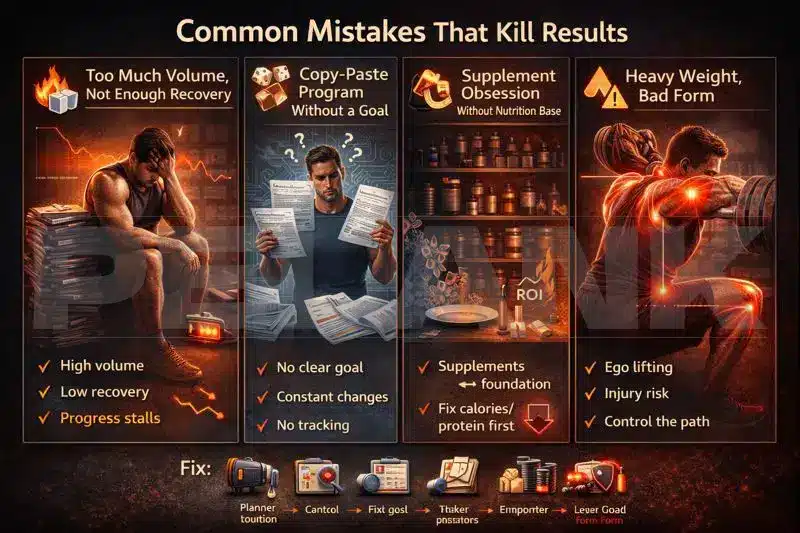
🎲 Copycat Programs Without a Goal = Confusion and Burnout
🧩 A program that worked for someone else won’t necessarily work for you; training level, recovery, lifestyle, and even body structure differ.
🧭 A goal-less program means not knowing what you’re pursuing right now—bulk, cut, recomp, or strength. When the goal is vague, exercise selection, volume, and nutrition become random too.
🌀 Signs of this mistake: the program changes every week, PRs aren’t tracked, and progress is defined only by “feel.”
🛠️ Practical fix: set an 8–12 week goal, keep a few key lifts consistent, and track progress with numbers (weight, reps, effective sets, waist measurement).
🥤 Supplement Overuse Without a Nutrition Base = Burning Money
💊 Supplements only make sense once calories, protein, and sleep are dialed in; otherwise, even the best supplements have minimal impact.
🥩 The most common failure scenario: low daily protein, inconsistent calories, poor sleep—then hoping powders and pills will compensate.
🧾 Practical fix: first lock in the numbers using tools (TDEE and daily protein), then use supplements only if there’s a gap (whey to complete protein, creatine for performance).
🏷️ Buying rule: if you can’t explain exactly what problem a supplement solves for you, you probably don’t need it.
🏋️ Heavy Weights with Poor Form = Guaranteed Injury
🎯 Heavy weight itself isn’t bad; the problem starts when load increases and the movement path breaks down, shifting stress from the target muscle to the joints and sensitive tissues.
🧰 A common mistake is letting cheating escalate so much in the final sets that training shifts from “bodybuilding” to “risk-building.”
🧱 Practical fix: keep one simple rule—if you can’t repeat the same movement next week with similar form, you took too much risk today.
🎥 The golden tool: film your heavy sets; if bracing collapses, range of motion is cut short, or control is lost, intelligently reduce weight or reps.
🛡️ A lasting rule: in bodybuilding, the real win is years of high-quality training—not a hype-driven PR that sets you back for months.
📚 References for this section: [s4] [s9] [s34] [s35] [s36] [s37]
A Practical Roadmap for Bodybuilding
What Should I Do Starting Today—Exactly?
🧩 This roadmap is designed to move you from information overload to precise action—minimal decision-making, maximum progress.
🎯 The overarching rule across all phases is the same: run a simple program so well that you’re forced to make it harder—rather than changing it every week.
🟢 Two-Week Start
Simple, Executable, No Confusion
🧱 The goal of these two weeks is to build three things: training habit, acceptable technique, and baseline data tracking.
📅 Recommended training plan: full-body, 3 sessions per week (for example, Saturday/Monday/Wednesday or Monday/Wednesday/Friday).
🏋️ Keep core movements fixed (always the same—just make them better): squat-dominant, hip-hinge–dominant, push, pull, core.
🎚️ Set intensity/difficulty: perform most sets around RIR 2–3 so technique doesn’t break down and the body adapts quickly.
📦 Training volume: about 6–10 effective sets per muscle per week is enough for now; don’t chase high volume yet.
📝 Data tracking: log body weight (weekly average), waist measurement, and key performance records (weight × reps).
🍽️ Minimal but correct nutrition: bring daily protein close to target and establish a consistent meal pattern.
💧 Recovery: prioritize sleep and keep training at a level you can repeat with the same quality in week two.

🟡 Eight-Week Path
Clear Progression + Data Tracking
🧭 The goal of this phase is real progression: more reps, more weight, or better quality with consistent form.
📅 Suggested training structure: 4 sessions per week (upper/lower) or 3 more advanced full-body sessions—whichever you can execute more consistently.
📌 Standard progression method: set a rep range for each exercise (for example, 8–12), increase reps first, then add a small amount of weight.
🧱 Volume management: if a muscle lags, add only 2–4 sets per week for that muscle and reduce volume elsewhere so overall fatigue doesn’t explode.
🧾 Data tracking should become strict: weekly average body weight, waist measurement, and at least three key lifts should show numerical progress.
🍽️ Adjust calories based on goal: if bulking, weight gain should be slow; if cutting, weight loss should be controlled so training quality isn’t destroyed.
🛠️ Quality control: if form breaks down in the final sets, it means your true RIR is lower than you think—or volume/intensity has climbed too high.
🔵 Twelve-Week Path
Body Goals, Programming, and Nutrition
🎯 This phase is about visible change—setting clear body goals and making the process measurable.
🧩 Step one: define the goal precisely (for example, +2 kg of muscle with slow weight gain, −4 kg of fat while maintaining PRs, or recomposition with a smaller waist and better lifts).
📅 Suggested training structure: 4–5 sessions per week with a clear mesocycle (for example, 4–6 weeks of manageable overload + 1 lighter week).
📦 Simple, executable periodization: several volume-focused weeks with slightly higher RIR, followed by several intensity-focused weeks with fewer sets and higher effort, then a short deload if needed.
🍽️ Nutrition must be engineered: target calories are adjusted based on weight trends, protein stays consistent, and carbohydrates are managed to support training quality.
📸 Success metrics: consistent photos (same lighting and angles), waist measurement, weekly average body weight, and training performance—not daily feelings.
🧯 Risk management: if joint pain or sleep disruption shows up, reduce volume first and apply autoregulation; hero-mode usually breaks the plan.
🏁 End of 12 weeks: one lighter week + data analysis + a decision for the next cycle (continue bulking, cut, or specialize a weak muscle).
📚 References for this section: [s4] [s9] [s10] [s13] [s34]
Frequently Asked Questions
FAQ
🗓️ For most beginners: 3 full-body sessions per week are the most sustainable starting point.
📈 As your level increases: 4 sessions (upper/lower) or 5–6 sessions (PPL) if your recovery is excellent.
🧠 The right benchmark: measurable progression + good sleep + minimal joint pain.
🟢 A 3-day full-body split is excellent for fast onboarding and learning proper technique.
🟡 A 4-day upper/lower split becomes ideal once form is consistent and you want to distribute volume better.
🎯 If you’re unsure: start with full body, then upgrade later.
📦 Safe starting point: about 6–10 “effective” sets per muscle per week.
📊 Common range for solid growth: about 10–20 effective sets (depending on muscle, level, and recovery).
🧯 If sleep or joints start suffering, volume has exceeded capacity.
🎚️ An effective set is a working set performed close to failure (typically 0–3 reps in reserve).
🧾 Very light, technique-only, or warm-up sets usually don’t count as “effective sets.”
🔁 Goal: fewer sets, but high-quality and repeatable ones.
🧱 Muscle growth isn’t limited to 6–12; wider ranges can work as long as the sets are challenging.
📌 The most practical approach: run compound lifts mostly in the 6–12 range and isolation work in the 10–20 range.
🎯 What matters more: true effort + gradual progression.
⚠️ Training to failure is a tool, not a daily rule.
🎛️ For most sets: RIR around 1–3 works better to preserve form and recovery.
🧩 Save failure mostly for the last set or for isolation exercises.
⏱️ For hypertrophy, 60–120 seconds is usually a good starting point (heavier lifts may need more).
🏋️ For strength: longer rest periods (2–5 minutes) help maintain quality.
📌 Simple rule: rest long enough so the next set is truly high quality.
📸 Subjective changes usually come sooner, but clear visible changes typically take several weeks to a few months.
📈 Three markers of the right trajectory: PRs are going up, waist measurement is under control, and photos are improving.
🧠 Rushing is the enemy of sustainable progress.
⚖️ It depends on which goal matters more right now: building muscle or losing fat.
📌 If you’re very lean with low strength: a clean bulk usually makes more sense.
📉 If body fat is high and waist size is elevated: a controlled cut works better.
🎯 Best choice: a clear 8–12 week goal plus trend tracking.
🧩 For beginners or those returning after a break: yes, recomposition is more likely.
🥩 Key conditions: sufficient protein, progressive resistance training, and a deficit that isn’t too aggressive.
🔁 For very advanced lifters: it usually becomes harder and slower.
🥚 Common practical range: about 1.6–2.2 g per kg of body weight per day.
📉 During hard cuts, higher intakes are sometimes needed to preserve muscle.
🧾 More important than obsession: daily consistency.
🍽️ It’s best to spread it across 3–5 meals so muscle protein synthesis is stimulated multiple times throughout the day.
⏰ Having a protein-containing meal near training is helpful, but the real “magic” is total daily intake.
✅ If you do just one thing: make every meal protein-focused.
🏆 Creatine monohydrate is one of the best supplements in terms of effect-to-cost ratio.
🧱 Simple dose: 3–5 grams every day (consistency matters more than timing).
💧 Initial weight gain is usually water inside the muscle, not fat.
🥛 If you can meet your daily protein needs through food, whey is not essential.
🧩 If you’re falling short, whey is the easiest way to fill the gap.
🏷️ Buying criteria: transparent label + reputable quality.
❤️ Cardio, when done intelligently, usually doesn’t hurt—and can even support heart health and fat management.
⚖️ If cardio volume or intensity gets too high, it can interfere with leg recovery—so manage duration and intensity wisely.
🧠 Muscle-building priority: resistance training + recovery.
🚫 True spot reduction doesn’t exist; the body loses fat systemically, not locally.
📉 The real solution: calorie deficit + resistance training + time.
📏 For tracking: waist measurement + consistent photos.
📒 It’s usually one of these: no tracked progression, unstructured volume/intensity, incorrect calories, or poor sleep.
🔍 Collect one week of data: average body weight, waist measurement, and main lift records.
🛠️ Then fix only one variable (for example, calories or volume)—not everything at once.
😬 DOMS is a signal, not a growth metric.
🧊 If DOMS is excessive: go lighter for one or two sessions, clean up form, and improve sleep and nutrition.
🎯 The real growth marker: measurable progression.
🚨 Take sharp pain, pain deep inside the joint, pain with swelling, or worsening pain seriously.
🧰 Quick fixes: reduce volume, increase RIR, adjust range of motion, change exercise angle or equipment.
🧭 If pain is persistent or accompanied by numbness or weakness, a professional evaluation is worth it.
🧱 Repeatable form matters more than weight: consistent movement path, proper bracing, and control.
🎥 Film heavy sets; if form collapses in the final set, the load is too heavy.
🛡️ Real progress means years of training without breaking the body.
🧬 Usually no—muscle growth in women is gradual and depends on nutrition and programming.
🎯 Resistance training typically improves shape, strength, and body composition.
📌 If you’re worried about getting bulky: control calories and keep progression intentional.
Final Summary
🧠 Scientific bodybuilding is a simple but serious cycle: progressive training + measurable nutrition + real recovery.
🎯 If you apply just this one sentence correctly, you’ll be ahead of more than 90% of people:
“Each week, either train a little better, recover a little better, or eat a little more precisely.”
✅ Quick Checklist for Scientific Bodybuilding (Training/Nutrition/Recovery)
🏋️ Structure your program so each muscle is stimulated at least twice per week (or use a 3-day full-body split to start).
📦 Start weekly volume low and high-quality, and only increase it when progress stalls.
🎚️ Keep most sets close to failure (RIR 1–3) without breaking form.
🧩 Choose exercises based on pain-free progression, not popularity.
📈 Track progress (weight × reps, effective sets, waist measurement, weekly average body weight).
🍽️ Adjust calories based on your goal (bulk/cut/recomp) and fine-tune every 2 weeks using weight trends.
🥩 Keep daily protein intake consistent and practical (spread across multiple meals).
🧃 Manage carbohydrates around training to preserve set quality.
💧 Take hydration and electrolytes seriously, especially during sweaty sessions or hot weather.
🌙 Make sleep the number one recovery priority (when sleep drops, everything drops).
🧊 Every 4–8 weeks (or when signs of chronic fatigue appear), run a smart deload.
🚨 Treat joint pain as a signal to adjust: modify volume, range of motion, angle, or proximity to failure.
Pelank Life | Body Health Assessment
The Best Body Health Calculators Using Scientific Methods
Developed by Pelank Life ©

Mohsen Taheri
December 28 , 2025
Resources
Schoenfeld BJ. The mechanisms of muscle hypertrophy and their application to resistance training. J Strength Cond Res. 2010 Oct;24(10):2857-2872. doi:10.1519/JSC.0b013e3181e840f3. Available from: https://journals.lww.com/nsca-jscr/Fulltext/2010/10000/The_Mechanisms_of_Muscle_Hypertrophy_and_Their.40.aspx
Schoenfeld BJ. Potential mechanisms for a role of metabolic stress in hypertrophic adaptations to resistance training. Sports Med. 2013 Mar;43(3):179-194. doi:10.1007/s40279-013-0017-1. Available from: https://link.springer.com/article/10.1007/s40279-013-0017-1
Damas F, Phillips SM, Lixandrão ME, et al. The development of skeletal muscle hypertrophy through resistance training: the role of muscle damage and muscle protein synthesis. Eur J Appl Physiol. 2018 Mar;118(3):485-500. doi:10.1007/s00421-017-3792-9. Available from: https://link.springer.com/article/10.1007/s00421-017-3792-9
American College of Sports Medicine. American College of Sports Medicine position stand. Progression models in resistance training for healthy adults. Med Sci Sports Exerc. 2009 Mar;41(3):687-708. doi:10.1249/MSS.0b013e3181915670. Available from: https://journals.lww.com/acsm-msse/Fulltext/2009/03000/Progression_Models_in_Resistance_Training_for.26.aspx
Grgic J, Schoenfeld BJ, Orazem J, et al. Effects of resistance training performed to repetition failure or non-failure on muscular strength and hypertrophy: a systematic review and meta-analysis. J Sport Health Sci. 2022 Mar;11(2):202-211. doi:10.1016/j.jshs.2021.01.007. Available from: https://www.sciencedirect.com/science/article/pii/S2095254620301361
Sale DG. Neural adaptation to resistance training. Med Sci Sports Exerc. 1988 Oct;20(5 Suppl):S135-S145. doi:10.1249/00005768-198810001-00009. Available from: https://journals.lww.com/acsm-msse/Abstract/1988/10000/Neural_adaptation_to_resistance_training.3.aspx
Gabriel DA, Kamen G, Frost G. Neural adaptations to resistive exercise: mechanisms and recommendations for training practices. Sports Med. 2006;36(2):133-149. doi:10.2165/00007256-200636020-00004. Available from: https://link.springer.com/article/10.2165/00007256-200636020-00004
Hubal MJ, Gordish-Dressman H, Thompson PD, et al. Variability in muscle size and strength gain after unilateral resistance training. Med Sci Sports Exerc. 2005 Jun;37(6):964-972. Available from: https://journals.lww.com/acsm-msse/Abstract/2005/06000/Variability_in_Muscle_Size_and_Strength_Gain.3.aspx
Schoenfeld BJ, Ogborn D, Krieger JW. Dose-response relationship between weekly resistance training volume and increases in muscle mass: a systematic review and meta-analysis. J Sports Sci. 2017;35(11):1073-1082. Available from: https://pubmed.ncbi.nlm.nih.gov/27433992/
Schoenfeld BJ, Ogborn D, Krieger JW. Effects of resistance training frequency on measures of muscle hypertrophy: a systematic review and meta-analysis. Sports Med. 2016 Sep;46(11):1689-1697. doi:10.1007/s40279-016-0543-8. Available from: https://pubmed.ncbi.nlm.nih.gov/27102172/
Schoenfeld BJ, Ogborn D, Krieger JW. Effect of repetition duration during resistance training on muscle hypertrophy: a systematic review and meta-analysis. Sports Med. 2015 Apr;45(4):577-585. doi:10.1007/s40279-015-0304-0. Available from: https://pubmed.ncbi.nlm.nih.gov/25601394/
Schoenfeld BJ, Grgic J, Van Every DW, Plotkin DL. Effects of range of motion on muscle development during resistance training: a systematic review. SAGE Open Med. 2020 Jan 21;8:2050312120901559. doi:10.1177/2050312120901559. Available from: https://pmc.ncbi.nlm.nih.gov/articles/PMC6977096/
Schoenfeld BJ, Grgic J, Van Every DW, Plotkin DL. Loading recommendations for muscle strength, hypertrophy, and local endurance: a re-examination of the repetition continuum. Sports (Basel). 2021 Feb 22;9(2):32. doi:10.3390/sports9020032. Available from: https://pmc.ncbi.nlm.nih.gov/articles/PMC7927075/
Gentil P, et al. Single vs. multi-joint resistance exercises: effects on muscle strength and hypertrophy. 2015. Available from: https://pubmed.ncbi.nlm.nih.gov/26446291/
de França HS, et al. The effects of adding single-joint exercises to a multi-joint exercise resistance training program on upper body muscle strength and size in trained men. 2015. Available from: https://pubmed.ncbi.nlm.nih.gov/26244600/
Heidel KA, et al. Machines and free weight exercises: a systematic review and meta-analysis. 2022. Available from: https://pubmed.ncbi.nlm.nih.gov/34609100/
Haugen ME, et al. Effect of free-weight vs. machine-based strength training on maximal strength, hypertrophy and jump performance: a systematic review and meta-analysis. BMC Sports Sci Med Rehabil. 2023 Aug 15;15(1):103. Available from: https://pubmed.ncbi.nlm.nih.gov/37582807/
Morton RW, Murphy KT, McKellar SR, et al. A systematic review, meta-analysis and meta-regression of the effect of protein supplementation on resistance training-induced gains in muscle mass and strength in healthy adults. Br J Sports Med. 2018 Apr;52(6):376-384. Available from: https://pubmed.ncbi.nlm.nih.gov/28698222/
Jäger R, Kerksick CM, Campbell BI, et al. International Society of Sports Nutrition position stand: protein and exercise. J Int Soc Sports Nutr. 2017;14:20. Available from: https://pubmed.ncbi.nlm.nih.gov/28642676/
Helms ER, Aragon AA, Fitschen PJ. Evidence-based recommendations for natural bodybuilding contest preparation: nutrition and supplementation. J Int Soc Sports Nutr. 2014 May 12;11:20. Available from: https://pubmed.ncbi.nlm.nih.gov/24864135/
Thomas DT, Erdman KA, Burke LM. Position of the Academy of Nutrition and Dietetics, Dietitians of Canada, and the American College of Sports Medicine: nutrition and athletic performance. J Acad Nutr Diet. 2016 Mar;116(3):501-528. doi:10.1016/j.jand.2015.12.006. Available from: https://pubmed.ncbi.nlm.nih.gov/26920240/
Aragon AA, Schoenfeld BJ. Nutrient timing revisited: is there a post-exercise anabolic window? J Int Soc Sports Nutr. 2013 Jan 29;10(1):5. doi:10.1186/1550-2783-10-5. Available from: https://pubmed.ncbi.nlm.nih.gov/23360586/
American College of Sports Medicine, Sawka MN, Burke LM, et al. American College of Sports Medicine position stand. Exercise and fluid replacement. Med Sci Sports Exerc. 2007 Feb;39(2):377-390. doi:10.1249/mss.0b013e31802ca597. Available from: https://pubmed.ncbi.nlm.nih.gov/17277604/
Burke LM, Hawley JA, Wong SHS, Jeukendrup AE. Carbohydrates for training and competition. J Sports Sci. 2011;29 Suppl 1:S17-S27. doi:10.1080/02640414.2011.585473. Available from: https://pubmed.ncbi.nlm.nih.gov/21660838/
Kreider RB, Kalman DS, Antonio J, et al. International Society of Sports Nutrition position stand: safety and efficacy of creatine supplementation in exercise, sport, and medicine. J Int Soc Sports Nutr. 2017 Jun 13;14:18. doi:10.1186/s12970-017-0173-z. Available from: https://pmc.ncbi.nlm.nih.gov/articles/PMC5469049/
International Society of Sports Nutrition. International Society of Sports Nutrition position stand: safety and efficacy of creatine supplementation in exercise, sport, and medicine [Internet]. 2025 [cited 2025 Dec 25]. Available from: https://www.sportsnutritionsociety.org/PDFuploads/ISSN-PDF-Upload-394.pdf
Guest NS, et al. International society of sports nutrition position stand: caffeine and exercise performance. J Int Soc Sports Nutr. 2021;18(1):1. Available from: https://pubmed.ncbi.nlm.nih.gov/33388079/
National Institutes of Health, Office of Dietary Supplements. Vitamin D: fact sheet for health professionals [Internet]. Updated 2025 Jun 27 [cited 2025 Dec 25]. Available from: https://ods.od.nih.gov/factsheets/VitaminD-HealthProfessional/
Bonilla DA, Moreno Y, Gho C, et al. Effects of ashwagandha (Withania somnifera) on physical performance: systematic review and Bayesian meta-analysis. J Funct Morphol Kinesiol. 2021 Feb 11;6(1):20. doi:10.3390/jfmk6010020. Available from: https://pmc.ncbi.nlm.nih.gov/articles/PMC8006238/
Lv ZT, et al. Omega-3 polyunsaturated fatty acid supplementation for reducing muscle soreness after eccentric exercise: a systematic review and meta-analysis of randomized controlled trials. Pain Res Manag. 2020 Apr 23;2020:8062017. doi:10.1155/2020/8062017. Available from: https://pubmed.ncbi.nlm.nih.gov/32382573/
Fernández-Lázaro D, et al. Omega-3 fatty acid supplementation on post-exercise recovery: a review. Nutrients. 2024;16(13):2044. Available from: https://www.mdpi.com/2072-6643/16/13/2044
Watson NF, Badr MS, Belenky G, et al. Recommended amount of sleep for a healthy adult: a joint consensus statement of the American Academy of Sleep Medicine and Sleep Research Society. Sleep. 2015;38(6):843-844. doi:10.5665/sleep.4716. Available from: https://pubmed.ncbi.nlm.nih.gov/26290205/
Behm DG, Chaouachi A. A review of the acute effects of static and dynamic stretching on performance. Eur J Appl Physiol. 2011 Nov;111(11):2633-2651. doi:10.1007/s00421-011-1879-2. Available from: https://pubmed.ncbi.nlm.nih.gov/21560027/
Meeusen R, Duclos M, Foster C, et al. Prevention, diagnosis, and treatment of the overtraining syndrome: joint consensus statement of the European College of Sport Science and the American College of Sports Medicine. Med Sci Sports Exerc. 2013 Jan;45(1):186-205. doi:10.1249/MSS.0b013e318279a10a. Available from: https://pubmed.ncbi.nlm.nih.gov/23247672/
Cheung K, Hume P, Maxwell L. Delayed onset muscle soreness: treatment strategies and performance factors. Sports Med. 2003;33(2):145-164. Available from: https://pubmed.ncbi.nlm.nih.gov/12617692/
Keogh JWL, Winwood PW. The epidemiology of injuries across the weight-training sports: a systematic review. Sports Med. 2017;47(3):479-501. Available from: https://pubmed.ncbi.nlm.nih.gov/27328853/
Hackett DA, Chow CM. The Valsalva maneuver: its effect on intra-abdominal pressure and safety issues during resistance exercise. J Strength Cond Res. 2013 Aug;27(8):2338-2345. doi:10.1519/JSC.0b013e31827de07d. Available from: https://pubmed.ncbi.nlm.nih.gov/23222073/
Related Articles
What is HIIT training? A complete 10 part guide

Diagonal Neck Stretch
Strength Training vs. Cardio: Which Is Better for Your Goals?

How regular exercise helps improve sleep quality?
What Is Bodybuilding? A Comprehensive Scientific Guide in 13 Sections

Methods for Rapid Weight Loss with Exercise

Founder of Pelank Platform (6+ years) | Founder & Manager of Galaxy Gym (11+ years) | M.Sc. Student in Exercise Physiology & Nutrition | Certified Fitness & Conditioning Coach | Official Member of the Bodybuilding & Physical Fitness Federation
- This author does not have any more posts.
