

Face Pull
| English Name | Face Pull |
|---|---|
| Difficulty | Intermediate |
| Movement Patterns | Pull Pattern |
| Muscle Contraction Types | Mixed (Con + Ecc) |
| Primary Muscle (EN) | Posterior Deltoid |
| Muscle Groups | Shoulder Muscles Trapezius |
|---|---|
| Workout Type | Endurance Strength training |
| Required equipment | Cable machine |
💠 Exercise guide
✅ The face pull is one of the most effective exercises for strengthening the rear deltoids, rotator-cuff muscles, and the scapular stabilizers. This movement plays a key role in improving shoulder balance, correcting rounded-shoulder posture, and reducing the risk of injuries caused by weak posterior-shoulder musculature.
By promoting healthier shoulder mechanics and improving upper-back activation, the face pull helps enhance posture, pressing performance, and overall joint stability—making it a must-have exercise in any strength or corrective program. 💪🔥
💠 How to perform the exercise
Setup
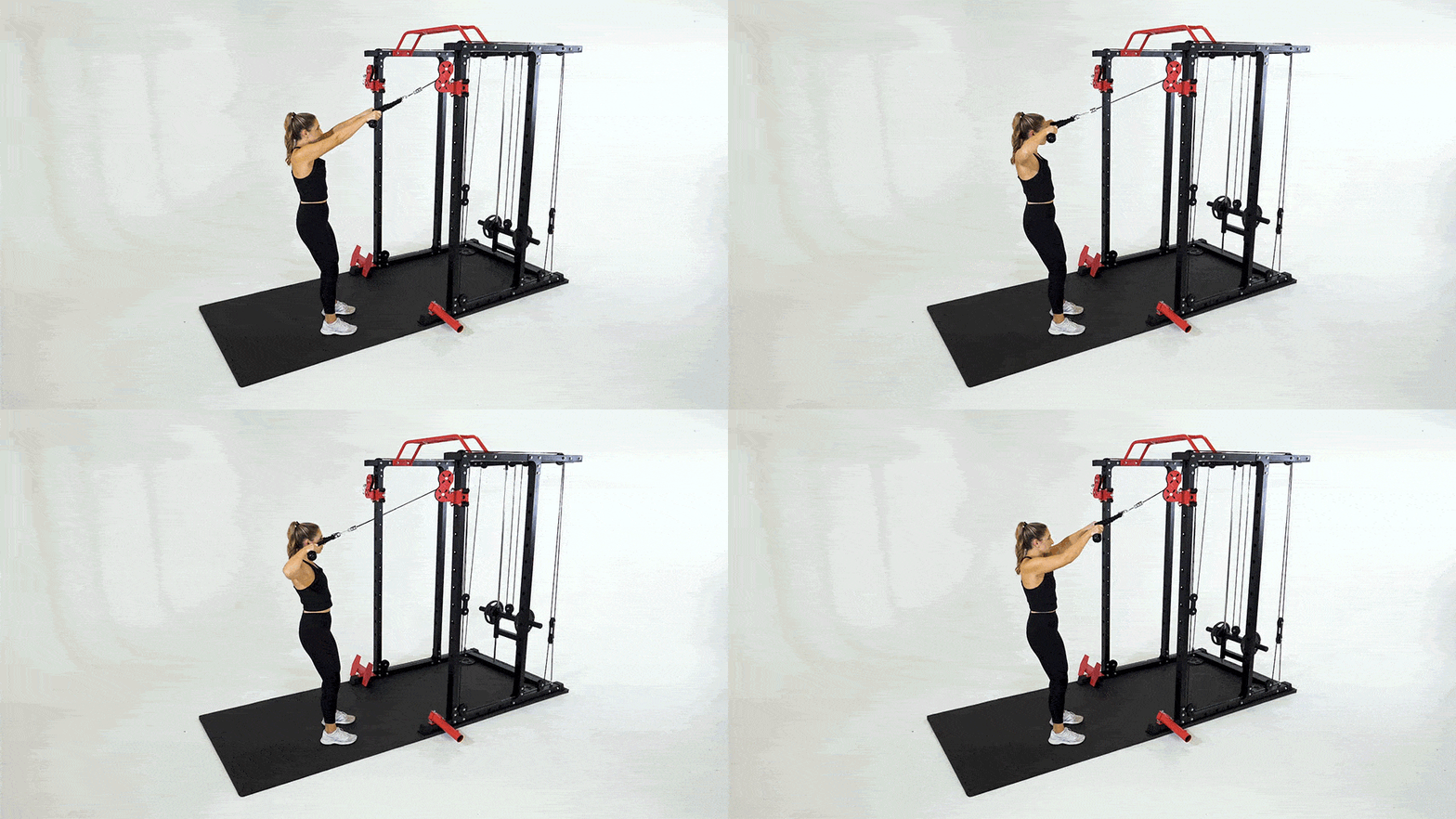
✅ Attach the rope handle to a high pulley on the cable machine, ensuring the anchor point is set slightly above head level.
✅ Grab the rope with both hands, using a neutral grip (palms facing each other).
✅ Take one or two steps back until the cable becomes fully taut without slack.
✅ Stand with your feet shoulder-width apart, brace your core, and maintain a tall, upright posture.
✅ Keep a slight bend in your knees and pull your shoulders down and back before starting the movement.
Execution
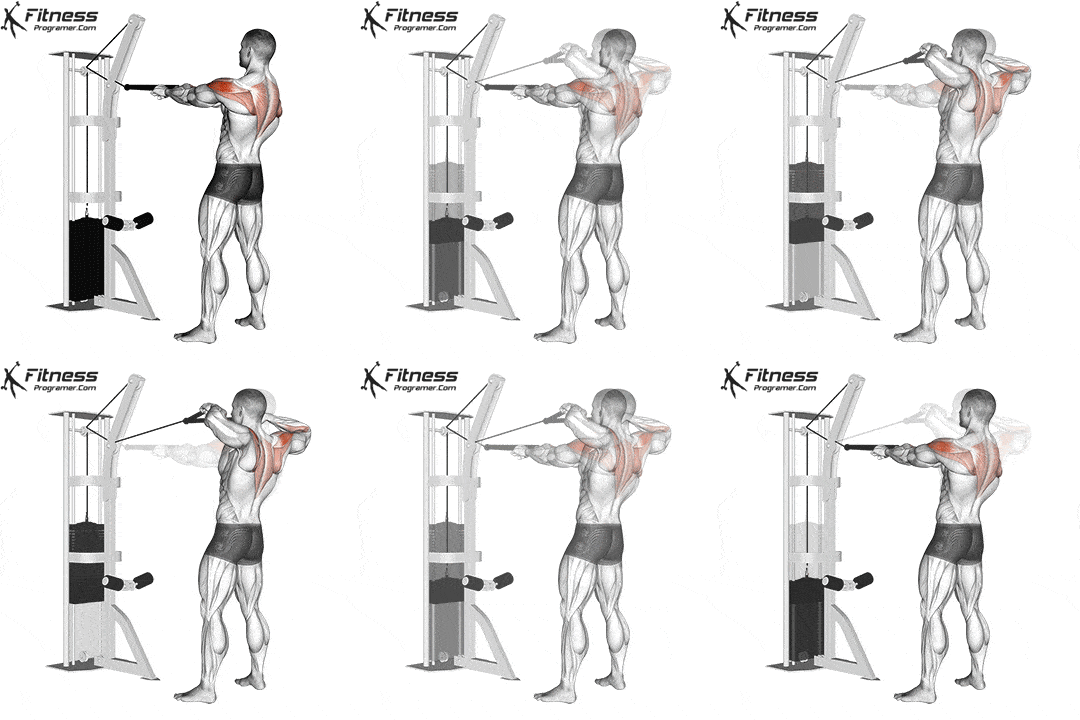
✅ Pull the rope toward your face, driving your elbows outward and slightly upward to maximize rear-deltoid activation.
✅ Pause briefly at the peak contraction, squeezing the rear delts, external rotators, and upper-back muscles for a strong isometric hold.
✅ Slowly return the rope to the starting position with full control, maintaining tension on the cable throughout the eccentric phase.
Coaching Cues
✔️ Keep your elbows slightly higher than your hands to maximize activation of the rear delts and scapular retractors.
✔️ Perform each rep slowly and under full control, avoiding any swinging, leaning, or using momentum to pull the rope.
✔️ Keep your chest lifted and spine neutral, preventing the upper back from rounding during the movement.
✔️ Select a weight that allows you to maintain perfect form, ensuring consistent tension on the rear delts and rotator cuff muscles.
Benefits of the exercise
1️⃣ Strengthens the rear deltoids, helping restore optimal shoulder muscle balance.
2️⃣ Improves posture by correcting rounded shoulders and promoting better scapular alignment.
3️⃣ Builds scapular stabilizer strength, reducing the risk of shoulder impingement and rotator cuff injuries.
4️⃣ Excellent for athletes who rely on upper-body pushing and pulling movements.
5️⃣ Enhances shoulder stability and neuromuscular control, improving overall joint health.
6️⃣ Boosts performance in sports such as bodybuilding, swimming, boxing, and CrossFit.
7️⃣ Increases endurance of posterior shoulder muscles, lowering injury risk during repetitive athletic demands.
8️⃣ Provides smooth, consistent tension throughout the movement thanks to the cable system.
9️⃣ Balances strength between anterior and posterior upper-body muscles, promoting structural symmetry.
🔟 Suitable for all fitness levels, making it easy to integrate into beginner, intermediate, or advanced programs.
💠 Muscles engaged in the movement
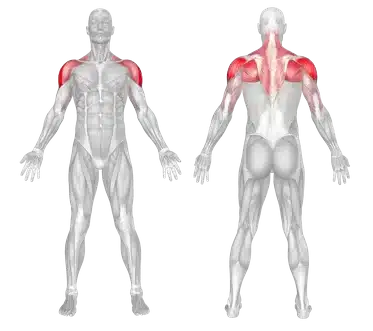
✅ The face pull primarily targets the rear deltoids, but it also activates several key assisting and stabilizing muscles to maintain proper shoulder mechanics, controlled movement, and optimal scapular positioning throughout the exercise.
Main muscles
Synergistic muscles
Stabilizers
Deltoid Muscle
🔹 The deltoid muscle is one of the most important and voluminous muscles of the shoulder region. Its primary function is to move the arm in various directions and stabilize the shoulder joint. Due to its triangular shape, it is named “deltoid,” derived from the Greek word “Δέλτα” (delta), meaning triangle.
🔹 The deltoid muscle is divided into three distinct heads, each playing a specific role in shoulder movement. The anterior head assists in forward motions and arm flexion, the middle head is responsible for abduction and lifting the arm, and the posterior head supports extension and movements behind the body. This muscle is essential for the stability and strength of the shoulder joint, and its weakness can lead to limited range of motion, reduced shoulder power, and an increased risk of injury.
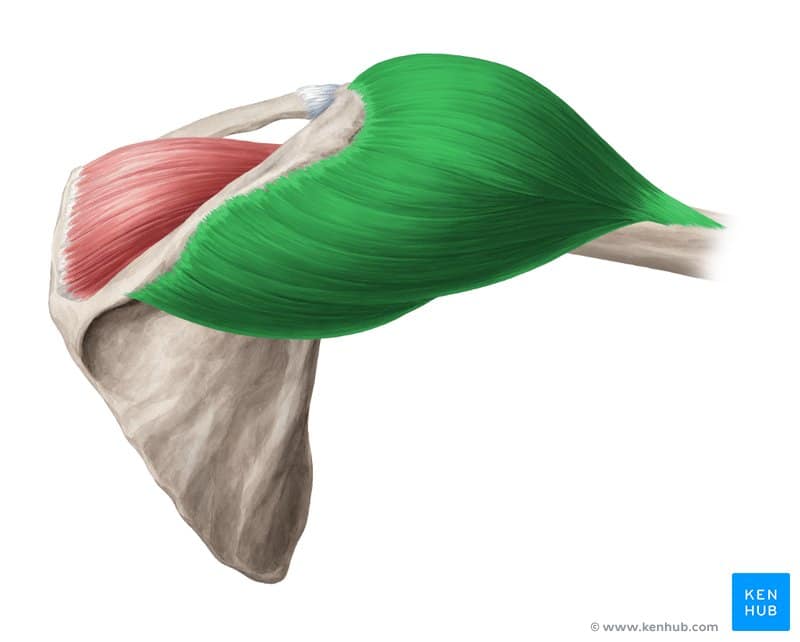
✅ Persian Name: Deltoeid
✅ Latin Name: Deltoideus
✅ Common Name: Shoulder Muscle
✅ Location:
🟡 A superficial muscle located at the top of the upper arm, covering the shoulder joint.
🟡 It forms a cap-like structure over the shoulder joint.
🟡 It directly overlays the head of the humerus and originates from the clavicle, scapula, and the upper part of the arm.
✅ 🔹 Origin
✔ Anterior part: from the outer surface of the clavicle
✔ Middle part: from the acromion, a portion of the scapula
✔ Posterior part: from the spine of the scapula
✅ 🔹 Insertion
✔ All parts of the deltoid muscle insert onto the deltoid tuberosity of the humerus.
✅ 🔹 Function
📌 The deltoid muscle is divided into three parts, each with a specific function:
1️⃣ Anterior Head
- ✔ Moving the arm forward (shoulder flexion)
- ✔ Internal rotation of the arm
- ✔ Assists in horizontal adduction of the arm (moving the arm forward across the body)
2️⃣ Middle Head
- ✔ Lifting the arm outward (shoulder abduction)
- ✔ Assists in stabilizing the shoulder during arm elevation
3️⃣ Posterior Head
- ✔ Moving the arm backward (shoulder extension)
- ✔ External rotation of the arm
- ✔ Assists in horizontal abduction of the arm (moving the arm backward across the body)
📌 Function Summary: The deltoid muscle plays a key role in all shoulder movements and is one of the primary muscles responsible for moving the arm in various directions.
✅ 💪🏻 Muscle Fiber Types
✔ The deltoid muscle consists of a combination of fiber types. ✔ A combination of slow-twitch fibers (Type I) and fast-twitch fibers (Type II). ✔ It is composed of both fiber types.
✔ The anterior and posterior heads contain more fast-twitch fibers, which are suited for powerful and rapid movements.
✔ The middle head has a higher proportion of slow-twitch fibers, which help maintain muscular endurance during sustained activity.
✅ 🏋🏻♂️ Role in Sports and Physical Activities
✔ Plays a key role in all overhead movements, such as shoulder press and bench press.
✔ Crucial for sports like weightlifting, swimming, gymnastics, and wrestling.
✔ Considered one of the primary muscles involved in carrying heavy objects, throwing, and raising the arm.
✅ 🧗🏻♂️ Strength and Endurance
✔ The deltoid plays a vital role in maintaining shoulder joint stability, and its weakness can reduce control over shoulder movements.
✔ This muscle is well-suited for both strength and endurance activities and is heavily engaged in many professional sports.
✅ 🧠 Innervation
✔ Axillary Nerve (also known as the underarm nerve) – responsible for controlling deltoid muscle movements and providing sensation to the shoulder area.
✅ 🩸 Blood Supply
✔ Posterior Circumflex Humeral Artery
✔ Thoracoacromial Artery
✅ 🤼♂️ Role in Sports and Physical Activities
✔ Directly involved in all shoulder and arm movements.
✔ A key muscle for athletes in bodybuilding, weightlifting, swimming, boxing, and combat sports.
✔ Strengthening this muscle improves shoulder shape, prevents injuries, and boosts upper body strength.
✅ 🏌🏻♂️ Interaction with Other Muscles and Joints
✔ Works closely with the rotator cuff muscles, back muscles, and pectoralis major.
✔ Weakness in this muscle can lead to excessive strain on the shoulder and scapular joints, increasing the risk of injury.
✅ 💉 Vulnerability and Potential Issues
✔ One of the most injury-prone muscles in bodybuilding and strength sports due to its crucial role in heavy movements.
✔ Common injuries include tears, strains, tendon inflammation, and cramps—often caused by improper use of heavy weights.
✅ 🏋🏻♂️ Strength Training Exercises for the Deltoid Muscle
1️⃣ Dumbbell or Barbell Shoulder Press – Strengthens all parts of the deltoid
2️⃣ Lateral Raise – Targets the middle head of the deltoid
3️⃣ Bent-Over Reverse Fly – Strengthens the posterior head of the deltoid
4️⃣ Front Raise with Dumbbell or Barbell – Focuses on the anterior head
5️⃣ Arnold Press – Activates all heads of the deltoid simultaneously
✅ 🧘🏻♀️ Stretching and Recovery
✔ Forward and backward shoulder stretches
✔ Wall walks with the hand to improve flexibility
✅ Fun Fact
✔ The deltoid muscle is actually one of the key muscles that shapes and enhances the appearance of the upper body.
✅ Practical Tip
✔ Overtraining the deltoid without strengthening the back and rotator cuff muscles can disrupt shoulder muscle balance.
🔴 Name and Location: A superficial muscle that covers the shoulder joint and originates from the clavicle, scapula, and humerus.
🟠 Anatomy: Composed of three parts—anterior, middle, and posterior—each responsible for different shoulder movements.
🟡 Function:
✔ Anterior: Arm flexion and internal rotation
✔ Middle: Arm abduction and elevation
✔ Posterior: Arm extension and external rotation
🟢 Physiology: A combination of slow- and fast-twitch fibers, allowing for both endurance and explosive power movements.
🔵 Innervation: Axillary nerve, which controls the muscle’s movement and sensation in the shoulder area.
🟣 Importance: Active in all upper-body movements, bodybuilding, weightlifting, swimming, boxing, and combat sports.
🟤 Exercises: Shoulder press, lateral raise, front raise, bent-over raise, Arnold press.
⚫ Fun Fact: A key muscle for shoulder strength and aesthetics, yet one of the most injury-prone muscles during heavy training.
Infraspinatus Muscle
🔹 The infraspinatus muscle is one of the four key rotator cuff muscles, playing a crucial role in stabilizing and controlling the shoulder joint. It is essential for external rotation of the arm and maintaining shoulder joint stability.
🔹 This muscle is actively engaged in many athletic movements such as throwing, pulling weights, and rotational shoulder actions. Weakness in the infraspinatus can lead to shoulder joint instability, reduced range of motion, and an increased risk of injuries like rotator cuff tendon tears.
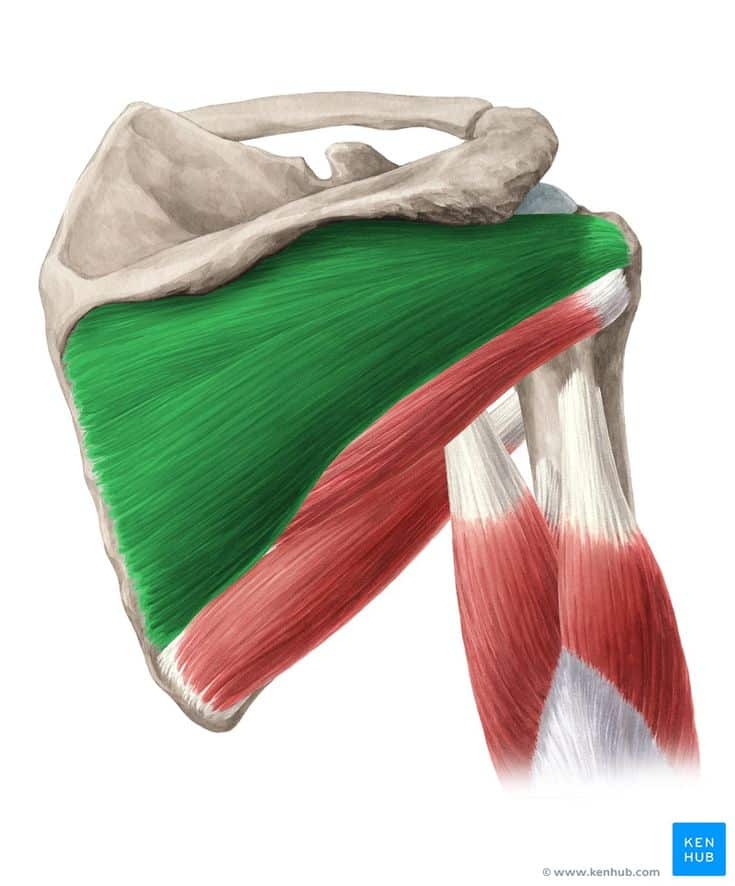
✅ Persian Name: Tahte Khari
✅ Latin Name: Infraspinatus
✅ Common Name: External Rotator of the Shoulder | Posterior Rotator Cuff Muscle
✅ Location:
🟡 Located on the posterior (back) side of the scapula, within the infraspinous fossa.
🟡 It is part of the rotator cuff muscle group responsible for external rotation and stabilization of the shoulder.
🟡 Its primary function is to externally rotate the arm and prevent excessive displacement of the humeral head in the glenohumeral joint.
✅ 🔹 Muscle Origin
✔ Infraspinous fossa of the scapula
✅ 🔹 Muscle Insertion
✔ Greater tubercle of the humerus
✅ 🔹 Muscle Function
📌 Primary functions of the infraspinatus muscle:
✔ External rotation of the arm – rotating the arm outward
✔ Stabilizing the shoulder joint against sudden forces
✔ Controlling throwing and rotational shoulder movements
📌 Movements involving activation of the infraspinatus:
✔ External rotation of the arm in resistance exercises (e.g., band external rotations)
✔ Throwing movements such as ball throws, javelin throws, and discus throws
✔ Resistance-based exercises like lateral pulls and controlled shoulder movements
✅ 💪🏻 Muscle Fiber Types
✔ A combination of ✔ A combination of slow-twitch fibers (Type I) and fast-twitch fibers (Type II).
✔ Contains a higher proportion of slow-twitch fibers, which contribute to endurance and shoulder joint control.
✅ 🏋🏻♂️ Role in Sports and Physical Activities
✔ A key muscle for controlling rotational movements and stabilizing the shoulder in sports like swimming, baseball, basketball, and weightlifting
✔ Engaged in light resistance and stretching exercises to prevent shoulder injuries
✔ Weakness in this muscle can lead to shoulder instability and reduced range of motion.
✅ 🧗🏻♂️ Muscle Strength and Endurance
✔ A small but essential muscle for controlling and stabilizing shoulder movements
✔ Requires controlled exercises to enhance stability and prevent tendon inflammation
✅ 🧠 Innervation
✔ Suprascapular nerve (C5, C6), which controls the function of this muscle.
✅ 🩸 Blood Supply
✔ Suprascapular artery
✅ 🤼♂️ Role in Sports and Physical Activities
✔ A key muscle in stabilizing the shoulder joint and controlling rotational movements
✔ Active in sports involving throwing, gymnastics, swimming, wrestling, and weightlifting
✔ Weakness in this muscle increases the risk of rotator cuff tears and reduces the power of throwing motions.
✅ 🏌🏻♂️ Interaction with Other Muscles and Joints
✔ Works closely with the posterior deltoid, other rotator cuff muscles (supraspinatus, teres minor, subscapularis), and the posterior shoulder muscles
✔ Weakness in this muscle increases the load on the shoulder joint and its stabilizing muscles.
✅ 💉 Vulnerability and Potential Issues
✔ One of the most commonly injured muscles due to throwing motions and sudden stress.
✔ Weakness or inflammation in this muscle can lead to shoulder pain, and partial or complete rotator cuff tears.
✅ 🏋🏻♂️ Strengthening Exercises for the Infraspinatus
1️⃣ External Rotation with Resistance Band – one of the most effective exercises to strengthen this muscle
2️⃣ Isometric Shoulder Exercises – enhances shoulder stability
3️⃣ Reverse Fly with Dumbbells – improves muscle strength and endurance
4️⃣ Controlled Range of Motion Exercises – helps prevent tendon inflammation
5️⃣ Physiotherapy Exercises – improves overall rotator cuff function
✅ 🧘🏻♀️ Stretching and Recovery Movements
✔ Outward arm stretches to improve flexibility and reduce muscle tension
✔ Using a foam roller to enhance blood flow and reduce inflammation
✅ Fun Fact
✔ The infraspinatus is one of the most important muscles in throwing movements, and athletes in throwing sports often have a highly developed infraspinatus.
✅ Practical Tip
✔ Strengthening the infraspinatus with light weights and resistance bands is the most effective way to prevent injuries and improve shoulder movement control.
🔴 Name and Location: A deep muscle located on the back of the scapula, beneath the supraspinatus, and part of the rotator cuff group.
🟠 Anatomy: Originates from the infraspinous fossa of the scapula and inserts into the greater tubercle of the humerus.
🟡 Function:
✔ External rotation of the arm
✔ Shoulder stabilization during throwing movements
🟢 Physiology: Predominantly composed of slow-twitch fibers for shoulder joint control and endurance.
🔵 Innervation: Suprascapular nerve, which controls this muscle.
🟣 Importance: Plays a vital role in throwing, rotational movements, and stabilizing the shoulder joint.
🟤 Exercises: Band external rotations, physiotherapy exercises, reverse fly.
⚫ Fun Fact: One of the key muscles for enhancing shoulder control and stability in throwing sports.
Trapezius muscle
The trapezius muscle is one of the most important superficial back muscles, extending from the occipital region to the middle of the back. It plays a key role in shoulder movements, scapular stabilization, and neck motions. Strengthening this muscle improves shoulder endurance, reduces neck pain, and enhances overall posture
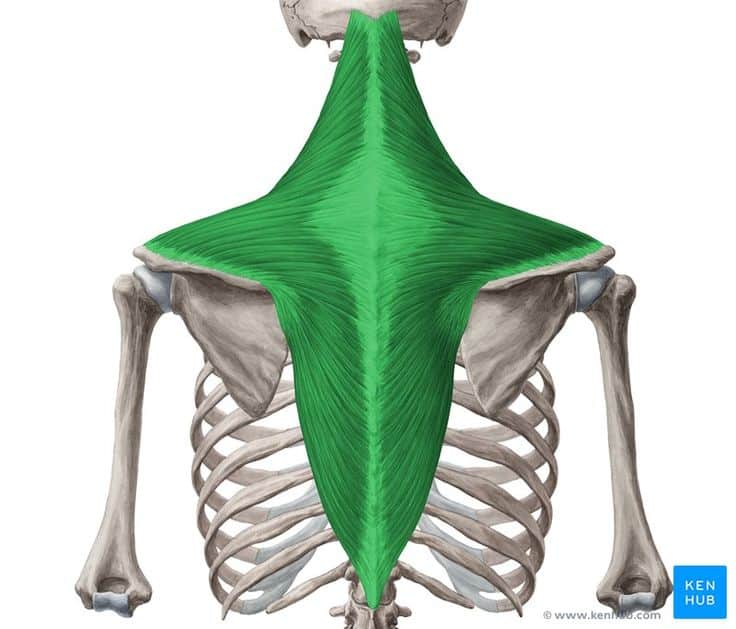
✅ Persian Name: Zozanaghei
✅ Latin Name: Trapezius
✅ Common Name: Trapezius muscle
✅ Location:
🟡 A superficial muscle extending from the base of the skull to the twelfth thoracic vertebra (T12).
🟡 Positioned as a broad, diamond-shaped muscle on both sides of the spine.
🟡 Responsible for shoulder movements, scapular stabilization, and assisting neck motions.
✅ 🦾 Origin
✔ Occipital bone
✔ Cervical ligamentum nuchae
✔ Cervical and thoracic vertebrae (C7-T12)
✅ 🦿 Insertion
✔ Clavicle (lateral third)
✔ Acromion process of the scapula
✔ Spine of the scapula
✅ 📌 Division and Function | Muscle Roles
🔹 The trapezius muscle consists of three main parts, each with different functions:
1️⃣ Upper (Superior) part
✔ Elevates the scapula (like shrugging the shoulders)
✔ Assists in head rotation and neck flexion
2️⃣ Middle part
✔ Retracts the scapula (drawing the shoulder blades closer together)
3️⃣ Lower (Inferior) part
✔ Depresses the scapula (pressing the shoulders downward)
✔ Assists in upward-to-downward rotation of the scapula
✅ Main Functions:
✔ Stabilization and movement of the scapula
✔ Assistance in head and neck movements
✔ Providing stability during shoulder and arm motions
✅ 💪🏻 Muscle Fiber Types
✔ A combination of slow-twitch fibers (Type 1) for endurance and fast-twitch fibers (Type 2) for rapid movements.
✔ The lower part contains more slow-twitch fibers, aiding in endurance maintenance.
✔ The upper part has a higher proportion of fast-twitch fibers, suited for explosive and quick movements.
✅ 🏋🏻♂️ Role in Motor and Sports Performance
✔ Plays a key role in weightlifting, bodybuilding, swimming, gymnastics, and wrestling.
✔ Active during overhead press, pull-ups, deadlifts, and rowing movements.
✔ Strengthening this muscle increases neck endurance and reduces injuries caused by spinal stress.
✅ 🧗🏻♂️ Muscle Strength and Endurance
✔ This muscle is engaged in all overhead and shoulder movements.
✔ Weakness in this muscle leads to reduced endurance in strength training and increases the risk of shoulder and neck pain.
🧠 Innervation | Neural Control
✔ Accessory nerve (Cranial Nerve XI)
✔ Branches of cervical nerves (C3-C4)
🩸 Blood Supply
✔ Transverse cervical artery
✔ Suprascapular artery
✅ 🤼♂️ Role in Sports and Physical Activities
✔ Important in sports such as bodybuilding, weightlifting, swimming, wrestling, and boxing.
✔ Vital for head and neck stability in American football, rugby, and martial arts.
✅ 🏌🏻♂️ Relationship with Other Muscles and Joints
✔ Works alongside the rhomboid muscles, levator scapulae, and latissimus dorsi in scapular movement and stabilization.
✔ Weakness in this muscle leads to poor posture, neck pain, and limited shoulder mobility.
✅ 💉 Vulnerability and Potential Issues
✔ Spasms and tightness in this muscle are common and often cause pain in the neck and upper shoulder area.
✔ Weakness or lack of strengthening can lead to shoulder drooping and reduced power in overhead movements.
✅ 🏋🏻♂️ Key Exercises to Strengthen the Trapezius Muscle
1️⃣ Dumbbell or Barbell Shrugs – Increase size and strength of the upper trapezius
2️⃣ Wide-Grip Pull-Ups – Engage the middle and lower parts of the muscle
3️⃣ Deadlifts – Strengthen the entire trapezius muscle
4️⃣ Bent-Over Rows with Barbell or Dumbbells – Target the middle portion of the muscle
5️⃣ Face Pulls with Cable – Enhance strength and endurance of the middle and lower trapezius
✅ 🧘🏻♀️ Stretching and Recovery Exercises
✔ Neck Stretch – Reduces tension in the upper trapezius
✔ Trapezius Stretch – Increases flexibility and reduces spasms
✔ Shoulder Stretch – Improves range of motion
✅ Interesting Fact:
✔ The trapezius muscle plays a crucial role not only in shoulder and neck movements but also in stabilizing the spine and controlling upper body motions.
✅ Practical Tip:
✔ Combining strength exercises (such as deadlifts) with stretching movements (like neck stretches) is highly effective for improving performance and preventing muscle injuries.
🔴 Name and Location: A superficial muscle on both sides of the spine from the neck to mid-back
🟠 Anatomy: Three parts (upper, middle, lower) with distinct functions
🟡 Function: Stabilizes and moves the scapula; assists head and neck movements
🟢 Physiology: Combination of slow- and fast-twitch fibers for endurance and strength
🔵 Innervation: Accessory nerve and cervical nerves (C3-C4)
🟣 Importance: Active in bodybuilding, weightlifting, swimming, and martial arts
🟤 Exercises: Shrugs, deadlifts, pull-ups, rows, neck stretches
⚫ Interesting Fact: The most important muscle for overhead movements and shoulder stabilization
💠 Other Exercises
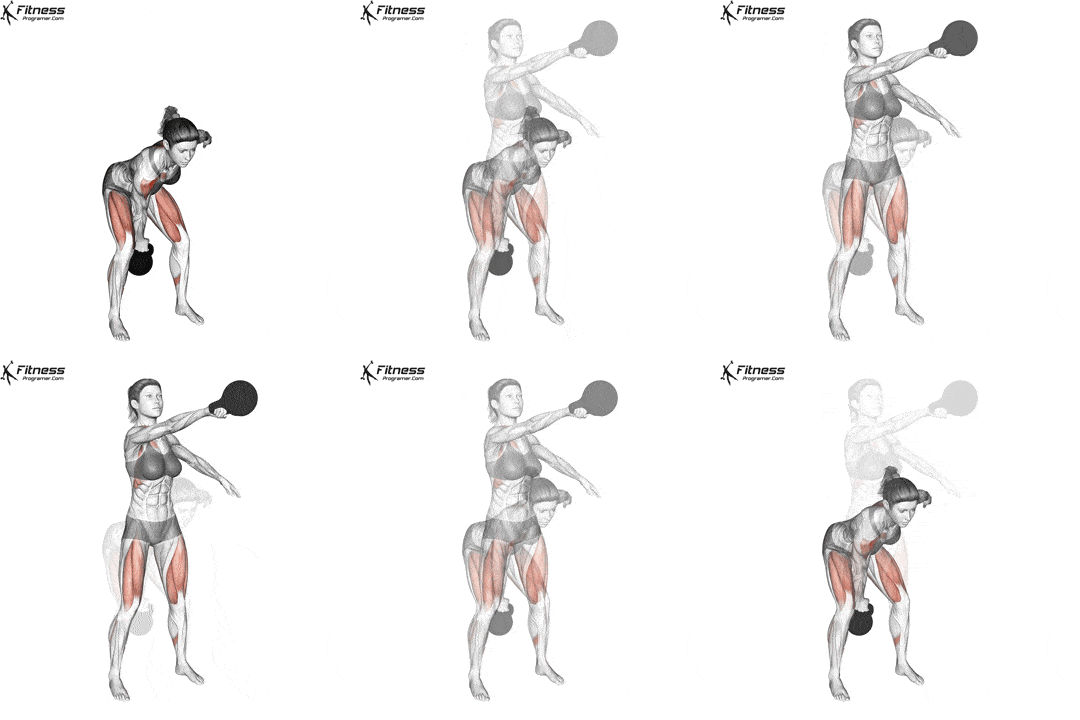


Pelank Life | Body Health Assessment
The Best Body Health Calculators Using Scientific Methods
Developed by Pelank Life ©
Muscle training
Pelank is a comprehensive encyclopedia of the body’s muscles, providing an accurate and scientific review of all muscles. Below, you can find muscle groups. By clicking on each muscle group, you will have access to complete information about it, including:
1️⃣ Basic information about the muscle
2️⃣ Muscle anatomy
3️⃣ Muscle physiology
4️⃣ Innervation and blood supply
5️⃣ Importance of the muscle in the body and sports
6️⃣ Strengthening exercises
7️⃣ Scientific and interesting facts
📌 At the end, a summary review of each muscle will be provided.
Body muscles training guide link
🔹 The muscle group engaged in this movement is highlighted in color.
Sharing
References
✅ Official Physical Activity Guidelines
✅ General Overview and Recommendations for the Public
✅ Science-Based and Health-Oriented Education
✅ Policy Making and Comparative Data

Comments