


Archer push-up
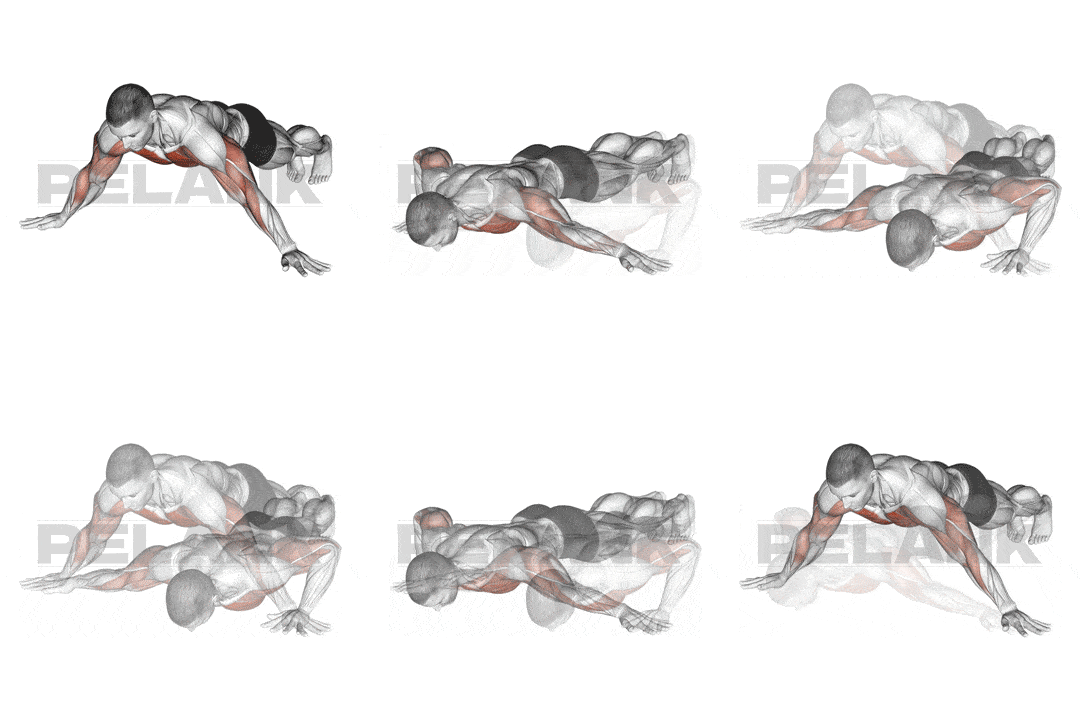
| English Name | Archer Push-Up |
|---|---|
| Difficulty | Advanced |
| Movement Patterns | Push Pattern |
| Muscle Contraction Types | Mixed (Con + Ecc) |
| Primary Muscle (EN) | Pectoralis Major |
| Muscle Groups | Chest muscles Full body Triceps muscles |
|---|---|
| Workout Type | Balanced Calisthenics Functional Strength training |
| Required equipment | No equipment |
💠 Exercise guide
✅ The archer push-up is an advanced variation of the push-up in which body weight is shifted to one side, placing greater load on one arm. In addition to increasing chest and triceps strength, it helps improve neuromuscular control and overall body balance, and serves as a solid progression toward a one-arm push-up.
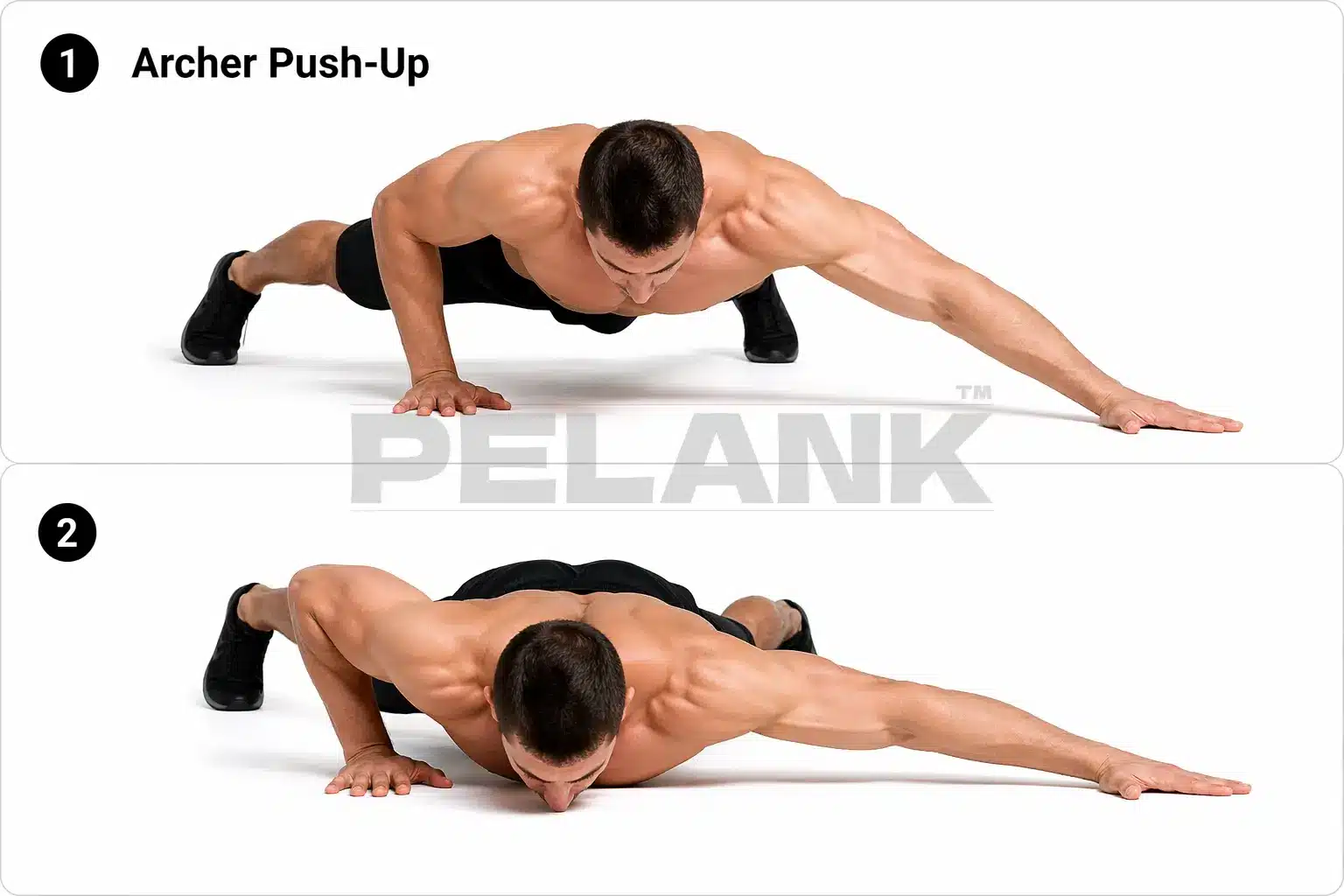
💠 Execution Guide
Setup
✅ Get into a high plank position (hands placed wider than shoulder-width)
✅ Place your feet slightly wider than usual for balance
✅ Keep your body in a straight line from head to heels
✅ Engage your core and glutes
✅ Look down at the ground with your neck aligned with your spine
Execution
✅ Lower your body toward one arm (the working arm bends)
✅ The opposite arm stays nearly straight and extends out to the side
✅ Bring your chest closer to the bent arm
✅ Pause briefly at the bottom of the movement
✅ Push back up using the bent arm
✅ Repeat on the other side (alternate left and right)
Coaching Cues
✔️ Keep the working arm’s elbow close to your body (controlled angle)
✔️ Keep your hips stable throughout the movement and avoid rotation
✔️ Maintain your body in a straight line at all times
✔️ Perform the movement slowly and with control
✔️ Inhale as you lower down, exhale as you push up
Benefits of the exercise
1️⃣ Increase unilateral chest strength
2️⃣ Improve balance and body control
3️⃣ Strengthen core muscles
4️⃣ Increase upper body muscular endurance
5️⃣ Prepare for the one-arm push-up
6️⃣ Improve neuromuscular coordination
7️⃣ Increase range of motion in the shoulder joint
8️⃣ Engage stabilizing muscles
9️⃣ Can be performed without equipment
🔟 Improve shoulder control and stability
Common Mistakes
❌ Hip rotation to the sides
❌ Insufficient elbow bend in the working arm
❌ Fully locking out the extended arm
❌ Letting the hips drop and the lower back arch
❌ Performing the movement too fast and without control
❌ Improper hand placement
❌ Reduced range of motion
❌ Shoulders shrugging up toward the ears
Breathing Pattern
🌬️ Inhale while lowering
💨 Exhale while pushing up
🔸 During high-intensity effort, the Valsalva maneuver can be used in a controlled manner
ROM Guidelines
🔵 Recommended range: Getting the chest fully close to the working hand
🔵 Minimum range: elbow bent to at least 90 degrees
🔵 Risky range: partial reps or excessive joint locking
Precautions & Contraindications
⚠️ People with shoulder injuries should be cautious
⚠️ If you feel wrist pain, adjusting hand angle is necessary
⚠️ Severe core weakness can lead to lower back injury
⚠️ Not recommended for beginners
Variations & Alternatives
🔹 Simpler version: regular push-up or knee push-up
🔹 Advanced version: one-arm push-up
🔹 Limited-equipment version: incline push-up
🔹 Alternative: single-arm dumbbell chest press
Advanced Biomechanics
🧠 Shifting the center of mass toward the working hand
🧠 Increasing torque on one shoulder joint
🧠 Greater engagement of anti-rotation core muscles
🧠 The lowering phase is the most challenging part of the movement
Programming Tips
📌 3 to 4 sets
📌 6 to 10 reps per side
📌 Tempo: 3-1-1 (slow lowering phase)
📌 Suitable for upper body days or bodyweight training sessions
📌 Useful for building strength and motor skill development
💠 Muscle Involvement
✅ The archer push-up shifts body weight to one side, creating greater activation of the chest muscle on that side while the core muscles work to prevent body rotation.
Main muscles
Synergistic muscles
Dynamic stabilizer
Stabilizers
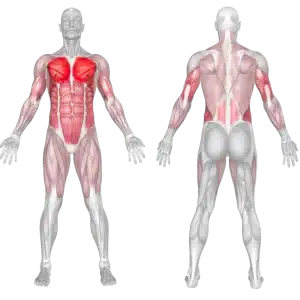
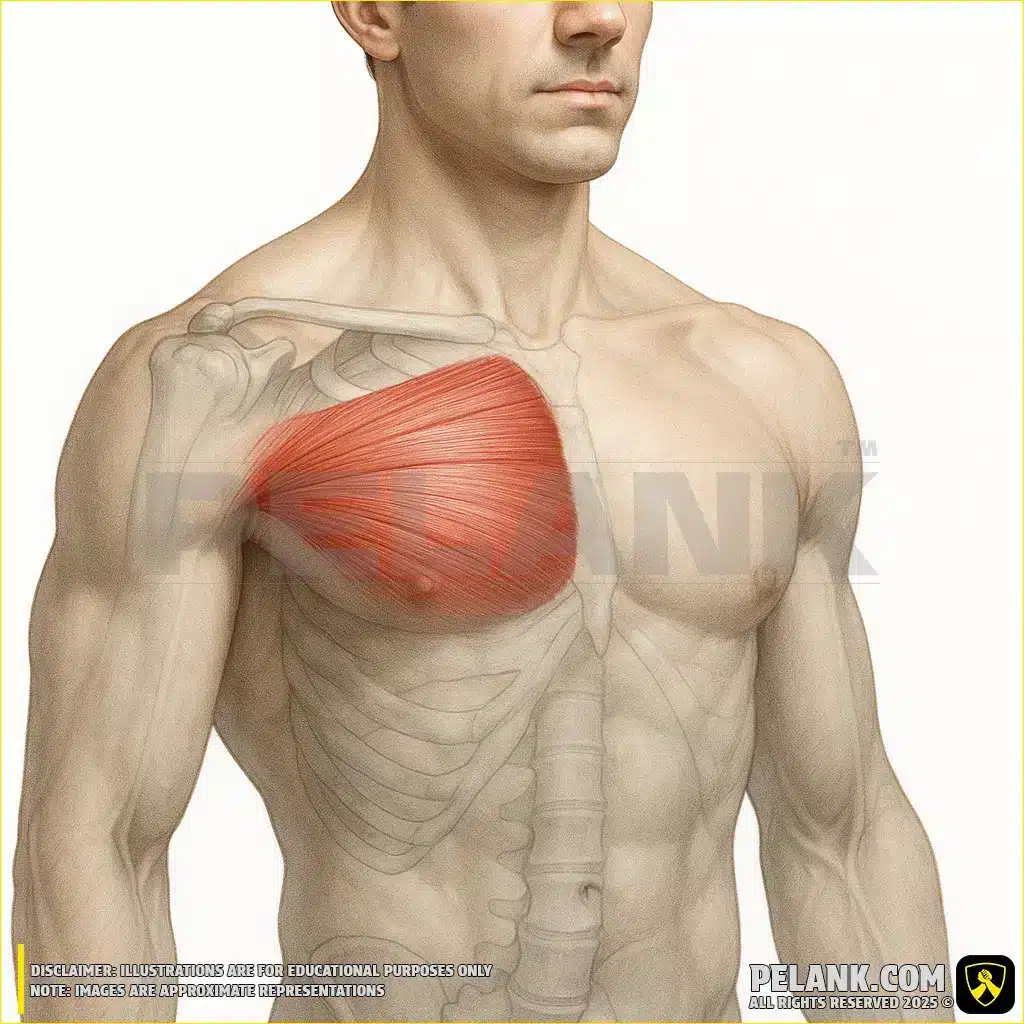
Pectoralis major muscle
Pectoralis major Muscle
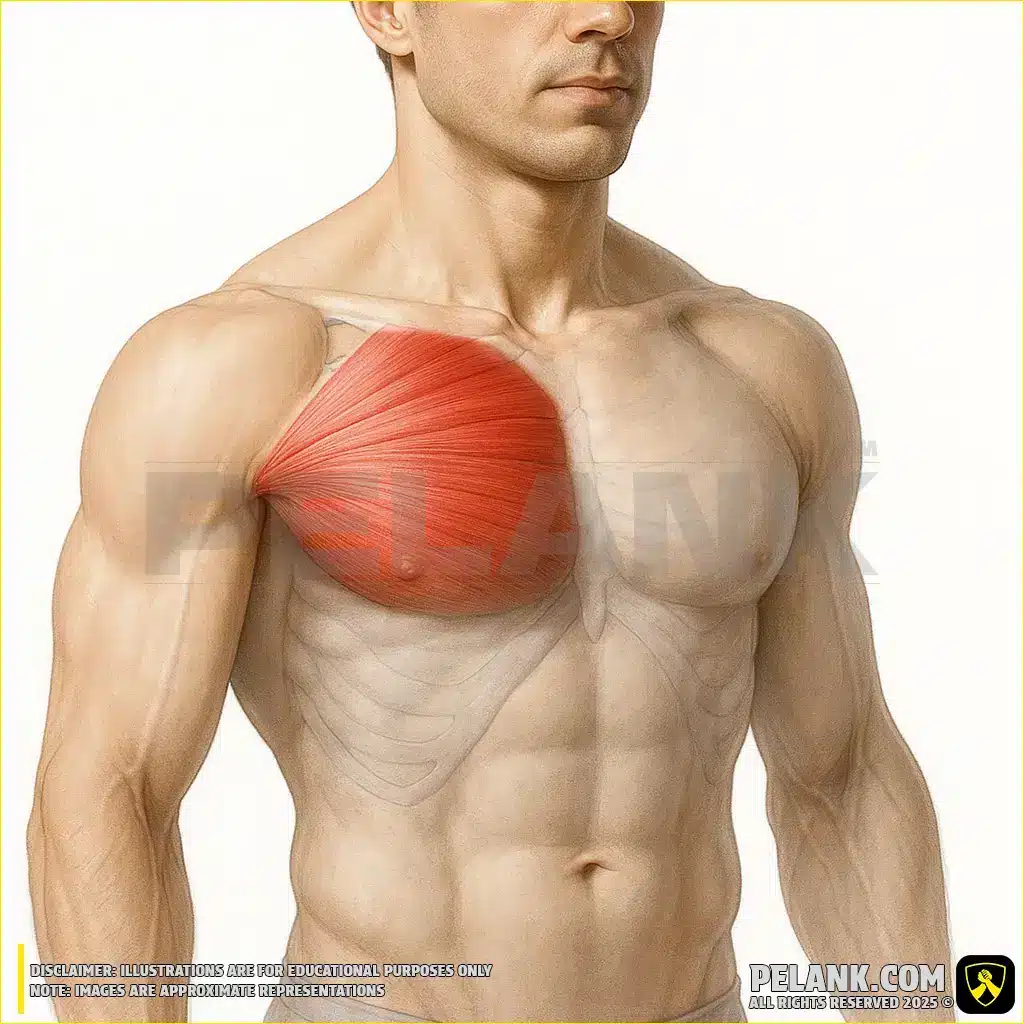
The pectoralis major, or large chest muscle, is one of the most important muscles of the thoracic region, located on the anterior part of the chest. This muscle is responsible for various shoulder movements such as adduction, rotation, and flexion of the arm. It plays a key role in pushing movements such as the bench press and push-ups. Strengthening this muscle improves upper-body strength, enhances chest aesthetics, and increases stability in strength training exercises.
🖼️ Image Gallery
Click on the images to enlarge them.




🔷 Full Description
Click on the title to read the sections.
✅ Persian Name: Sinei Bozorg
✅ Latin Name: Pectoralis Major
✅ Common Name: Chest Muscle | Pecs
✅ Location
🟡 Positioned at the front of the chest, lying over the pectoralis minor muscle.
🟡 Originates from the clavicle, sternum, and ribs, and attaches to the humerus.
🟡 Plays a key role in pushing movements such as the bench press and push-ups.
✅ 🦾 Origin
✔ Medial part of the clavicle
✔ Sternum
✔ Ribs 1 to 6
✅ 🦿 Insertion
✔ Bicipital groove of the humerus
✅ 📌 Classification and Function
The pectoralis major muscle consists of two main parts:
1️⃣ Clavicular Head
✔ Responsible for raising the arm and moving it forward
✔ Active in movements such as the incline bench press
2️⃣ Sternocostal Head
✔ Responsible for adducting the arm inward and downward
✔ Active in movements such as the flat bench press and push-ups
✅ Main Functions:
✔ Flexion of the arm at the shoulder joint
✔ Adduction of the arm toward the body
✔ Internal rotation of the arm
✔ Assisting in pushing movements such as the bench press and push-ups
✅ 💪🏻 Muscle Fiber Type
✔ A combination of fast-twitch fibers for generating explosive power
✔ A small amount of slow-twitch fibers for maintaining muscular endurance
✅ 🏋🏻♂️ Role in Movement and Athletic Performance
✔ Primary muscle involved in bench press, parallel bar dips, push-ups, and cable flys
✔ Enhances upper body strength in bodybuilding, CrossFit, and boxing
✅ 🧗🏻♂️ Muscle Strength and Endurance
✔ A large and powerful muscle responsible for explosive upper body movements
✔ Strengthening it improves performance in all pushing exercises and helps prevent shoulder injuries
🧠 Innervation
✔ Medial & Lateral Pectoral Nerves
🩸 Blood Supply
✔ Lateral Thoracic Artery
✔ Internal Thoracic Artery
✅ 🤼♂️ Role in Sports and Physical Activities
✔ Bodybuilding: Bench press, parallel bar dips, cable crossovers
✔ Boxing & MMA: Delivering powerful punches and maintaining a defensive guard
✔ Pushing sports: Push-ups, dips, upper-body strength exercises
✅ 🏌🏻♂️ Interaction with Other Muscles and Joints
✔ Works in coordination with the anterior deltoid, triceps brachii, and pectoralis minor during pushing movements
✔ Strengthening it helps reduce stress on the shoulder joint and prevents injuries
✅ 💉 Vulnerability and Potential Issues
✔ Weakness in the muscle can lead to reduced upper body strength and poor posture
✔ Overstretching may result in tendon inflammation or partial tears
✅ 🏋🏻♂️ Main Exercises to Strengthen the Pectoralis Major
1️⃣ Barbell Bench Press
The best exercise for increasing chest strength and size
2️⃣ Incline Bench Press
Strengthens the clavicular head of the chest muscle
3️⃣ Parallel Bar Dips
Develop the size and strength of the pectoralis major muscle
4️⃣ Cable Crossover
Focuses on adducting and contracting the muscle
5️⃣ Dumbbell Fly
Stretches and strengthens the chest muscles
✅ 🧘🏻♀️ Stretching and Recovery Movements
✔ Chest stretch on the wall | Improves chest flexibility
✔ Standing chest stretch | Increases the range of motion of the shoulder and chest
✅ Fun Fact
✔ The pectoralis major is one of the strongest upper body muscles and plays a vital role in all strength-based sports.
✅ Practical Tip
✔ To build a well-developed and symmetrical chest, combine pushing exercises with stretching movements and focus on all areas of the muscle.
🔴 Name & Location
A large, superficial muscle at the front of the chest
🟠 Anatomy
Consists of two heads (clavicular and sternocostal) with different functions
🟡 Function
Adduction, internal rotation of the arm, and assistance in pushing movements
🟢 Physiology
A combination of fast- and slow-twitch fibers for power and endurance
🔵 Innervation
Medial and lateral pectoral nerves
🟣 Importance
Key in bodybuilding, boxing, swimming, and pushing movements
🟤 Exercises
Bench press, dips, cable crossovers, dumbbell flys
⚫ Fun Facts
The most important muscle for building upper-body strength and chest
Triceps Brachii Muscle
Triceps Brachii Muscle
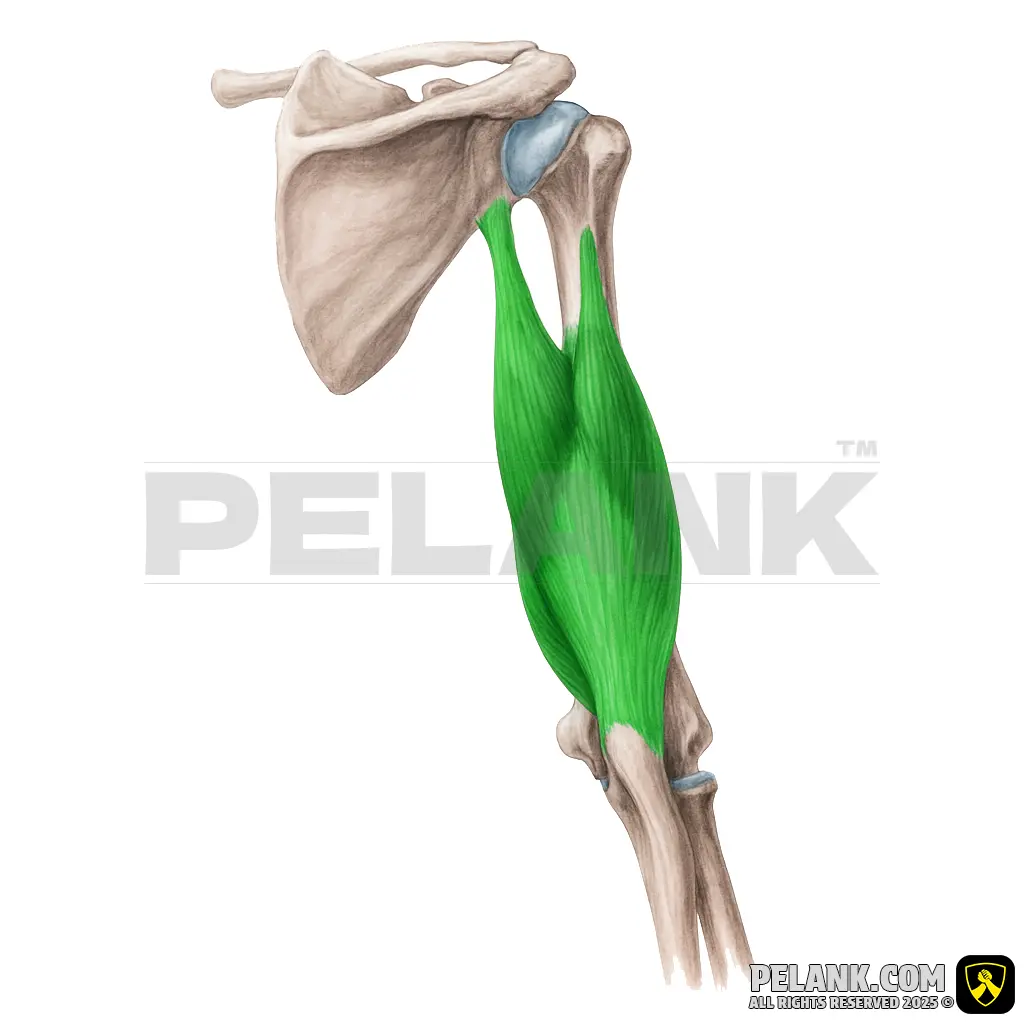
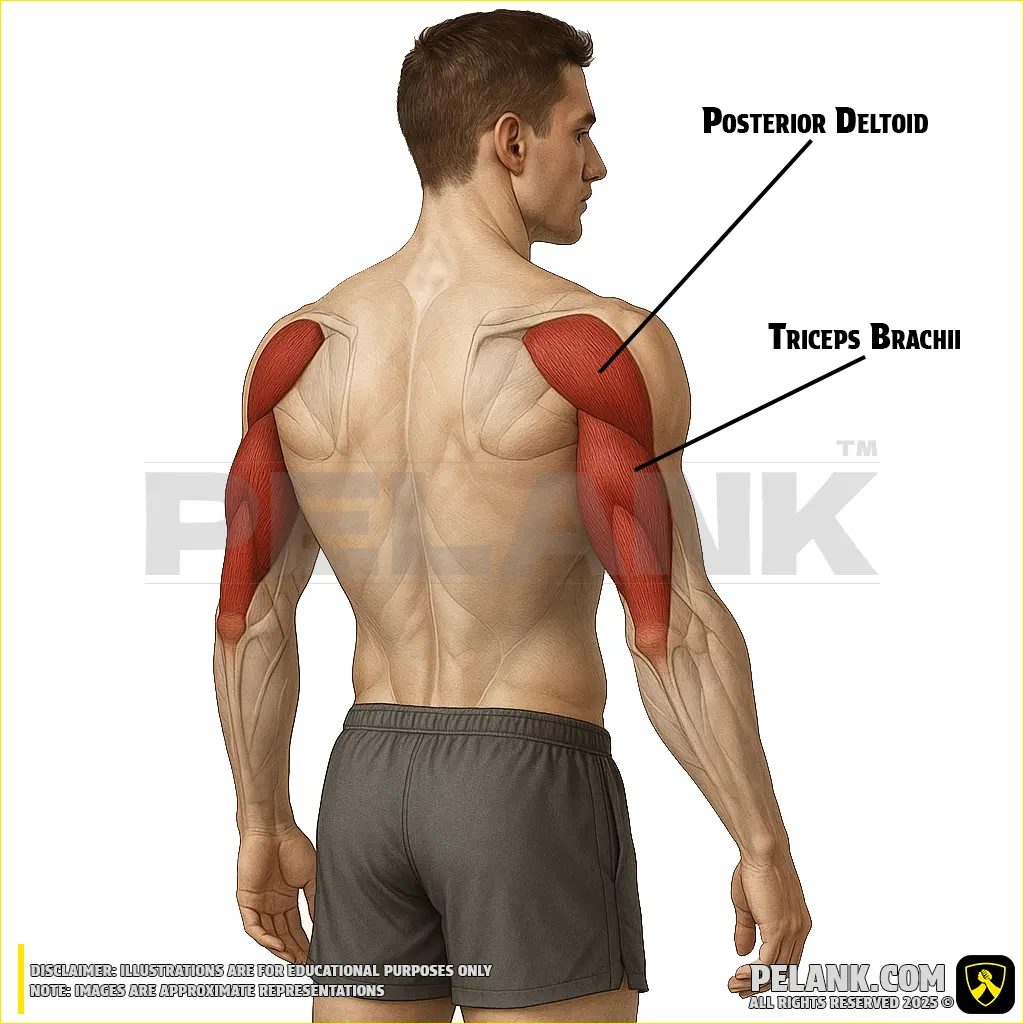
The triceps brachii is one of the strongest muscles of the posterior arm, with its primary function being elbow extension and generating force in pushing movements. This muscle has three heads (long, medial, and lateral), all located at the back of the arm, and they attach to the ulna in the forearm.
✅ Why is this muscle important?
✔ The sole muscle responsible for elbow extension and essential in strength movements.
✔ Stabilizes the elbow and shoulder joints during pressing exercises like the bench press.
✔ Directly impacts strength gains in bodybuilding, gymnastics, boxing, and weightlifting.
🖼️ Image Gallery
Click on the images to enlarge them.
🔷 Full Description
Click on the title to read the sections.
✅ Persian Name: Azole Se Sare Bazoei
✅ Latin Name: Triceps Brachii
✅ Common Name: Back of the Arm
✅ Location:
🟡 Located in the posterior (back) part of the arm, extending from the scapula to the forearm bone.
🟡 Composed of three heads: long, medial, and lateral.
🟡 Responsible for elbow extension and assists in shoulder stabilization.
✅ 🦾 Origin
✔ Long Head: originates from the infraglenoid tubercle of the scapula
✔ Medial Head: originates from the posterior surface of the humerus, below the lateral head
✔ Lateral Head: originates from the posterior surface of the humerus, above the medial head
✅ 🦿 Insertion
✔ Ulna bone – olecranon process
✅ 📌 Classification and Function
The three main heads of the triceps brachii muscle are:
1️⃣ Long Head
✔ The strongest head and the only one originating from the scapula.
✔ Besides extending the elbow, it plays a role in arm movements and shoulder stabilization.
✔ More active in movements that involve pulling weight behind the body, such as parallel dips.
2️⃣ Medial Head
✔ Located beneath the lateral head and more active during strength and endurance movements.
✔ Plays a greater role in light, repetitive exercises like cable triceps extensions.
3️⃣ Lateral Head
✔ Responsible for muscle mass and the V-shape appearance of the back of the arm.
✔ More active in heavy exercises such as close-grip bench press and lying barbell triceps extensions.
✅ Main Functions:
✔ Elbow extension – the primary muscle responsible for straightening the forearm.
✔ Stabilizes the elbow during pressing movements such as push-ups and bench press.
✔ Assists shoulder movements (long head of the muscle).
✅ 💪🏻 Muscle Fiber Type
✔ A combination of fast-twitch fibers (Type II) and slow-twitch fibers (Type I) ✔ Fast-twitch fibers are activated during powerful and explosive movements such as bench press and dips.
✔ Slow-twitch fibers are important for endurance in continuous movements like push-ups and parallel bar exercises.
✅ 🏋🏻♂️ Role in Motor and Athletic Performance
✔ Active in all pressing movements such as bench press, push-ups, dips, and parallel bar exercises.
✔ Plays a key role in sports like boxing, weightlifting, gymnastics, and basketball.
✔ Helps stabilize the shoulder joint during overhead movements like shoulder press and clean and jerk.
✅ 🧗🏻♂️ Muscle Strength and Endurance
✔ A very strong and essential muscle for increasing upper body strength.
✔ Weakness in this muscle leads to reduced strength in pressing movements and increased strain on the elbow and shoulder.
🧠 Innervation
✔ The radial nerve (C6–C8) is responsible for controlling this muscle.
🩸 Blood Supply
✔ Deep brachial artery
✅ 🤼♂️ Role in Sports and Physical Activities
✔ Bodybuilding: Active in triceps exercises, bench press, dips, and lying barbell presses.
✔ Boxing and martial arts: Plays a key role in straight punches and increasing punching power.
✔ Weightlifting: Helps stabilize the elbow during shoulder presses and clean and jerk.
✔ Gymnastics and CrossFit: Vital in movements like parallel bars, pull-ups, and dips.
✅ 🏌🏻♂️ Connection with Other Muscles and Joints
✔ Works alongside the deltoid and pectoral muscles during pressing movements.
✔ Weakness in this muscle increases strain on the shoulder and elbow, raising the risk of joint injury.
✅ 💉 Vulnerability and Potential Issues
✔ Strain or inflammation of the triceps tendon (Triceps Tendinitis) causes pain at the back of the elbow.
✔ Weakness in this muscle may reduce pressing strength and increase strain on the shoulders.
✅ 🏋🏻♂️ Main Exercises to Strengthen the Triceps Brachii Muscle
1️⃣ Lying Barbell Triceps Extension (Skull Crushers) – targets all heads of the muscle
2️⃣ Parallel Dips – best for strength and endurance
3️⃣ Cable Triceps Pushdown – ideal for muscle isolation
4️⃣ Close-Grip Bench Press – combines triceps and chest muscles
5️⃣ Overhead Dumbbell Triceps Extension – emphasizes the long head more
✅ 🧘🏻♀️ Stretching and Recovery Movements
✔ Triceps stretch to improve flexibility.
✔ Massage and foam rolling to reduce tension after exercise.
✅ 🔍 Interesting Fact
✔ 70% of the arm’s volume comes from the triceps brachii! If you want bigger arms, you need to focus on this muscle.
✅ 💡 Practical Tip
✔ For complete growth, perform exercises at different angles to engage all three heads of the muscle!
🔴 Name and Location: A three-headed muscle located at the back of the arm, extending from the shoulder to the elbow.
🟠 Anatomy: Originates from the scapula and humerus, and attaches to the ulna bone in the forearm.
🟡 Function: Elbow extension, shoulder stabilization, and assisting pressing movements.
🟢 Physiology: Contains both strength and endurance fibers, active in power and endurance arm movements.
🔵 Innervation: Radial nerve (C6–C8), which controls the function of this muscle.
🟣 Importance: Active in bodybuilding, boxing, weightlifting, swimming, CrossFit, and gymnastics.
🟤 Exercises: Parallel dips, close-grip bench press, lying barbell triceps extension, overhead dumbbell triceps extension, cable triceps pushdown.
⚫ Interesting Fact: It makes up 70% of the arm’s volume, so focusing on this muscle is essential for increasing arm size!
Anterior Deltoid muscle
Anterior Deltoid Muscle
🔹 The anterior deltoid is one of the three parts of the deltoid muscle. Its primary functions are moving the arm forward (flexion), internal rotation, and assisting in horizontal shoulder movements. This muscle plays a key role in many upper-body exercises, especially strength training movements like bench press, front raises, and throwing actions.
🔹 The anterior deltoid is one of the most important muscles involved in pressing and pushing movements. Due to its engagement in many strength exercises, it is often well-developed among athletes and bodybuilders. However, overusing this muscle without strengthening the posterior shoulder muscles (posterior deltoid and rotator cuff) can lead to muscular imbalances and increase the risk of shoulder injuries.

🔷 Full Description
Click on the title to read the sections.
✅ Persian Name: Deltoid Ghodami
✅ Latin Name: Anterior Deltoid
✅ Common Names: Front part of the deltoid muscle | Anterior head of the shoulder
✅ Location:
🟡 Located at the front of the shoulder, forming the anterior part of the deltoid muscle.
🟡 Originates from the clavicle and lies over the upper part of the humerus.
🟡 Alongside the middle and posterior parts of the deltoid, it acts as part of the shoulder cap and assists in arm movements.
✅ 🔹 Origin
✔ Anterior surface of the lateral third of the clavicle (Clavicle – Anterior Surface of Lateral Third)
✅ 🔹 Insertion
✔ Deltoid tuberosity on the humerus bone (Deltoid Tuberosity, Humerus)
✅ 🔹 Function
📌 Primary functions of the anterior deltoid:
✔ Arm flexion – moving the arm forward (like raising the hand in front of the body)
✔ Internal rotation of the arm – rotating the arm inward toward the body
✔ Assisting in horizontal adduction – moving the arm inward on a horizontal plane (such as during a chest fly)
✔ Helping stabilize the shoulder joint during upper-body movements
📌 Movements that activate the anterior deltoid:
✔ Raising the arm forward (such as front raises)
✔ Throwing movements (ball throws, javelin throws)
✔ Moving weights in pressing and fly exercises
✅ 💪🏻 Muscle Fiber Types
✔ A combination of fast-twitch fibers (Type II) and slow-twitch fibers (Type I)
✔ Predominantly composed of fast-twitch fibers for rapid and powerful movements
✔ This characteristic makes the anterior deltoid highly active in explosive and strength exercises like weightlifting and throwing
✅ 🏋🏻♂️ Role in Sports and Physical Activities
✔ Active in all pressing, throwing, and forward arm-raising exercises
✔ Plays a key role in strength sports, bodybuilding, weightlifting, boxing, and discus throwing
✔ An important muscle in daily activities such as lifting objects and carrying items
✅ 🧗🏻♂️ Strength and Endurance
✔ Requires high strength for pressing exercises and overhead movements
✔ Overdevelopment can lead to muscular imbalances and increase the risk of shoulder injuries
✅ 🧠 Innervation
✔ Axillary nerve (C5, C6), which controls the movements of this muscle.
✅ 🩸 Blood Supply
✔ Posterior Circumflex Humeral Artery
✔ Thoracoacromial Artery
✅ 🤼♂️ Role in Sports and Physical Activities
✔ One of the key muscles for pushing and pressing movements in bodybuilding and weightlifting
✔ Active in throwing sports, swimming, boxing, gymnastics, and pulling movements
✔ Weakness can reduce pressing strength and increase the risk of shoulder injury
✅ 🏌🏻♂️ Interaction with Other Muscles and Joints
✔ Closely connected with the middle deltoid, pectoralis major, rotator cuff muscles, and triceps brachii
✔ Weakness in this muscle can lead to excessive strain on the shoulder joint and reduced upper body strength
✅ 💉 Vulnerability and Potential Issues
✔ One of the muscles prone to inflammation and strain due to high activity in upper-body training
✔ Weakness can cause excessive strain on the pectoral and shoulder muscles, leading to shoulder injuries
✅ 🏋🏻♂️ Strength Training Exercises for the Anterior Deltoid
1️⃣ Front Raise with Dumbbells – the most important exercise for strengthening the anterior deltoid
2️⃣ Overhead Shoulder Press with Dumbbells or Barbell – high engagement of the anterior deltoid
3️⃣ Arnold Press – simultaneous strengthening of all deltoid parts with emphasis on the anterior head
4️⃣ Incline Bench Press – combined strengthening of the anterior deltoid and pectoralis major
5️⃣ Close-Grip Push-ups – bodyweight exercise targeting this muscle
✅ 🧘🏻♀️ Stretching and Recovery
✔ Stretching the arm forward and across the body to improve flexibility and prevent muscle tightness
✔ Using a foam roller to reduce muscle tension and enhance blood flow
✅ Fun Fact
✔ The anterior deltoid is most engaged in throwing movements, which is why athletes in discus, javelin, and boxing typically have a very strong anterior deltoid.
✅ Practical Tip
✔ Overdeveloping the anterior deltoid without balancing it with the posterior deltoid can lead to muscular imbalances and increased stress on the shoulder joint.
🔴 Name and Location: A superficial muscle located at the front of the shoulder joint, originating from the clavicle.
🟠 Anatomy: Part of the deltoid muscle that, along with the middle and posterior deltoids, surrounds the shoulder and attaches to the humerus.
🟡 Function:
✔ Arm flexion – moving the hand forward
✔ Internal rotation of the arm – rotating the hand inward
✔ Horizontal adduction – assisting in bringing the arm inward on a horizontal plane
🟢 Physiology: Composed mainly of fast-twitch fibers, which provide power and speed in pressing movements.
🔵 Innervation: Axillary nerve, which controls the movements of this muscle.
🟣 Importance: Plays a vital role in pressing exercises, throwing, bodybuilding, boxing, and strength sports.
🟤 Exercises:
✔ Front raise
✔ Shoulder press
✔ Arnold press
✔ Incline bench press
✔ Close-grip push-ups
⚫ Fun Fact: One of the most utilized muscles in throwing and pressing movements, which, if overdeveloped, can lead to muscular imbalances and shoulder injuries.
💠 Other Exercises



Pelank Life | Body Health Assessment
The Best Body Health Calculators Using Scientific Methods
Developed by Pelank Life ©
💠 Muscle Training
Pelank is a comprehensive encyclopedia of the body’s muscles, providing an accurate and scientific review of all muscles. Below, you can find muscle groups. By clicking on each muscle group, you will have access to complete information about it, including:
1️⃣ Basic information about the muscle
2️⃣ Muscle anatomy
3️⃣ Muscle physiology
4️⃣ Innervation and blood supply
5️⃣ Importance of the muscle in the body and sports
6️⃣ Strengthening exercises
7️⃣ Scientific and interesting facts
📌 At the end, a summary review of each muscle will be provided.
Body muscles training guide link
🔹 The muscle group engaged in this movement is highlighted in color.

Mohsen Taheri
✅ Official Physical Activity Guidelines
✅ General Overview and Recommendations for the Public
✅ Science-Based and Health-Oriented Education
✅ Policy Making and Comparative Data
Comments